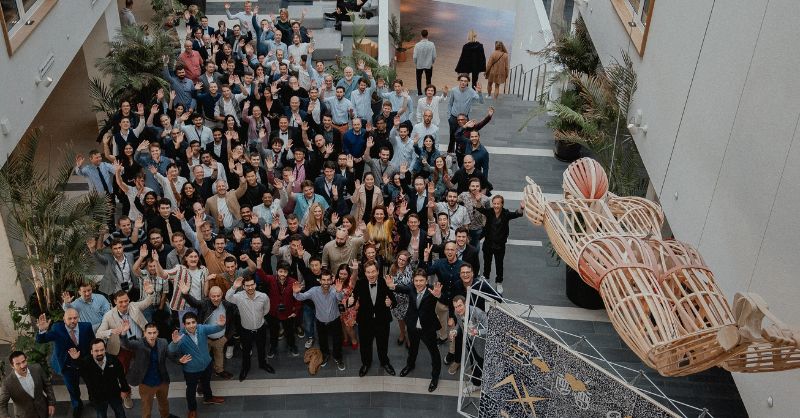

Axelera AI funding talks are underway as the Dutch chip startup seeks to raise more than €150M. The company, backed by Samsung and the European Union, aims to close the round by year-end. A spokesperson confirmed the raise and said the team was “very pleased” with progress, while declining to share details. The new valuation was not disclosed.
In practice, Axelera AI funding momentum speaks to a familiar scene for builders at the edge of AI. Engineers wrestle with latency, privacy, and mounting cloud bills. Edge computing promises relief by processing data on devices. That is where Axelera AI positions its chips for cameras, robots, and other systems. The company designs semiconductors to run computer vision and generative AI applications without relying on large cloud services.
Axelera AI financing context: demand, Europe’s aims, and edge competition
Global investors are piling into AI infrastructure that supports products like ChatGPT and industrial robots. Europe, meanwhile, is pushing to reduce reliance on components and companies from the US and Asia. The EU invested in Axelera AI’s $68M round a year ago through the Innovation Council Fund. Afterward, the bloc said the startup is working “to secure Europe’s place in the AI revolution, eliminate reliance on foreign chips, and build a competitive, sovereign AI industry.”
Axelera AI’s semiconductors differ from GPUs designed for large data centres. Demand “for AI processing directly on edge devices, including phones, PCs and vehicles, will rise quickly over the next decade,” according to a recent market note. Bloomberg Intelligence estimated the market could more than double to around $140B by 2029, driven by privacy needs and independence from cloud services. Still, edge chips are a busy field. Qualcomm, Nvidia, and a range of startups are developing competing solutions.
Founders, origins, and leadership
Axelera AI was formed in 2021 and is based in the Brainport Eindhoven tech hub, near ASML. The company operates in 15 European countries, with research offices in Belgium, Switzerland, the UK, and Italy. The leadership team blends corporate and research pedigrees.
Fabrizio Del Maffeo is the CEO and co-founder. Before founding Axelera AI, he served as Head of AI at the Bitfury Group. Earlier, he was Vice President and Managing Director of AAEON Technology Europe within the ASUS Group. He leads a world-class executive team, board, and advisors from top AI Fortune 500 companies.
Evangelos Eleftheriou is the Chief Technology Officer and co-founder. He is an IEEE Fellow and an IBM Fellow. Before Axelera AI, he spent over 35 years at IBM Research – Zurich, holding several management roles. He has coauthored over 250 publications and holds over 160 patents. His awards include the IEEE ComSoc Leonard G. Abraham Prize Paper Award, the Eduard Rhein Foundation Technology Award, the IEEE Control Systems Technology Award, and the IEEE Transactions on Control Systems Technology Outstanding Paper Award. He is a Foreign Member of the US National Academy of Engineering and holds degrees from Carleton University and the University of Patras. His interests include AI, machine learning, neuromorphic computing, and in-memory computing.
What the company says it is solving
“If you put limited constraints on cost, power and scalability, Artificial Intelligence is easy. This is how today’s available AI technology has been designed – for cloud computing, delivering inefficient and expensive technologies based on standard and graphic computing architectures – poorly optimised for applications with inference capabilities. For example, hardware for edge applications needs a completely innovative design which considers specific computational performance, power and economic needs.”
“At Axelera® AI, we are revolutionising the field of artificial intelligence by developing a cutting-edge hardware and software platform for accelerating inference, wherever you want to compute it. Our platform, built using proprietary digital in-memory computing (D-IMC) technology and RISC-V dataflow architecture, delivers industry-leading performance and usability at a fraction of the cost and energy consumption of current solutions.”
“We aim to lead the democratisation of Artificial Intelligence. Offering faster, easy-to-use AI acceleration while minimising power and cost, to simplify AI at the Edge.”
Technology, products, and roadmap
Since July 2021, the company has taped out three AI processing units and introduced its Metis AI Platform. The platform combines the Metis AIPU with the adaptable Voyager SDK to streamline machine-learning deployment. The company plans to release a small chip, called Titania, by 2028. It is designed for AI on robots, cars, and data centres.
Investment so far, and who is backing Axelera AI
In March, Axelera AI said it had raised more than $200M in equity and grants. In addition to the EU, backers include the Samsung Catalyst Fund, the Dutch government, and Italy’s CDP Venture Capital Sgr. In March, the company also clinched a €61.6M EU grant.
The company cites an oversubscribed Series A that brought total investment to $50M at the time. It then completed an oversubscribed $68M Series B, bringing the total raised to $120M. The Series B is described as Europe’s largest oversubscribed Series B in the fabless semiconductor industry. Investor backgrounds and prior portfolio companies were not disclosed in the press release.
Growth, expansion, and sector focus
The company says it is not a regular deep-tech firm. Led by its CEO, it has grown to more than 190 colleagues worldwide in three years. Last year, it reported a “business pipeline” exceeding $100M and noted plans to expand further into industrial manufacturing, retail, and health care.
Several well-capitalised companies are building edge AI chips. Qualcomm and Nvidia are prominent, alongside a range of startups. Axelera AI positions its hardware and software around digital in-memory computing and a RISC-V dataflow architecture. The company argues this approach cuts cost and power while improving usability for edge inference.