
The comparison of gold and silver prices in India is a significant topic that reflects the broader economic, cultural, and geopolitical dynamics affecting the country. Gold and silver have long been considered vital assets for Indian investors, deeply rooted in tradition and investment strategies. In recent years, the interplay between these two precious metals has garnered attention due to their fluctuating prices, influenced by global economic conditions, supply and demand dynamics, and cultural factors. Understanding these trends is crucial for investors, policymakers, and the general public as they navigate the complexities of the bullion market in India. Notably, the prices of gold and silver in India have shown remarkable volatility, with shifts often mirroring global market trends and domestic economic conditions.
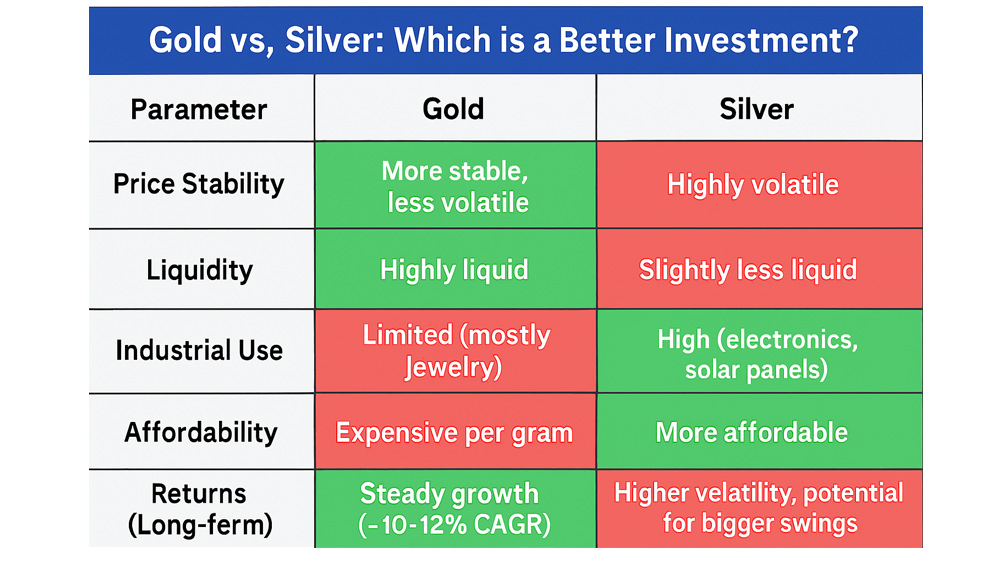
In 2025, both gold and silver have witnessed exceptional price surges in the Indian market, driven by a combination of global economic uncertainty, currency fluctuations, and shifting investment trends. As of early August, 24-carat gold is trading around ₹1,02,500 per 10 grams—an all-time high—marking a staggering year-to-date gain of nearly 38%. This rally has been fuelled by factors such as a weakening rupee against the US dollar, escalating geopolitical tensions, inflationary pressures, and the traditional safe-haven demand from Indian households during festive and wedding seasons. At the same time, silver has outperformed gold in percentage terms, rising about 30% in 2025 so far to hover between ₹1,16,000 and ₹1,17,000 per kilogram. While gold’s momentum is largely anchored in its role as a store of value and hedge against volatility, silver’s surge is being powered not only by investor interest but also by strong industrial demand from sectors like solar energy, electric vehicles, and electronics. The current investor sentiment shows a shift: while conservative buyers continue to accumulate gold for stability, a growing number of investors are turning to silver for its relatively lower entry cost and potential for higher short-term returns, despite its greater volatility. In essence, the 2025 scenario positions gold as the preferred long-term wealth preserver and silver as the high-growth contender, with both metals enjoying robust demand in India’s evolving investment landscape. For instance, as of late 2023, the gap between gold and silver prices narrowed significantly, approaching a ratio of nearly 1:1—a rare occurrence attributed to geopolitical tensions and changing investor sentiment toward safe-haven assets.
Historical price movements reveal that gold prices have surged dramatically over the decades, reaching over ₹50,000 per 10 grams in 2020, while silver has also seen substantial increases, albeit influenced by its dual role as an industrial and precious metal. Several controversies surround the pricing dynamics of gold and silver in India, particularly regarding government policies, trade regulations, and cultural demand patterns. Tariffs imposed on imports and shifts in fiscal policy have led to fluctuations in market prices, prompting debates about the impact of such measures on domestic consumers and investors. Furthermore, the cultural significance of gold in Indian society, particularly during festival and wedding seasons, complicates the price dynamics as demand surges, affecting the overall market landscape.
Read more:
Leverage Pareto Principle: Generating Jobs for Tamil Nadu’s Future
The first step is to identify key issues and prioritize problems. Governments can identify the 20% of issues that cause 80% of the problems, such as corruption or infrastructure deficits.
In this series, we will be focusing on the topmost priority of this time: Generating Jobs in Tamil Nadu. While corruption is an evergreen subject, we can also focus on other issues that can indirectly reduce corruption. By addressing these underlying priorities, we can create a multi-pronged approach to combat corruption along the way
In summary, the comparison of gold and silver prices in India encapsulates a confluence of economic indicators, investor behavior, and cultural traditions, making it a crucial area of study for understanding not only the bullion market but also the broader Indian economy. As both metals remain central to investment and cultural practices, their prices will continue to be a focal point of interest amid ongoing global economic uncertainties.
 Historical Overview
The historical development of coinage in India reflects the evolution of economic practices and the changing political landscape from ancient times to the modern era. The origins of Indian coinage can be traced back to the early 1st millennium BCE, primarily consisting of copper and silver coins known as Karshapanas or Pana. These early coins were often stamped bars of metal, suggesting the innovation of stamped currency was built upon existing forms of token currency that were prevalent in the Janapadas and Mahajanapada kingdoms of Early historic India.
The Gupta Era
The Gupta period (approximately 320 to 550 CE) marked a significant phase in Indian numismatics, particularly in the minting of silver coins. Chandragupta II initiated the silver coinage following the overthrow of the Western Satraps. His successors, Kumaragupta and Skandagupta, continued the use of traditional coin types, such as the Garuda and Peacock motifs, while also introducing new designs. However, a gradual decline in the purity of gold coins was noted over time, decreasing from 90% under Chandragupta I (319–335 CE) to around 75–80% under Skandagupta (467 CE). This decline was indicative of the diminishing territorial control and financial stability of the Gupta Empire. Indo-Sasanian Influence, the period of Indo-Sasanian coinage (530–1202 CE) illustrates the broader influences on Indian coins, as the Indo-Greek Kingdom’s coinage began to affect regional currencies by the 1st century BCE. Various tribes, dynasties, and kingdoms issued coins featuring Prākrit legends, reflecting the diverse cultural milieu of the time. The extensive coinage of the Kushan Empire also left a lasting impact on Gupta coinage and subsequent monetary systems in Kashmir. During the colonial era, particularly in the 19th century, coinage underwent substantial changes with the introduction of British rule. The British Raj led to a standardized currency system, which replaced many traditional forms of currency. The changes in coinage during this period were closely tied to broader economic policies and the integration of India into the global trade system, thus altering the historical pricing dynamics between gold and silver.
Factors Influencing Gold and Silver Prices
Global Economic Conditions
The prices of gold and silver are significantly influenced by global economic factors, including political stability, currency fluctuations, and interest rates. In India, which relies heavily on imports for its gold and silver supply, changes in the international market directly impact domestic prices. Political instability or shifts in government policy can lead to increased volatility in precious metal prices, affecting investor sentiment and demand. Demand and Supply Dynamics – The demand and supply of gold and silver in the international market play a crucial role in determining their prices. As per the World Gold Council, mining contributes to 75% of the global gold supply, while recycled gold accounts for the remaining 25%. In India, demand is driven by various segments: fabrication (45%), bars and coins (24%), exchange-traded funds (23%), and central banks (7%). The silver market similarly responds to industrial demand, which introduces different dynamics than those seen in gold, as silver serves both as a precious and industrial metal.
Investor Sentiment
Investor behavior heavily influences the pricing of gold and silver. During times of economic uncertainty, investors often seek safe-haven assets, leading to increased demand for gold and silver. This shift from riskier assets to safer investments can create sustained price support for precious metals. The psychology of investors, including factors such as loss aversion and herd behavior, further amplifies the price movements of these metals during periods of market instability.
Economic Policies and Monetary Factors and Market Trends and Ratios
Central bank policies and monetary factors significantly impact gold and silver prices. For instance, changes in interest rates and monetary supply can drive capital flows into precious metals as investors seek to protect their wealth. In the context of India, the Reserve Bank of India’s monetary policy decisions, including adjustments to the Cash Reserve Ratio, can affect liquidity in the banking system and consequently influence precious metal demand and pricing dynamics. The relationship between gold and silver prices is also reflected in the silver-to-gold ratio, which indicates the relative valuation between the two metals. A higher ratio suggests that silver is undervalued relative to gold and can influence buying decisions among investors. Additionally, the performance of gold during geopolitical tensions underscores its role as portfolio insurance, attracting institutional investors and increasing its price during such events.
Seasonal and Cultural Demand
In India, cultural factors and seasonal demand also play a pivotal role in shaping gold and silver prices. The festival and wedding seasons witness a surge in demand for gold, traditionally seen as a symbol of wealth and prosperity. Such seasonal trends contribute to fluctuations in prices, particularly in a country where gold holds significant cultural importance.
Current Trends in Gold and Silver Prices
In the decade spanning 2016–2025, India’s precious-metals market has moved from a relatively steady uptrend into a sharp rally driven by macro shocks and industrial demand. At the core of the story is how gold and silver, though often lumped together as “precious metals” respond to different demand impulses. Gold remains India’s cultural and financial anchor: a store of value bought for weddings, festivals and as a hedge against currency weakness and inflation. Silver, while culturally important, carries significant industrial demand (electronics, solar panels, EVs), which has amplified its price action especially during periods of industrial expansion. Year-end price snapshots from 2016 to 2025 show this evolution clearly: gold rose from about ₹28,340 per 10 g (Mar 31, 2016) to ₹91,190 per 10 g (Mar 31, 2025), while silver moved from roughly ₹36,990 per kg (Mar 31, 2016) to ₹1,03,900 per kg (Mar 31, 2025) a structural rise with a particularly steep slope in 2024–2025. The year 2025 stands out, gold hit record levels in early August 2025 (above ₹1.02 lakh per 10 g in some market reports) as investors sought safe havens amid global uncertainty and a weakening rupee, producing large year-to-date percentage gains. Silver also surged in 2025 and in percentage terms it has at times outperformed gold due to a combination of investor rotation into the white metal and robust industrial offtake (notably solar and electronics). Market reports from major Indian and international outlets documented both the record gold bursts and the strong silver performance through mid-2025.
What the 2016–2025 data (year-end) shows
- Both metals rose materially between 2016 and 2025; gold’s price per 10 g more than tripled in this period, while silver’s per-kg value roughly tripled as well.
- Silver’s year-to-year swings are larger relative to gold a feature explained by silver’s smaller market and industrial linkage. When demand from manufacturing or renewable energy surges, silver amplifies gold’s directional moves.
- Converting gold’s per-10g to per-kg (×100) and dividing by silver’s per-kg produces a weight-basis GSR. Across 2016–2025 that ratio moved substantially, signalling changing relative value when the ratio is high it suggests silver is cheaper relative to gold and vice-versa. I computed the year-end GSRs in the table so you can spot potential entry points historically
Gold and silver prices in India have exhibited significant volatility in recent years, influenced by various global and domestic factors. As of late 2023, domestic gold prices have been trading at a discount compared to international prices, reflecting subdued local demand despite the ongoing wedding season. For instance, in mid-December 2023, the local price discount reached US$17 per ounce, the steepest in over eight months, indicating a decrease in physical demand amid high gold price. Recent Developments in Gold Prices Gold prices in India have experienced substantial fluctuations over the years. Starting from ₹3,200 per 10 grams in 1990, they surged past ₹50,000 in 2020, influenced by global uncertainties such as the COVID-19 pandemic and geopolitical tensions like the Russia-Ukraine conflict. The 2010s were characterized by peaks and troughs, with prices reaching a high of ₹38,600 in 2013 before stabilizing around ₹25,000 in 2014. The decade saw substantial domestic demand, particularly during festival seasons, which traditionally drive price spikes. In 2023, the dynamics shifted again as prices reached approximately ₹94,800 per tola, with market analysts noting that high prices have discouraged broader consumer purchases. The overall investment demand is expected to increase, supported by favorable economic growth prospects and rising domestic investment inflows amidst ongoing global uncertainties.
Key drivers (2016–2025)
- Periods of global instability (geopolitical tensions, inflation spikes, currency moves) pushed investors into gold; 2024–2025 was a pronounced example.
- An easing/weakening rupee raises INR-prices of imported gold and silver, magnifying domestic price moves.
- Rapid growth in solar installations, electronics and EVs over the early-to-mid 2020s has lifted structural demand for silver, contributing to its strong performance in 2024–2025.
- Weddings and festivals continue to sustain baseline gold demand every year, cushioning gold’s downside in corrections.
Trends in Silver Prices
Silver prices have also been impacted by similar external factors. As of early 2025, silver prices were fluctuating between ₹96,500 and ₹96,656 per kilogram, driven by global demand, currency exchange rates, and economic conditions. The geopolitical situation, particularly the continuing effects of the Russia-Ukraine war, has constrained international supply, causing silver prices to rise. Moreover, with rising inflation, silver is increasingly viewed as a safe investment, thereby boosting its demand. Interestingly, there has been a noteworthy shift in the pricing dynamics of gold and silver, with their prices nearing parity as of late 2023. Traders reported that the difference between one tola of gold and a kilogram of silver shrank to a mere ₹1,500, a rare occurrence reflecting the market’s volatility.
Consumer Behavior and Market Dynamics
Despite the traditionally high demand for gold during festival seasons, recent trends indicate a decline in consumer appetite for discretionary purchases due to elevated prices. Consumers are primarily buying gold to meet wedding-related needs while largely avoiding additional purchases. This change in buying behavior has led to increased jewellery recycling, further suppressing the demand for new imports. As the economy shows robust growth, propelled by healthy consumption and government investments, the interplay between price, demand, and consumer sentiment continues to evolve, impacting the broader bullion market in India. The high price environment presents challenges for jewellers, compelling them to adapt their inventory strategies in response to market conditions.
Recent Market Influences
The recent rise in gold prices is partly a reaction to monetary policy changes, including a low-interest-rate environment which historically favors gold investment due to lower opportunity costs. Current market trends suggest that institutional investors are reallocating their portfolios in response to ongoing trade tensions and anticipated rate cuts, further supporting gold’s price appreciation. This behavior highlights the protective nature of gold during periods of economic uncertainty. Conversely, silver’s performance has been affected by diminishing industrial demand amid these trade disputes. Despite the projected decline in gold prices potentially impacting investor sentiment, forecasts indicate an anticipated rise in silver prices, which may help stabilize the bullion market overall.
Investor Sentiment and Psychological Factors
Psychological factors also play a significant role in the price movements of both metals. As investors react to market uncertainties, capital tends to flow toward perceived safe havens like gold, driven by behaviors such as herd mentality and loss aversion. While both gold and silver have intrinsic value, gold’s status as a safe-haven asset tends to amplify its appeal during tumultuous economic periods, often leading to higher price performances compared to silver.
Trade Regulations
The Foreign Trade (Development and Regulation) Act, 1992 governs the import and export of goods in India, including precious metals like gold and silver. Recent changes in the Foreign Trade Policy have introduced specific provisions aimed at managing tariffs and duties on these commodities, directly affecting their market prices. For instance, the imposition of a 26 percent tariff on Indian imports by the United States under President Trump’s administration created ripples across various sectors, raising concerns about the pricing of gold and silver in the Indian market, especially as such tariffs impact overall trade dynamics.
Fiscal Policies
India’s fiscal policies, particularly those emphasizing austerity and reduced government spending, have broader economic implications that can affect gold and silver prices. Critics argue that austerity measures prioritize foreign investors at the expense of domestic welfare, leading to depressed domestic demand and falling real wages. This economic environment can drive investors towards gold and silver as safer asset classes during times of uncertainty, thereby influencing their prices in the local market.
Economic Conditions and Market Sentiment
Economic activities, such as GDP growth rates, inflation, and employment statistics, also play crucial roles. A slowdown in economic growth or high inflation tends to increase investor interest in gold and silver, as these commodities are often viewed as safe havens in turbulent times. For example, global economic slowdowns or high inflation rates typically lead to a shift in investor sentiment, further driving up the prices of these metals in India. Political Events and Policy Changes, Political stability and policy reforms in major gold-exporting countries can affect the availability and price of gold and silver in India. Changes in leadership or economic policies in these nations may lead to speculation and volatility in the commodities market. Additionally, alterations in mining and processing policies can impact supply, thereby affecting prices in the Indian context
Investment Options
Overview of Investment Vehicles
In the context of fluctuating gold prices influenced by global market dynamics, Indian investors have been increasingly exploring diverse investment options beyond traditional physical gold. This includes Gold Exchange-Traded Funds (ETFs), digital gold platforms, and Sovereign Gold Bonds (SGBs), which offer various benefits suited to different investment strategies and risk tolerances
Gold Exchange-Traded Funds (ETFs)
Gold ETFs have witnessed substantial growth in India, with assets under management increasing by over 20% annually in recent years. Elimination of storage and security concerns Enhanced liquidity for swift buying and selling. Reduced transaction costs compared to physical gold. Ability to invest smaller amounts, catering to a wider range of investors. The rise of digital gold platforms, integrated with popular payment applications like Google Pay and PhonePe, has made gold investments accessible to a broader demographic, particularly younger, tech-savvy investors. These platforms facilitate purchases starting as low as ₹1, making gold investment more democratic and appealing during periods of market uncertainty
Sovereign Gold Bonds (SGBs)
Sovereign Gold Bonds present a unique alternative to physical gold, offering a fixed interest rate of 2.5% in addition to tracking gold prices. No storage requirements, thus eliminating security concerns. Different tax implications compared to physical gold. A sovereign guarantee, which alters the risk profile for investors Recent issuances of SGBs have experienced varying subscription rates based on market sentiment and alternative investment opportunities, further demonstrating their potential as a flexible investment option during times of volatility.
Strategies for Investors
To effectively navigate the complex landscape influenced by tariff policies and market fluctuations, investors are advised to consider the following strategies such as Diversify across various precious metal holdings, balancing physical gold, ETFs, and SGBs based on individual risk tolerance. Monitor global trade developments, especially concerning US-China relations, as they may significantly impact market sentiment. Focus on certified products, ensuring quality and authenticity through established refiners. Be mindful of currency factors, such as the rupee-dollar exchange rate, which can affect local pricing dynamics. These strategies help investors optimize their portfolios while minimizing risks associated with market volatility, creating a robust framework for decision-making in gold and silver investments. Jewellers in India are also adjusting to these market fluctuations through various strategies, such as responsive inventory management and enhanced customer communication. They are adopting financial risk management tools, like gold futures and options contracts, to stabilize their operations amid changing market conditions This flexibility enables both investors and jewellers to effectively address the challenges presented by international tariff policies and their subsequent impacts on gold prices.