
(Bloomberg) — Kazakhstan’s central bank unexpectedly hiked its key interest rate to help tame accelerating inflation that’s running at almost double the target.
Most Read from Bloomberg
The National Bank of Kazakhstan raised the benchmark to 16.5% on Friday. Seven out of eight economists surveyed by Bloomberg forecast no change from 15.25%, while one analyst expected a 50 basis point increase.
“Pressure on prices from the external sector has increased due to further acceleration of inflation in Russia,” the country’s second-largest trading partner, the central bank said in a statement.
The bank also increased its forecast for price growth in 2025 to 10%-12%, citing external factors, higher fuel prices and value-added tax rates. The previous outlook saw 6.5%-8.5% inflation this year.
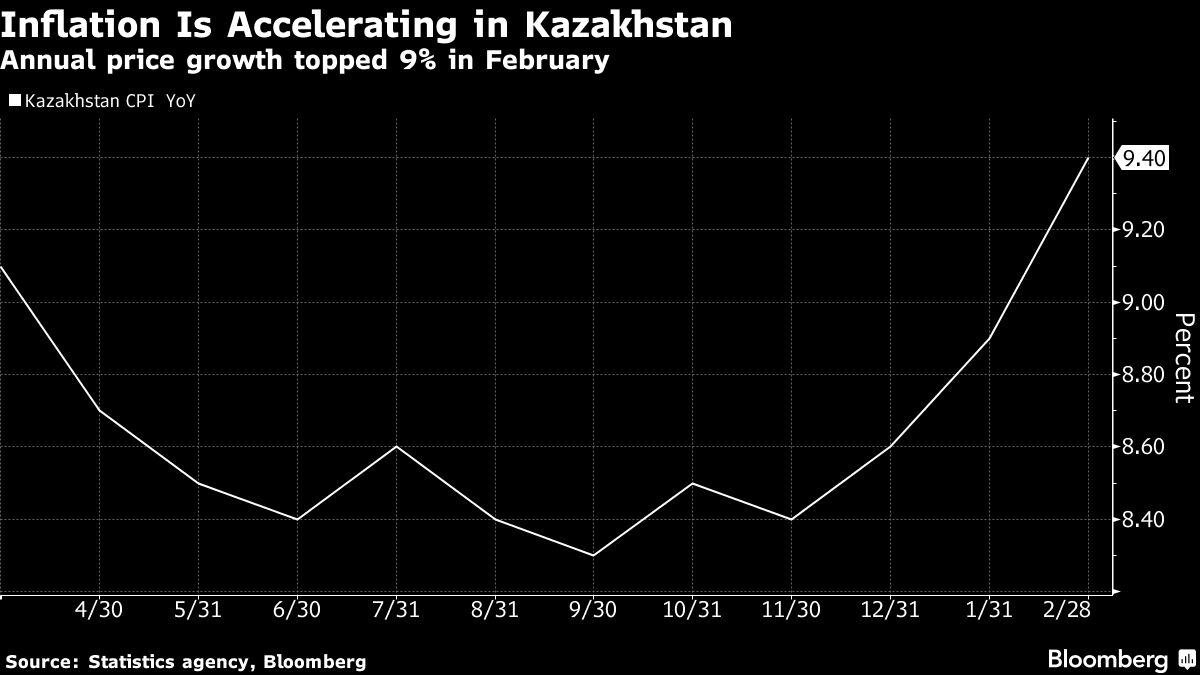
Consumer-price growth quickened for a third month to reach 9.4% in February from a year earlier, far outstripping the central bank’s 5% target. The government highlighted a “negative” trend in inflation this week, forecasting that it would reach about 10% by the end of the year, according to the Kazinform news service.
The outlook for central Asia’s largest oil producer is clouded by plans to raise value-added tax next year, with ministers estimating a “short-term” addition to inflation of about 3 percentage points. Kazakhstan is also seeking to boost government spending, including 1 trillion tenge ($2 billion) on state sponsored lending to add at least 2 percentage points to economic growth this year.
The Kazakh central bank cut its forecast for economic growth in 2025 to 4.2%-5.2% from 4.5%-5.5%, citing a reduction in the government’s outlook for oil production.
A weakening tenge led to the first increase in the key rate since 2022 in November after the central bank spent $1 billion on interventions.
The central bank said in its statement that Friday’s decision to increase rates was taken with the aim of avoiding a larger, future increase.
The national currency fell to a record low in January, but has appreciated about 7% since the last rate decision on Jan. 17. It’s been helped by a government order for state-run companies to sell half of their foreign currency revenue and a central bank decision to sell dollars to mirror domestic purchases of gold.