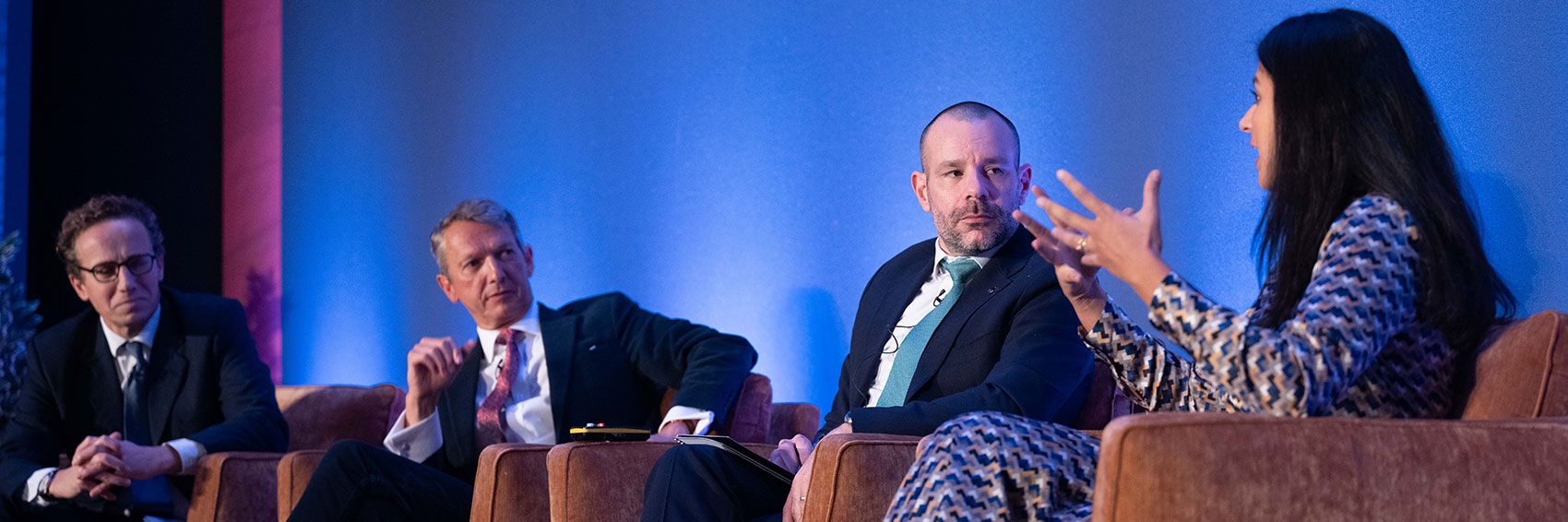
Our flagship annual Outlook event took place in the remarkable St George ballroom at The Peninsula London. Over the course of a thought-provoking evening, our clients heard from Andy Haldane, former Chief Economist at the Bank of England, who gave his insights into the current economic health of the UK, and from our investment experts, who offered their perspectives on the key trends set to define markets in 2026.
2026: The year of productivity
The evening began with Julien Lafargue, our Chief Market Strategist, reflecting on the extreme volatility of 2025 – marked by government shutdowns, geopolitical conflicts, and shifting market dominance – while outlining a cautious but optimistic thesis for the year ahead.
While headlines are often distracting, the defining factor for the global economy in 2026 will be productivity. Julien explained that productivity is important because it is essential for justifying massive AI capital expenditure and is one of the only ways for the US government to escape the conundrum of high debt without triggering runaway inflation or political fallout from rate hikes.
While US productivity recently ran at a 5% annualised pace, Julien suggested this is currently a standard post-recession recovery, rather than a direct result of AI. However, optimism remains high because AI adoption is still low – only 30% for large companies and around 20% for smaller ones. Therefore, if AI adoption continues to increase amongst companies, we could still see a significant increase in productivity. However, as Julien summed up, “If there is no productivity gain, there is no AI trade. There’s no AI capex. There is no demand for AI. AI is all about productivity gains.”
The second session of the evening leveraged Barclays’ group-wide expertise, as Hiral Patel, Global Head of Thematic Investing from Barclays Investment Bank gave a fascinating deep-dive into the emerging trends shaping the investment landscape.
Hiral based her speech around the sixth edition of the 2035 thematic roadmap, a centralised framework that tracks 150 global trends across sectors like technology, healthcare, and industrials. The most recent edition has moved away from a previously “rosy” outlook, as Hiral adopts a more realistic lens, termed ‘multipolar optimism’ – to account for rising geopolitical tensions, social unease, and fragmented global progress. She emphasised that investors must now be more selective, as structural trends evolve at different speeds under varying global rules.
Hiral highlighted three emerging trends that she believes will shape the future:
- AI and Green Data Centres: The focus is shifting from “asset-light” software to the physical bottlenecks of AI, specifically electricity shortages and water usage. Future capital expenditure will be increasingly “energy-oriented”, with potential opportunities in data centre cooling and energy storage.
- Quantum Computing: Predicted to reach an “inflection point” within the next 12 to 18 months, quantum computing will move beyond hype to address complex processing in cryptography, pharmaceuticals, and advanced materials.
- AI in Healthcare: While historically under-invested in the public market, AI is gaining traction in drug discovery, diagnostics, and patient monitoring. Due to regulatory and data integration hurdles, Hiral reflected that this trend currently remains better suited for the private investment space, but long-term public investment opportunities are likely to increase.
Hiral concluded by reflecting on the social systems that will be affected by these emerging trends, and how that becomes its own trend, “What are the potential macro implications of structural unemployment, reskilling, lifelong learning? (…) all of this could be packaged into investing in education technology”.
Investing through uncertainty
So, given the uncertainty surrounding both geopolitics and markets this year, what are the implications for investors? This was the question posed by Julien as he hosted a panel session, joined by our guest speaker, Andy Haldane, former Chief Economist at the Bank of England and Alastair Randall, our Global Co-Head of Investment Management. Throughout a lively debate, the session examined the volatile intersection of shifting geopolitics, the long-term economic integration of AI, and the escalating risks associated with global public debt.
Andy Haldane observed a market tendency to overreact to immediate “shocks” while underreacting to systemic issues like sovereign debt, which he believes could be a potential risk. Alastair Randall emphasised the importance of building resilience within investment portfolios – focusing on high-quality, low-leverage balance sheets and utilising gold as an “airbag” to navigate an era defined by unpredictable new world order dynamics. Despite these uncertainties, the speakers maintained that the US dollar’s status as a reserve currency remains unchallenged for the foreseeable future, even as central bank independence is increasingly eroded by necessary coordination with fiscal authorities.
To end the panel session, Alastair reminded clients that diversification – not only within asset classes, remains key to managing volatility, “Diversification cannot simply be through asset classes because they can be correlated and go down together; it needs to be engineered through both portfolio construction as much as asset allocation”.
Our thanks again to all those who attended and contributed to this memorable event.