
Preliminary Examination: Current events of national importance.
Mains Examination: General Studies II: Indian Constitution—historical underpinnings, evolution, features, amendments, significant provisions and basic structure.
What’s the ongoing story: In the first Republic Day parade after Operation Sindoor, India will showcase its military might, including its newly-raised Bhairav light commando battalion and a range of indigenous platforms, in a phased battle array format.
— Why was January 26 chosen to be India’s Republic Day?
— Poorna Swaraj resolution in1929 and Republic day in 26th Jan 1950-Connect the dots
— What is Constitutionalism?
— What makes this year’s Republic Day unique?
— What is Operation Sindoor?
— Know about the Dhruv Helicopter, Main Battle Tank Arjun, BMP-II and NAMIS-II Nag Missile System.
Story continues below this ad
— Read about the Shaktiban, Dhanush, Brahmos, Akash and medium range surface-to-air missiles Barak 8, Drone Shakti and Glacier ATV.
— What is the difference between Republic Day and Independence Day flag hoisting?
Key Takeaways:
— This will be the first time that the public will get to see military assets in the sequence they would appear during actual combat.
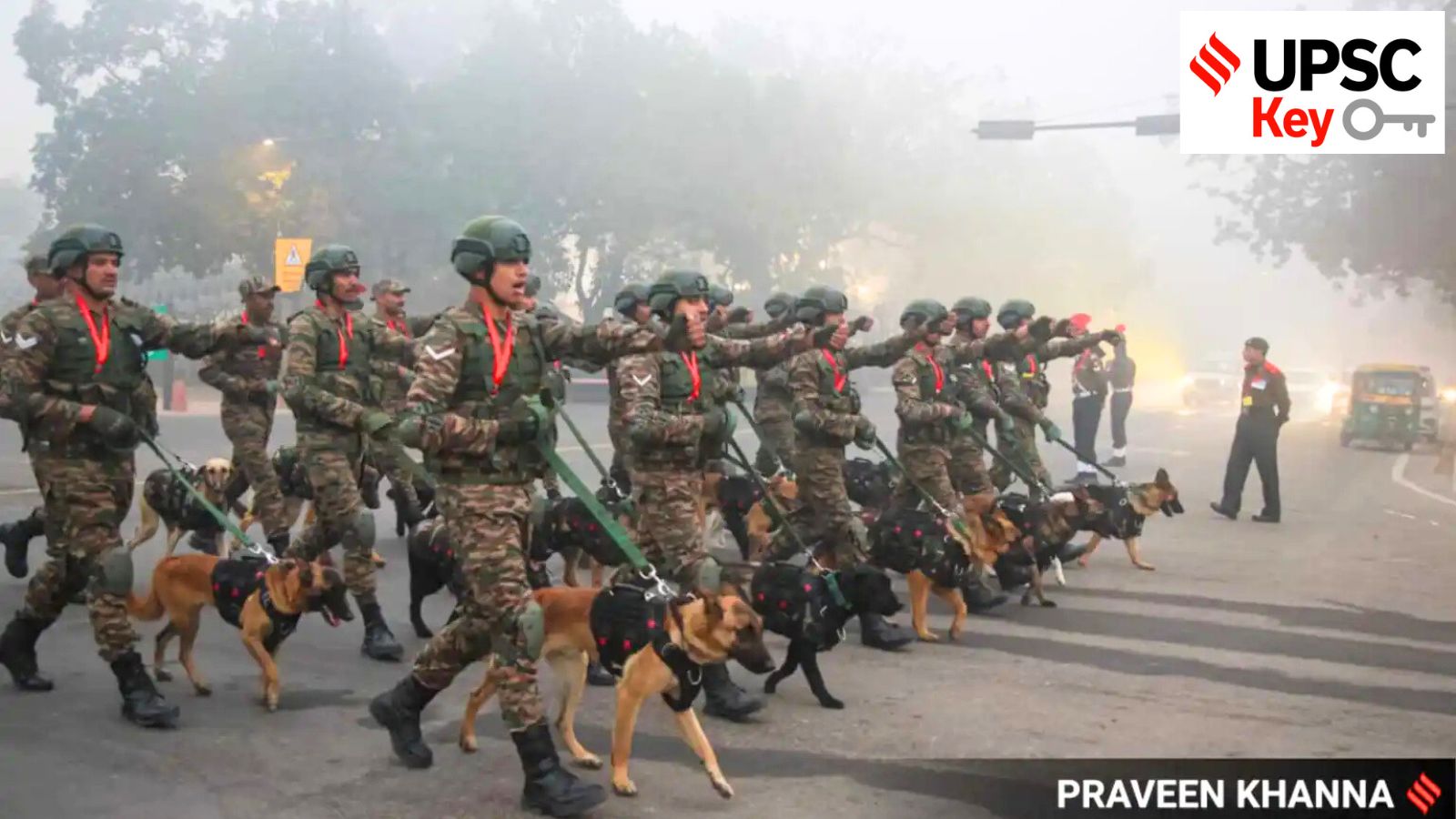
— They will move down Kartavya Path in formations similar to an actual battle scenario, starting with reconnaissance, followed by other military units such as logistics and personnel accompanying these platforms, wearing battle gear.
Story continues below this ad
—- Surveillance platforms are likely to be showcased first in high mobility reconnaissance vehicles with drones and anti-tank missiles, aerial display of helicopters such as Apache and the Light Combat Helicopter Prachand.
— This will likely be followed by display of tanks, BMPs, artillery guns, air defence platforms and missiles, logistics vehicles to support these columns, robotic dogs, Bactrian camels and Zanskar ponies.
— Finally, the infantry columns and the Bhairav light commando battalion, which will make its debut in the parade this year, will make an appearance.
— In a statement, the Ministry of Defence said the Indian Army will be represented by a mounted column of 61 Cavalry and battle array formation. It said there will be a display of seven marching contingents, HMRV (High Mobility Recce Vehicle – BFSR & ATGM) and ALH Dhruv Helicopter, T-90, Main Battle Tank Arjun, BMP-II and NAMIS-II Nag Missile System, IOC (Integrated Operational Centre), UGVs, ATV (All Terrain Vehicle), LSV (Light Strike Vehicle) with Trailer (Robotic Mules and UGV), Shaktiban, ATAGS and Dhanush, URLS and Brahmos, Akash and medium range surface-to-air missile Barak 8, Drone Shakti and Glacier ATV.
Story continues below this ad
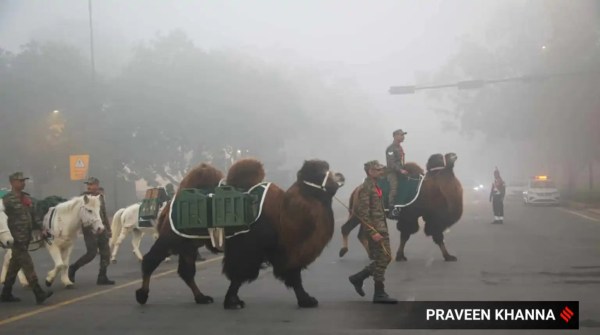 An animal contingent comprising Zanskar ponies, Bactrian camels, and dogs with handlers contingent will march past the saluting dais.
— It said an animal contingent comprising Zanskar ponies, Bactrian camels, and dogs with handlers contingent, Scouts contingent, Rajput contingent, Assam contingent, JAK LI contingent, Artillery contingent, Bhairav contingent in ‘Uncha Kadam taal’, and Ladakh Scouts will march past the saluting dais.
— The battlefield scenario will also include display of aerial assets such as helicopters and aircraft. These will be followed by the armoured columns depicting T-90, MBT Arjun, mechanised columns of BMP II and NAMIS II Nag missile system.
— The integrated operational centre, where the entire battle is closely monitored using different surveillance equipment, will likely be displayed next. These will be followed by unmanned ground vehicles, all-terrain vehicles and light strike vehicles. Robotic mules, logistics vehicles to support these columns, robotic dogs, Bactrian camels and Zanskar ponies too will be there.
Finally, the infantry columns and the Bhairav light commando battalion, which will make its debut in the parade this year, will be showcased.
Do You Know:
Story continues below this ad
— 150 years of ‘Vande Mataram’ will be the focus of this year’s Republic Day Parade. Enclosure backdrops on the Kartavya Path will bear old paintings illustrating the opening stanzas of the National Song and floral artworks at the main stage will pay homage to its composer Bankim Chandra Chatterjee.
— The Lahore Session of the INC was convened in December 1929. On December 19, the historic “Poorna Swaraj” resolution was passed in the session. Literally meaning “total self-rule/sovereignty,” the resolution read, “The British government in India has not only deprived the Indian people of their freedom but has based itself on the exploitation of the masses, and has ruined India economically, politically, culturally and spiritually…. Therefore…India must sever the British connection and attain Poorna Swaraj or complete independence.”
— This declaration of Independence was officially promulgated on January 26, 1930. The Congress urged Indians to come out and celebrate “independence” on that day. The resolution also contained in it an affirmation to the Gandhian methods of nonviolent protest, which would start almost immediately after Poorna Swaraj Day was celebrated.
— From 1930 till India finally won its independence in 1947, January 26 was celebrated as “Independence Day” or “Poorna Swaraj Day” with Indians reaffirming their commitment towards sovereignty on that day.
Story continues below this ad
— However, India won independence from the British on August 15, 1947. Thus, when leaders had to decide on a day to promulgate India’s new constitution, January 26 was thought to be ideal. Not only did this date already hold nationalist significance, the Constitution in many ways reflected the “Poorna Swaraj” declaration of two decades back.
Other Important Articles Covering the same topic:
📍R-Day Parade: 18 contingents, 30 tableaux, 13 bands, Bhairav Battalion debut
📍Why was January 26 chosen to be India’s Republic Day?
Previous year UPSC Prelims Questions Covering similar theme:
(1) What was the exact constitutional status of India on 26th January 1950? (UPSC CSE 2021)
(a) A Democratic Republic
(b) A Sovereign Democratic Republic
(c) A Sovereign Secular Democratic Republic
(d) A Sovereign Socialist Secular Democratic Republic
(2) In the context of the Indian defence, what is ‘Dhruv’? (UPSC CSE 2008)
(a) Aircraft-carrying warship
(b) Missile-carrying submarine
(c) Advanced light helicopter
(d) Intercontinental ballistic missile
Previous year UPSC Mains Question Covering similar theme:
Story continues below this ad
Discuss each adjective attached to the word ‘Republic’ in the ‘Preamble’. Are they defendable in the present circumstances? (UPSC CSE 2013)
POLITICS
Uttarakhand awarded ‘Leader’ status in Startup India Ranking
Syllabus:
Preliminary Examination: Current events of national and international importance.
Mains Examination: General Studies-II: Government policies and interventions for development in various sectors and issues arising out of their design and implementation.
What’s the ongoing story: In the ‘States’ Startup Ecosystem Ranking (5th Edition)’, released by the Department for Promotion of Industry and Internal Trade under the Ministry of Commerce and Industry, Uttarakhand has been recognised as a leader for developing a robust startup ecosystem.
— What is the Startup India scheme?
Story continues below this ad
— Know about the States’ Startup Ranking and key highlights of the 5th edition.
— What is the significance of competitive federalism in promoting entrepreneurship and innovation among the states in India?
— What is the status of startups in India?
— What are the steps taken by the government to create an ecosystem of innovation?
— What are the key drivers of India’s startup ecosystem?
— How can emerging technologies like AI, blockchain, and IoT accelerate growth in Startups ecosystem?
Key Takeaways:
— A Certificate of Appreciation was presented to the state’s Industries Department on the occasion of National Startup Day.
— “Our government has developed favourable policies, simple processes and a strong ecosystem to promote startups. The state’s youth have an incredible potential for innovation, and the government is providing them support at every level,” said CM Pushkar Singh Dhami.
Do You Know:
— The States’ Startup Ranking is a yearly capacity-building exercise created and released by DPIIT that evaluates all of India’s states and Union Territories on their efforts to build an ecosystem conducive to startup growth.
— States’ Startup Ranking was launched in February 2018 to achieve the vision of building a robust startup ecosystem in the country. It aims to evaluate the Indian startup landscape through the eyes of state policy intervention and identify state practices that accelerate ecosystem growth and development.
— Under the 5th Edition of States’ Startup Ranking evaluation period under consideration was from 1st January 2023 to 30th November 2024.
— Launched on 16th January, 2016, the Startup India Initiative has rolled out several programs with the objective of supporting entrepreneurs, building a robust startup ecosystem and transforming India into a country of job creators instead of job seekers. These programs are managed by a dedicated Startup India Team, which reports to DPIIT.
Other Important Articles Covering the same topic:
📍How India can become the world’s leading startup ecosystem
Previous year UPSC Mains Question Covering similar theme:
“While we flaunt India’s demographic dividend, we ignore the dropping rates of employability.” What are we missing while doing so? Where will the jobs that India desperately needs come from? Explain. (UPSC CSE 2014)
“Demographic Dividend in India will remain only theoretical unless our manpower becomes more educated, aware, skilled and creative.” What measures have been taken by the government to enhance the capacity of our population to be more productive and employable? (UPSC CSE 2016)
OPINION
The US has always eyed Greenland, much before Trump
Syllabus:
Preliminary Examination: Current events of national and international importance.
Mains Examination: General Studies II: Effect of policies and politics of developed and developing countries on India’s interests.
What’s the ongoing story: Saptarshi Basak writes- “Donald Trump’s insistence on taking over Greenland has unsettled Denmark and its autonomous island, as well as much of Europe.”
— Know in detail about Greenland.
— What is the geopolitical significance of Greenland in the context of Arctic politics?
— Why does Greenland matter to the US?
— Know the history of the US quest to acquire Greenland.
— The Arctic region is often described as a “global commons.”-Why?
— Read about the Monroe Doctrine.
— What is the North Atlantic Treaty Organization (NATO)?
— What was the rationale behind the creation of NATO, who forms part of it, and where does it stand today?
— Map Work: Locate Greenland on map.
Key Takeaways:
— “Trump first floated the idea in 2019, but his renewed interest and demonstrated willingness to follow through on what he says — from bombing Iran last year to attacking Venezuela this year — mean that his words cannot be taken lightly. Yet while Trump may be acting with his usual brazenness in a post-War international order whose rules great powers don’t seem to care about, Greenland has actually long featured in Washington’s imagination, illustrated by Arctic Circle scholars like Marc Jacobsen and Sara Olsvig.”
— “The first reported expression of official US interest in Greenland dates back nearly 200 years, not long after the dissolution of the 434-year-old political union between the kingdoms of Norway and Denmark, after which, under the 1814 Treaty of Kiel, Greenland came under the latter’s control. In 1832, US President Andrew Jackson floated the idea of buying it, at a time when US territorial acquisitions were not unusual (recall the phrase “Louisiana Purchase”). This interest emerged after the articulation of the Monroe Doctrine, whose broad contours are now familiar, mostly because Trump has crudely rechristened it as the “Donroe Doctrine.”
— “In 1867, US Secretary of State William Seward recommended that Greenland be purchased alongside Alaska, which he had just negotiated with Russia. Academic consensus suggests that Seward’s plan was to flank Canada and put pressure on it to become part of the US. But any such move would have encountered British resistance.”
— “In the years leading up to WWI, the US again sought to purchase Greenland and the Danish West Indies because it wanted the shipping lanes and also to prevent the Germans from using them as military bases. A few days before the US declared war on Germany, the Danish West Indies were transferred to the US on March 31, 1917. Washington, however, stopped short of recognising Danish sovereignty over Greenland.”
— “As WWII erupted, the White House again debated the merits of acquiring Greenland. After the Nazis occupied Denmark (but not Greenland) in April 1940, the US quickly established a consulate in Nuuk, the capital of Greenland. A 1941 US-Denmark agreement granted the US broad authority to establish military bases in the island to prevent a Nazi takeover. Following Hitler’s defeat, Truman in 1946 made a formal offer to buy Greenland, which Denmark again rejected. By then, however, the Nazi threat had been replaced by a new one: the Soviet Union.”
— “The Cold War, organised around NATO and the Warsaw Pact, again made the Americans look at Greenland as essential to security. Denmark, a founding member of NATO, found itself — and Greenland — bound to US interests. The 1951 defence agreement between the two paved the way for Thule Air Base, now known as Pituffik Space Base. Little surprise that Greenlanders were not consulted. Throughout the Cold War, the US used Greenland as a bulwark against the Soviets. It was a part of NATO’s northern shield, and as the nuclear race heated up, American nuclear weapons were stored at the base despite Denmark’s 1957 nuclear weapons-free zone policy.”
— “With the disintegration of the USSR and the US’s “unipolar moment”, Greenland shifted from being important for countering Russia to being central to a long-term Arctic strategy around shipping routes and climate change. But the rise of China — now calling itself a “near-Arctic state” — and the deepening China-Russia nexus, have again sparked American military interest, first publicly articulated by Trump 1.0 Secretary of State Mike Pompeo in 2019 at an Arctic Council ministerial meeting. He warned that the Council could no longer afford to focus solely on environment and science because China and Russia were acting against US interests. In Trump’s second term, it is not just rhetoric anymore: Threats are being issued, meetings convened, and troops deployed.”
— “It is true that Russia and China are interested in the Arctic. But it is also true that resisting those interests does not justify overriding the sovereign rights of a democratic country and its right to exercise self-determination — basic values the US has championed since WWII. A better way might be military collaboration to safeguard the region jointly for the US, Greenland, Denmark, and Europe. Does such an alliance already exist? A four-letter acronym comes to mind.”
From the front page: “Trump to hit Europe with 10% tariffs until he gets deal to buy Greenland”
— US President Donald Trump on Saturday vowed to implement a wave of increasing tariffs on European allies until the US is allowed to buy Greenland, escalating a row over the future of Denmark’s vast Arctic island.
— In a post on Truth Social, Trump said additional 10% import tariffs would take effect on February 1 on goods from Denmark, Norway, Sweden, France, Germany, the Netherlands, Finland and Great Britain—all already subject to tariffs imposed by Trump.
— Those tariffs would increase to 25% on June 1 and would continue until a deal was reached for the U.S. to purchase Greenland, Trump wrote. Trump has repeatedly said Greenland is vital to US security because of its strategic location and large mineral deposits and has not ruled out using force to take it. European nations this week sent military personnel to the island at Denmark’s request.
Do You Know:
— Greenland, part of NATO through the membership of Denmark, has strategic significance for the US military and for its ballistic missile early-warning system since the shortest route from Europe to North America runs via the Arctic island.
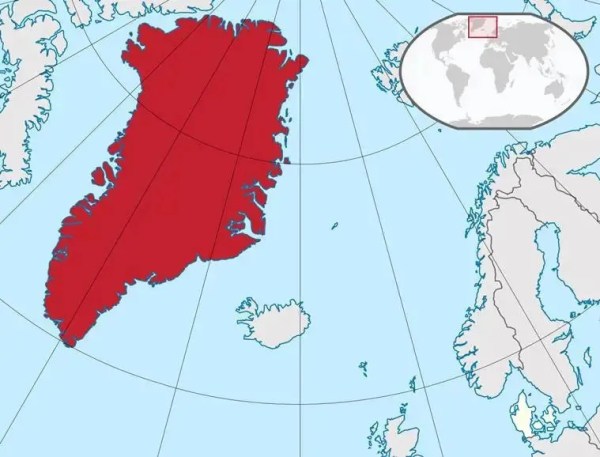 Location of Greenland, in the Kingdom of Denmark. (Source: Wikimedia Commons)
— Greenland is the largest island on Earth. It is situated in the Arctic and is the most sparsely populated territory in the world. It is bordered by the Atlantic Ocean on one side and the Arctic Ocean on the other. It is home to the northernmost point of land in the world—Kaffeklubben Island.
— Greenland is mineral-rich with large deposits of traditional resources such as gold, nickel, and cobalt. It also has some of the biggest reserves of rare earth minerals such as dysprosium, praseodymium, neodymium, and terbium. Of the 34 classified rare earth minerals, Greenland has about 23. It is these that have brought the island a lot of attention, along with several prospecting mining companies.
— As an autonomous territory of Denmark, Greenland hosts both Danish and US military bases. Its economy relies heavily on fishing, while substantial subsidies from the Danish government contribute about 20% of its GDP.
— Greenland, though geographically part of North America, has been under Denmark’s control—located nearly 3,000 km (1,860 miles) away—for around 300 years. Initially governed as a colony, Greenland remained isolated and economically underdeveloped for much of its early history.
— In 1953, it was integrated into the Kingdom of Denmark, granting Greenlanders Danish citizenship. A significant shift occurred in 1979, when a referendum on home rule allowed Greenland to take control of most internal policies, while Denmark retained authority over foreign affairs and defence.
Other Important Articles Covering the same topic:
📍Knowledge Nugget: Greenland and Geopolitics – What all you need to know for UPSC Exam?
📍Why Donald Trump wants to acquire Greenland: Key questions answered
UPSC Prelims Practice Question Covering similar theme:
(3) With reference to the Greenland, consider the following statements:
1. It was once a Danish colony and is now an autonomous province of Denmark.
2. It is located in the South Atlantic Ocean.
3. Its strategic importance rose during the Cold War, and the US had a large air base in Greenland.
4. It is rich in rare earth minerals.
How many of the statements given above are correct?
(a) Only one
(b) Only two
(c) Only three
(d) All four
THE WORLD
EU and Mercosur sign free trade deal after 25 years of negotiations
Syllabus:
Preliminary Examination: Current events of national and international importance
Mains Examination: General Studies-II: Bilateral, regional and global groupings and agreements involving India and/or affecting India’s interests.
What’s the ongoing story: Top officials from the EU and the South American bloc Mercosur signed a free trade agreement on Saturday in Paraguay, paving the way for the European Union’s largest-ever trade accord after 25 years of negotiations.
— What is Mercosur?
— European Union: Know in detail.
— What does the EU-Mercosur FTA entail?
— What is the significance of Europe for India?
— What are the challenges in the signing of trade deals between India and Europe?
— India-MERCOSUR: know in detail
— Map Work: Locate Mercosur and EU member countries on map.
Key Takeaways:
— The agreement, designed to lower tariffs and boost trade between the two regions, must now gain the consent of the European Parliament and be ratified by the legislatures of Mercosur members Argentina, Brazil, Paraguay and Uruguay.
— European Commission President Ursula von der Leyen and European Council President Antonio Costa joined the presidents of Mercosur countries at Saturday’s ceremony, with the exception of Brazilian President Luiz Inacio Lula da Silva, who sent his foreign minister.
— The deal received the green light from most European nations last week, despite concerns from farmers and environmental groups, who fear a surge of inexpensive South American imports and increased deforestation.
— Von der Leyen, who met with Lula before heading to Asuncion for the signing, said the deal would create the largest free trade zone in the world.
— “This agreement sends a very strong message to the world. It reflects a clear and deliberate choice. We choose fair trade over tariffs. We choose a productive, long-term partnership over isolation,” she said on Saturday.
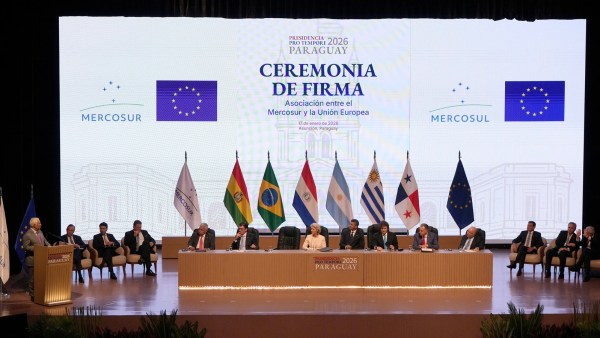 Meeting to sign a free trade deal between the European Union and Mercosur in Asuncion, Paraguay. (AP Photo)
— Just before the ceremony on Saturday morning, U.S. President Donald Trump vowed to impose increasing tariffs on eight European nations if the United States is not permitted to purchase Greenland.
Do You Know:
— Mercosur comprises Brazil, its largest member by territory, economy and population, along with Argentina, Paraguay, Uruguay and Bolivia, the newest member. Venezuela, once a member, has been been suspended indefinitely.
— Founded in 1991 to create a common market, spur development, and bolster democracy, Mercosur saw early successes, including a tenfold increase in trade within the bloc in its first decade.
— The European Union is a group of 27 countries in Europe. These countries came together to make things better, easier and safer for people. They agreed to work together and help each other.
— India established diplomatic relations with the European Economic Community — the first pillar of the future European Union — back in 1962. The Joint Political Statement signed in 1993 and the Cooperation Agreement of 1994 paved the way for the strengthening of ties between India and Europe.
Other Important Articles Covering the same topic:
📍EU, Latin America bloc Mercosur set to sign historic trade deal, despite French-led opposition
📍European Union, Mercosur bloc of South American nations sign landmark free trade agreement
📍 In a year of unpredictability, India ‘needs to accelerate EU FTA
Previous year UPSC Prelims Question Covering similar theme:
(4) Consider the following statements: (UPSC CSE 2023)
The ‘Stability and Growth Pact’ of the European Union is a treaty that:
1. limits the levels of the budgetary deficit of the countries of the European Union
2. makes the countries of the European Union to share their infrastructure facilities
3. enables the countries of the European Union to share their technologies
How many of the above statements are correct
(a) Only one
(b) Only two
(c) All three
(d) None
ECONOMY
RE industry flags concerns over CERC’s transmission framework
Syllabus:
Preliminary Examination: Current events of national importance, Economic development.
Mains Examination: General studies-II, III: Government policies and interventions, Infrastructure, Energy.
What’s the ongoing story: Private developers and other power sector stakeholders have raised concerns over proposals by the Central Electricity Regulatory Commission (CERC) to revamp the framework for granting transmission connectivity to future renewable energy projects.
— Read about the CERC.
— What is the role of CERC in India’s power sector?
— What are the proposed changes by the CERC regarding transmission connectivity for renewable energy projects?
— What are the key concerns raised by the Renewable energy sector?
— What are the reasons behind the underutilisation of India’s renewable energy transmission infrastructure?
— What is the General Network Access (GNA) framework for renewable energy projects?
Key Takeaways:
— In a staff paper released on November 25, the regulator proposed that future transmission connectivity be granted only against signed power purchase agreements (PPA), instead of Letter of Awards (LoAs) for efficient utilisation of transmission infrastructure. It has alternatively suggested an auction-based mechanism for allocating connectivity, coupled with firm commissioning timelines. Letter of Awards is an official letter issued to a successful bidder confirming the formal award of a project, contract, or allocation of capacity following a competitive bidding process.
— However, private developers, industry bodies, and REIAs have flagged concerns over the proposed changes, citing potential implications for project execution, tariffs and market competition.
— Lack of PPA signing is becoming a major hurdle in India’s renewable energy sector, with at least 42 GW of RE capacity still without PPAs. In November, rating agency ICRA maintained that the decline in project award and delays in signing PPAs for large RE capacity “reflects the concerns on execution related to available transmission connectivity for the RE sector.”
— Typically, developers secure LoAs from Renewable Energy Implementing Agencies (REIAs) — such as SECI, NTPC, SJVN and NHPC — which act as intermediary procurers by buying power from generators through long-term PPAs and selling it to end buyers through back-to-back power sale agreements (PSAs). Developers often begin project execution only after PPAs are signed, and delays in PPA execution therefore leave connectivity granted at the LoA stage underutilised.
— If implemented, the proposals would mark a significant departure from the existing framework under the General Network Access (GNA) regulations, which currently allow renewable projects to secure connectivity through multiple routes — including on the basis of LoAs or PPAs, partial land acquisition, or bank guarantees furnished in lieu of land documents.
— In their submissions to the regulator between December 24 and 27, stakeholders cautioned that the proposals could create new challenges, including higher tariffs due to dual auctions, concentration of connectivity with financially stronger players, difficulties for intermediary procurers, and limited accommodation for merchant power as well as captive and industrial renewable energy projects.
— Several private developers raised concerns over the proposal to grant future grid connectivity exclusively through an auction mechanism, arguing that it fails to address core structural issues in the sector.
Do You Know:
— CERC is a statutory body functioning under section 76 of the Electricity Act 2003 (CERC was initially constituted under the Electricity Regulatory Commissions Act, 1998 on 24th July, 1998)
— The Commission intends to promote competition, efficiency and economy in bulk power markets, improve the quality of supply, promote investments and advise government on the removal of institutional barriers to bridge the demand supply gap and thus foster the interests of consumers.
ALSO IN NEWS |
|
| Overhaul of import tariffs, customs to cut trade costs: GTRI | India needs a sweeping overhaul of its import tariff structure and customs administration to reduce trade costs, strengthen manufacturing competitiveness and revive export growth, think tank GTRI said on Saturday. It also recommended movement toward zero duty on most industrial raw materials and key intermediates, while adopting a low standard duty of around 5 per cent on finished industrial goods over the next three years. The think tank also pitched for eliminating inverted duty structures, where inputs are taxed more heavily than finished products, quietly eroding domestic manufacturing competitiveness. |
| Sharks are famous for fearsome teeth, but acidification could make them weaker | Sharks are the most feared predators in the sea, and their survival hinges on fearsome teeth that regrow throughout their lives. But changes in the ocean’s chemistry could put those weapons at risk. That is the takeaway from a study performed by a group of German scientists who tested the effects of a more acidic ocean on sharks’ teeth. Scientists have linked human activities including the burning of coal, oil and gas to the ongoing acidification of the ocean. As oceans become increasingly acidic, sharks’ teeth could become structurally weaker and more likely to break, the scientists found. That could change the big fishes’ status at the top of the ocean’s food chain, they wrote. Acidification occurs when oceans absorb more carbon dioxide from the air, the National Oceanic and Atmospheric Administration has said. The ocean is expected to become almost 10 times more acidic than it currently is by the year 2300, the German scientists wrote. |
| Stray dog control: Why ‘Lucknow model’ has been hailed in Supreme Court hearings | For the last six months, the Supreme Court has been hearing a suo motu case regarding the management of stray dogs across India, grappling with an increasingly polarised debate that often pits animal rights against public safety. Yet, one city has consistently found mention as a success story: Lucknow. The ‘Lucknow Model’ is the result of a public-private partnership between the Lucknow Municipal Corporation and Humane World for Animals India, the Indian affiliate of a global nonprofit. Since 2019, as per corporation figures, this collaboration has sterilised and vaccinated nearly one lakh dogs, achieving a coverage of over 84% – significantly higher than the 70% threshold recommended by the World Health Organization for effective population control. According to those on the ground, the success lies in moving beyond the traditional, often haphazard, approach to ABC. |
| PRELIMS ANSWER KEY |
| 1. (b) 2. (c) 3. (c) 4. (a) |
Subscribe to our UPSC newsletter. Stay updated with the latest UPSC articles by joining our Telegram channel – IndianExpress UPSC Hub, and follow us on Instagram and X.
🚨 Click Here to read the UPSC Essentials magazine for January 2026. Share your views and suggestions in the comment box or at manas.srivastava@indianexpress.com🚨