
(Bloomberg) — Russia’s central bank held borrowing costs at a historic high, damping speculation about an imminent start to easing by again signaling that it’s prepared to tighten policy to fight persistent inflation.
Most Read from Bloomberg
The Bank of Russia kept the key interest rate at 21% for a third meeting. The move was forecast by all economists surveyed by Bloomberg.
The central bank had maintained its harsh rhetoric at last month’s meeting, suggesting more hikes were on the cards to tame price pressures in the war economy. A rate hike will be considered to help return inflation to the 4% target if necessary, policymakers said in a statement on Friday.
“Price pressure remains high, and inflation expectations elevated,” Governor Elvira Nabiullina told reporters in Moscow. “This means that we shall have to maintain tight monetary conditions for a long period.”
While some analysts had suggested easing might start as soon as next month, Nabiullina said that could only be expected once officials were certain that price growth is slowing in a sustained manner toward target next year. A rate cut was not discussed today, she told reporters in Moscow.
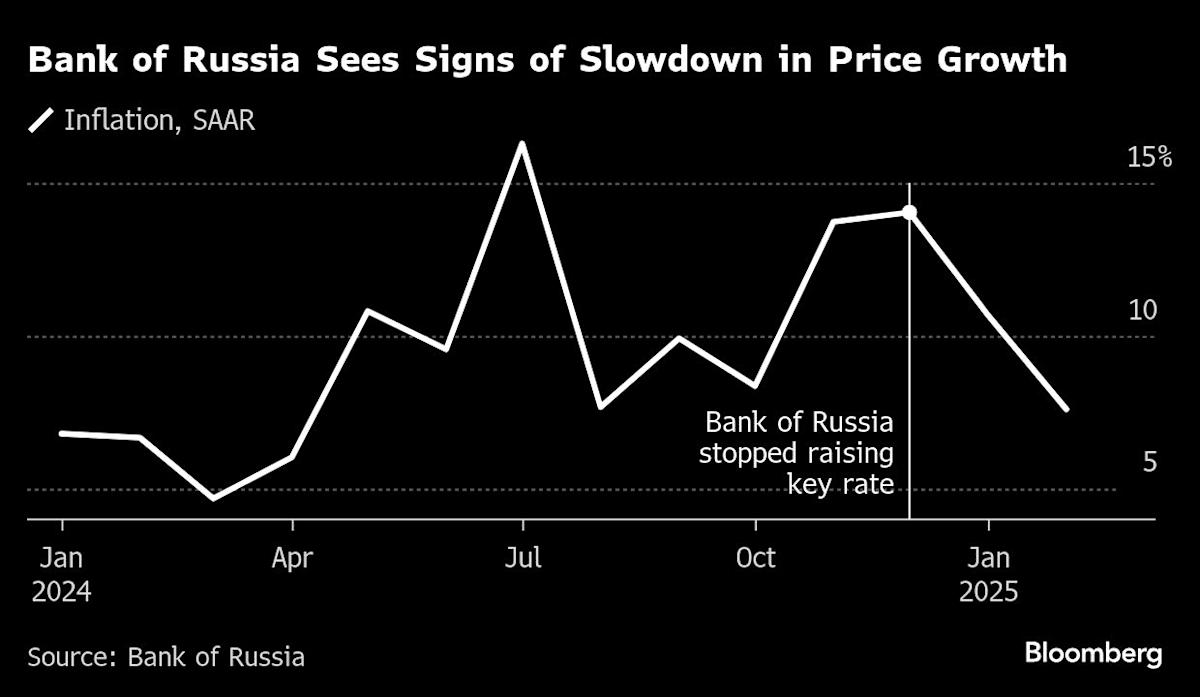
Although annual inflation hovers around 10%, the Bank of Russia had earlier pointed to a significant slowdown in seasonally adjusted price growth at the start of the year compared with December. For non-food products, the measure slowed by half due to ruble gains triggered by optimism over US-Russia negotiations on ending the war against Ukraine.
If geopolitical tensions ease, external conditions may improve, which might have a disinflationary effect, the bank said in its statement. While Nabiullina said this had created a “zone of uncertainty,” she said the likelihood of a rate hike had receded, though it wasn’t out of the question.
Officials said in the statement they would continue to weigh “the speed and sustainability” of a decline in inflation and inflation expectations.
“Current inflationary pressures have decreased but remain high, especially underlying ones,” the central bank said. “Domestic demand growth is still significantly outstripping the capabilities to expand the supply of goods and services.”
Inflation expectations, a key measure for rate setters, declined in February for the first time in five months. In March, the indicator slid further to 12.9% compared to 14% in January, central bank data published on Wednesday showed.