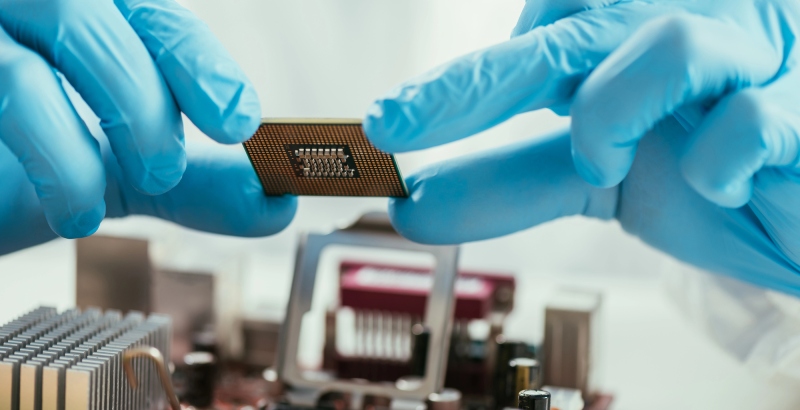

In the stormy seas of the global semiconductor market—a domain now inseparable from national sovereignty—Europe faces a choice. It cannot outspend the world’s manufacturing giants overnight, nor should it try as the continent’s path to enduring influence runs through the minds of its innovators, not the floor of a factory. By betting on design expertise and the agile fabless model, Europe is building the intellectual cornerstone for its sovereign future, ensuring it remains a major player by controlling the most valuable part of the chip: its design.
The European Union has quantified the ambitious price tag of its artificial intelligence ambitions: more than 400,000 advanced AI chips and at least €20 billion in capital. These resources are required to construct several so-called “AI gigafactories”, massive computing facilities dedicated to training the next generation of AI models, across the continent. The initiative, a joint project of the European Commission and the European Investment Bank Group, aims to translate Europe’s strategic industrial plans into tangible infrastructure, says European Commission Executive Vice-President for Technology Henna Virkkunen: “Europe is determined to be a global leader in artificial intelligence. In partnership with the EIB Group, we are channelling strong industrial demand into concrete projects that will underpin our long-term competitiveness.”
A central tension undercuts this ambitious plan. While the project is a statement of European sovereignty, its technical foundation is anything but. The Commission’s Henna Virkkunen acknowledged that the AI chips powering these gigafactories will, for now, be sourced largely from outside the bloc—primarily from the United States—as Europe lacks the domestic capacity to produce them at scale. This reliance underscores a paradox. The continent’s sovereign goals, from leading the global AI race to revitalising its industrial base, all hinge on advanced semiconductors, yet the Union is unable to provide itself with these essential components.
The foundation for change, however, is being built. A nascent domestic manufacturing base already exists, representing a seed of potential. The question now is whether this foundational capacity can scale rapidly enough to turn strategic ambition into genuine, homegrown technological independence.
Is technological self-sufficiency a myth?
Behind its simple name, a microchip is a minuscule and astonishingly complex feat of engineering. It is an electronic circuit, printed on a wafer of semiconductor material like silicon and housed in a protective casing. A very small chip can contain billions of transistors, encoding the essential logic that powers modern devices. While the fundamental steps of chip production are well-established, the actual design and manufacturing grow more intricate by the year. This push for sophistication is driven by the demands of nearly every major industry—from consumer electronics and automotive systems to artificial intelligence and national defence—all of which depend on faster, smarter, and more efficient silicon.
The global shortage of microchips that crippled auto and electronics supply chains during the COVID-19 pandemic turned this industrial component into a geopolitical alarm. What was once a highly specialised global supply chain is now viewed by nations as a critical, sovereign asset. This realisation has fundamentally reshaped the industry. Governments are now accelerating the development of domestic chip capabilities, pouring billions in subsidies into national champions and enacting stricter regulations to secure supply. This competition is not only reshaping existing markets but also fostering new ones, most notably by catalysing the long-awaited emergence of a serious semiconductor industry in Europe.
Having encountered the semiconductor supply shocks of the COVID-19 pandemic, the European Union is also mobilising significant capital and policy to build a more resilient technological future. Key initiatives include the European Innovation Council (EIC), with €850 million specifically targeted to boost Europe’s capabilities in quantum computing and semiconductors since 2021. In addition, the IEC Step & Scale Up Europe scheme will provide even more funding for innovative European companies. These fundings, part of the broader Horizon Europe program, is designed to strengthen the continent’s technological sovereignty, secure its supply chains, and foster innovation in the foundational sectors. Complementing EIC, the landmark EU Chips Act unlocks massive public and private investment and mandates the development of international partnerships with allied nations.
Now, the push for chip sovereignty is starting to yield results. Among them is Innatera, a Dutch startup designing neuromorphic AI accelerators. These specialised chips, built for ultra-low-power applications from smart sensors to data centres, aim to provide an energy-efficient alternative to dominant GPU architectures. The company’s path highlights the strategy behind Europe’s tech build-out. It was seeded by an €850,000 grant from the European Innovation Council, but its growth was equally fuelled by global partnerships. Spinning out of Delft University of Technology, the startup maintained the university’s key alliance with the Taiwanese manufacturing giant TSMC, further using this to obtain leverage. As a result, Innatera’s chips are fabricated on TSMC’s established 28-nanometer process—a mature, cost-effective node that bypasses the fierce competition for cutting-edge production. By leveraging the global partner’s development and manufacturing capacity, the startup has been able to commercialise its European-designed technology, demonstrating its neuromorphic processors in wearable devices and smart home products.
The case of Innatera underscores a defining tension in the global chip industry: complete self-sufficiency is a myth. The sector is fundamentally interdependent, with critical roles spread worldwide: Taiwan fabricates over 60% of all semiconductors and more than 90% of the most advanced ones; China leads in mass-producing mature-node chips for everyday electronics; and the Netherlands supplies the indispensable lithography machines, to name a few.
Even sovereignty-conscious nations like the United States have accepted that maintaining a competitive edge requires participating in this global web. No single country can currently go it alone. However, participation demands a careful equilibrium. A nation’s critical infrastructure—from defence systems to consumer supply chains—becomes vulnerable when it relies too heavily on foreign partners. A dependency like this transfers geopolitical and economic leverage, creating a single point of failure that can be exploited for coercion. The challenge, therefore, is not to achieve isolation but to build a resilient and diversified position within an unavoidably connected world.
In spite of all its efforts, Europe is still looking for a right balance in this intricate web. Achieving full semiconductor self-sufficiency is not currently on the table. The continent lacks the sheer manufacturing capacity to produce all the advanced chips it needs within its own borders. However, the fragmented and diverse nature of the global chip sector provides an alternative. Instead of a futile attempt at achieving quick complete independence, Europe can pursue a different strategy, concentrating its efforts and capital on strengthening its position in advanced design first.
Why does design prevail?
In the high-stakes contest for tech leadership, true sovereignty resides in design, not on the factory floor. A “fabless” company—which creates the chip’s architecture but outsources its physical manufacturing—controls the highest-value and most strategic part of the supply chain. This is the model used by Nvidia, a firm so pivotal that its chips are a focus of geopolitical tension. While its processors are built by TSMC and packaged by partners like Amkor, the United States rightly views Nvidia as a national asset. By concentrating its immense capital and talent purely on innovation, Nvidia and other fabless companies capture the core intellectual property, securing a competitive moat and sidestepping the ruinous costs of building and maintaining its own fabrication plants.
Speaking of own production costs, they are indeed sobering. Constructing a single state-of-the-art semiconductor fabrication plant costs upwards of $20 billion, requires near-constant multibillion-dollar upgrades, and demands immense scale to turn a profit. It is a capital trap that only a handful of global giants can afford. For a region like Europe, trying to build an entire sovereign industry from scratch under these terms is prohibitively expensive. And this is where the financial logic becomes compelling. Fostering chip design startups requires a fraction of the capital needed for a foundry, yet yields a far more flexible strategic return. Furthermore, a foundry is only relevant if it meets the demand from local businesses and start-ups. Without a full order book, such a facility is doomed to failure.
Consider the math: the entire €43 billion European Chips Act—the bloc’s flagship initiative to build a resilient semiconductor ecosystem—represents roughly the cost of constructing just two state-of-the-art fabrication plants. A portion of this fund is dedicated to scaling startups, not factories. The EU Chips Fund has already provided grants and equity to 76 startups from 18 member states.
This strategy is already proving its value. Companies like FMC, a fabless firm from Dresden, Germany, exemplify the model. By partnering with global foundries for manufacturing, FMC designs and delivers specialised chips for AI data centres that drastically cut energy consumption. Their fabless structure doesn’t hinder their mission; it enables them to rapidly create products critical for Europe’s strategic memory independence, directly feeding the continent’s ambitious AI infrastructure plans without the burden of a $20 billion fab.
The rise of another receiver of the grants, French fabless designer SiPearl, represents a major pillar of the European Union’s strategy for high-performance computing (HPC) sovereignty. SiPearl is developing advanced processors, like its HPC processor Rhea1 or Athena1, a processor designed for both government and defence applications, by pouring resources into core research and securing vital homegrown intellectual property, while sidestepping enormous fabrication costs. The payoff is critical: these technologies are destined for Europe’s first exascale supercomputers and will handle the continent’s most sensitive defence and government data. This guarantees that Europe’s most advanced computational work runs on hardware free from foreign backdoors, establishing a foundational layer of independence in the most critical computing domains.
Trajectory of SiPearl, Innatera, FMC and many others illustrates how quickly a strategic vision can gain traction. These young companies are not just producing technical components; they are actively reshaping Europe’s strategic calculus by providing sovereign alternatives in critical computing domains. “In an era of geopolitical uncertainty, with cybersecurity issues and armed conflicts on the rise, Europe’s technological sovereignty is more and more inseparable from sovereign hardware,” said SiPearl’s CEO, Philippe Notton. This sentiment is echoed across the continent’s investment community. “Memory chips are a critical layer of modern computing, and one where Europe must build greater independence,” added Tobias Faupel, Managing Director at the DeepTech & Climate Fonds, which invested in FMC. “FMC shows how deep technological excellence made in Germany can strengthen Europe’s semiconductor sovereignty.”
These nascent fabless champions represent the continent’s most urgent strategic lever and show that perhaps the solution for Europe lies not in a frantic, all-or-nothing race to build fabs, but in a more calculated path that begins with intellectual property. By channelling capital into design expertise and proprietary architectures, Europe can secure immediate sovereignty in critical sectors like AI, automotive, and defence—all while leveraging the world’s most advanced manufacturing through trusted partners. This creates a resilient and high-value knowledge economy in the near term, buying the continent the time and revenue needed to deliberately, and sustainably, cultivate its own manufacturing base for the future. In a world of shortages and rising tensions, controlling the blueprint may ultimately be more powerful than owning the factory.