
Fashion is going all in on AI.
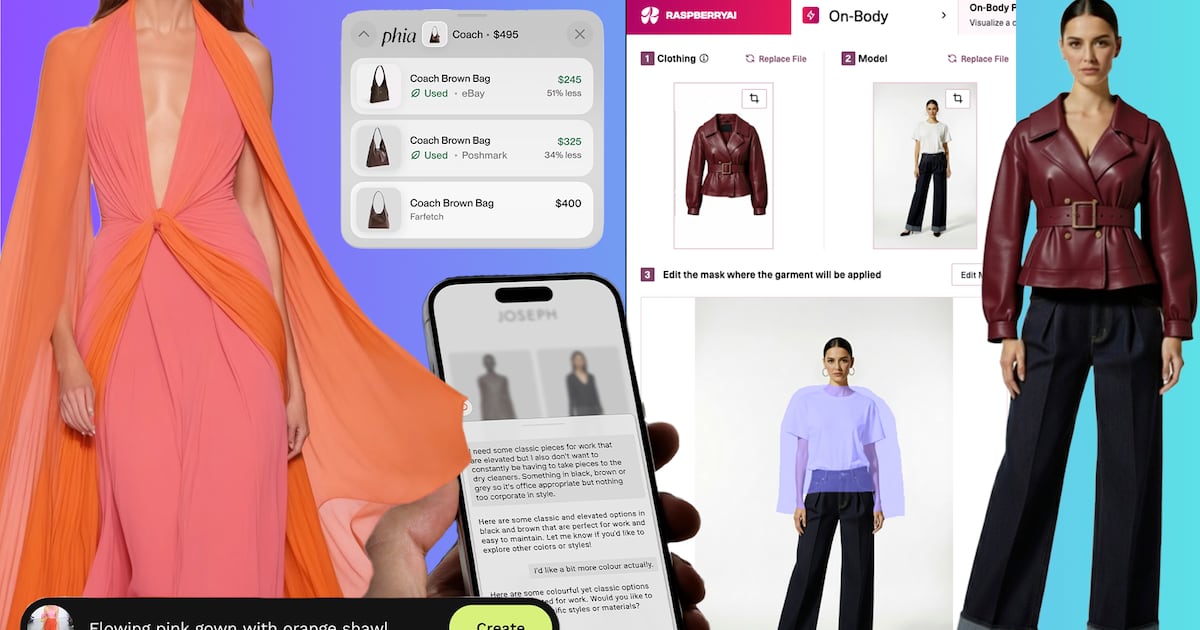
As the technology alters how products are made, marketed and sold, there are a growing number of AI-powered startups looking to bring the industry up to speed. In September, The Business of Fashion compiled a list of 18 that are already working with major brands, or are close to bringing promising technology solutions to market. They specialise in capabilities from generating imagery to improving product listings to personalising product recommendations. There’s Bing, a generative product design and marketing platform for jewellery brands; Spangle, which uses proprietary GPT technology to create personalised product pages; and Daydream, a ChatGPT-like search engine for fashion, to name a few.
The 18 upstarts have benefitted from investors’ insatiable appetite for anything AI-related, collectively raising more than $400 million in the last five years. What’s driving those investments is their potential to help fashion companies “keep costs down” and “respond at lightning speed to changes in trends,” said Nick Kramer, a principal at global consulting firm SSA & Company.
“AI really does promise to change the game and create new winners in the fashion industry,” Kramer said.

Before this emerging class of software companies can deliver on that promise, they’ll have to compete with big tech firms offering similar services. Tech giants like Shopify, Google, Perplexity and Open AI, for example, are steadily introducing a range of AI-powered shopping features on their platforms. In September, Open AI announced a partnership with Shopify to allow users to check out directly on ChatGPT. Since last November, Perplexity’s been offering a similar feature for its paying subscribers.
Still, the upstarts have an advantage of moving faster to evolve their capabilities, whereas the bigger companies may have to slowly adapt their existing technologies, Kramer argues. The newbies are already signing on notable brands: Spangle partners with Revolve and Alexander Wang; Altana, which uses AI to help companies find new suppliers and assess supply chain risks, works with L.L. Bean and Skims; and Sparkbox, an AI-powered pricing and inventory planning platform, counts River Island and New Balance as clients.
The startups “may not have a long track record but they have built a product exactly for today’s need versus a product that is trying to change,” Kramer said. “You get a cleaner product, a better experience and a much more fully formed version of that innovation.”
Also, many of these startups’ founders have technology backgrounds and cut their teeth at prominent firms. Julie Bornstein, who founded Daydream, was chief operating officer at online styling service Stitch Fix; Spangle’s founder, Maju Kuruvilla, was a vice president of software development at Amazon; and Gensmo, an AI-powered shopping app that personalises product recommendations, was founded by former Google software engineer Ning Hu.
But they’ll also have to differentiate themselves to avoid competing directly with each other, along with the giants, for consumer attention. Shopping platforms Vêtir and OneOff both focus on personalising product recommendations. But OneOff derives its recommendations from what users’ favourite celebrities wear, as opposed to Vêtir which recommends items based on what consumers already own. Croissant and Phia help shoppers estimate the resale value of new items, but the latter also tracks price drops on goods across retailers.
They’ll also need to build robust businesses to survive a potential AI bust. The excitement around AI, and how it will change the world, is not dissimilar to the dot com boom that birthed behemoths like Amazon, Google and eBay. But many more companies with unique propositions died painful deaths in the aftermath of the bubble, such as Pets.com.
In the meantime, it’s a race to see who has the most staying power.
“There’s gonna be one or two key winners,” said Amber Atherton, partner at investment firm Patron, which backs early stage tech startups including OneOff. “Every investor is hoping that they’re smart enough to back the right approach.”