
What is “tough tech,” and what is Engine Ventures?
In areas like clean energy, quantum computing, or human health, ideas developed in universities, with government or philanthropic funding, need additional support to move beyond the lab. The data shows that scientific and engineering breakthroughs face a “valley of death” between discovery and commercialization. Most venture funding isn’t geared towards what is often a longer, more complicated journey. The Engine exists to support that tough tech journey.
We launched out of MIT in 2016. One part is a nonprofit, The Engine Accelerator, which provides a set of services that make it easier, cheaper, and more fun to launch a tough tech startup. Our initial 25,000-plus square feet of labs, fabrication shops, and office space have grown to over 250,000 square feet.
The other part is The Engine Ventures, which I lead. We have four venture capital funds and over $1 billion in investments under management. We’ve invested into 65-plus companies, working with each of them to grow into firms with incredible impact and global scale.
We take the point of view that longer timelines are worth the wait if the result is something with resilience because it has real IP, a real moat around it, and a very large business to go after.
Would you share an example?
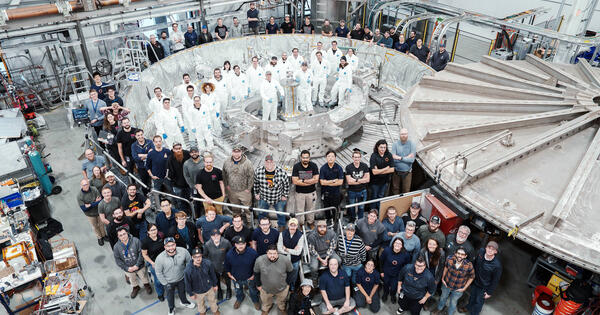
In 2018 we invested in Commonwealth Fusion Systems, which aims to be producing clean fusion energy in the early 2030s.
For 50 years governments around the world supported scientific research in plasma physics. There were such significant advancements that an international agreement was signed to build the world’s largest fusion reactor in France. The project, ITER, is exciting, but it’s so expensive that government funding for other fusion projects is extremely limited.
A group of graduate students and professors in the Plasma Science and Fusion Center at MIT saw a simpler path to net positive energy than the international project was taking. Rather than trying to tap any remaining grant funding in a research setting, they chose to develop the idea commercially.
Fusion power is produced in a tokamak—a machine that uses extremely powerful magnets to confine plasma in order to produce controlled thermonuclear fusion. The world has built over 200 tokamaks; none has managed to get more energy output than input. The group at MIT believed that using a new material for the magnets would allow a much smaller tokamak, which would be less expensive and faster to build.
They created a highly logical business plan. All the scientific and materials breakthroughs had already happened; what remained was fundamentally a long, challenging engineering project.
They started pitching for dollars in 2017. We backed them and spun them out of MIT. The key milestones in their business plan were to build a demonstration magnet. If that worked, they’d build SPARC, a pilot of their tokamak to prove out net positive energy. If that worked, they’d build ARC, the first commercial plant.
They’ve proved the magnet. They’re building SPARC; it will be tested in 2027. And they’ve sited ARC in Virginia with the target of having it producing energy in the early 2030s.
All those milestones have been in place for a very long time. This isn’t a company you pivot. This is a company where you set a plan, and you work the plan. And that’s what they’ve done, very, very effectively.
At this point Commonwealth has raised nearly $3 billion from a range of investors, including the Italian energy company Eni, Google, Gates Frontier, Nvidia, and Khosla Ventures. My belief is that they will be the first commercial fusion company in the world. A lot of other people believe that at this point too.
I sit on the board; it is an absolute privilege. The team has done everything they need to do on regulatory pathway, assembled the best people in the world, and demonstrated that they can build these things. They are on the way to becoming a global energy company.
What happens if fusion power starts putting electrons into the grid?
I mean, it’s fundamental. Energy is at the base of what you need to run a town, a city, a state, a world. When you consider so many of the difficult problems we face, then factor in abundant, affordable, clean energy, it changes the calculation. Think about the connection between energy and desalination of water, energy and AI, energy and clean air, energy and education—it opens up so many possibilities.
What does it feel like to be part of an undertaking with such extraordinary ambition?
I consider myself one of the luckiest people alive. I get to work with people who are fundamentally hopeful that the world could be a better place and have the knowledge to make it happen.
It’s inspiring, but it’s not a Pollyanna view. Commonwealth Fusion’s project, and every project I work on, requires not just vast amounts of knowledge but also the ability to combine expertise from many different areas in order to create and execute a viable plan to do something new. Working in that convergence, making sure they get the capital they need to move past real barriers to deliver difficult but extraordinarily positive things, is gratifying.
A true innovation changes what’s possible. And companies that succeed in doing that generally have an even bigger impact than anyone initially imagined.
I’d add that it’s also not unique. Our universities are teeming with people doing this sort of work. Engine Ventures is doing everything we can to support Commonwealth Fusion, but there are many paths to abundant clean energy. We’ve also funded work on deep geothermal, small modular nuclear, and energy storage. We want to come at the challenge of clean energy from many different directions. Different solutions will be appropriate for different contexts. But all of them point to abundance of clean energy being fundamental to unlocking other parts of society.
Would you expand on the role of venture capital both as a source of innovation and as a driver of social good?
One of the things that has made the U.S. innovation ecosystem quite different—and why so many countries around the world have tried to emulate it—is that private individuals and private organizations have put capital at risk at very early stages of companies, allowing many more ideas to be developed over time.
Within that asset class, you can’t say every individual fund has the same value to society. It doesn’t. Not everybody is a white-hat venture capitalist. But we want a system where people are taking a lot of risk for an upside that could be very big, because that enables progress and in the long-term has a very profound effect on society.
Yale SOM taught me to look at the world through multiple lenses. I use those lenses in everything I do. The capitalistic—how do you grow a business? That’s the first lens I use. But the second lens is, how would that shape society? They are both so important because when you join them together, you have more allies in getting important things done.
I focus my time on helping companies scale because impact scales when companies scale. And I focus on raising more venture funds because they are a fundamental driver of the next economy we want, the world we want to live in, and of great outcomes for businesses.
How does tough tech investing differ?
I think there are two fundamental types of venture capital. One is money that helps you go fast because fast is how you win. You go as quickly as you can to get users, subscribers, or network effects. OpenAI, Uber, Airbnb—there are hundreds of examples of this. Capital was poured into creating a product that was absolutely replicable by others, but speed gave it a fundamental advantage.
Then there’s venture capital that goes into breakthroughs in science and engineering. What you’re betting on there is that there are very few teams in the world that have the fundamental insight and can compile the sorts of talent that you need to win.
They’re both in venture, but they’re effectively different asset classes. The way you gain advantage, and return great capital to your LPs, is just different.
From the beginning, Engine Ventures believed in an approach that enables incredible people with an incredible idea to bring it forward to real breakthrough. There’s a difference between a new product and innovation. A true innovation changes what’s possible. And companies that succeed in doing that generally have an even bigger impact than anyone initially imagined.
Engine Ventures focuses on three areas: climate, human health, and advanced systems. Would you share a case study of what you’re looking for in human health?
We’ve invested in a company called Bexorg, which spun out of Yale in 2021. It’s revolutionizing brain science.
Over 95% of clinical trials for drugs treating diseases of the central nervous system fail. That’s largely because our understanding of the brain, our models of how it works, don’t capture the actual complexity of our biology.
Bexorg is building the most comprehensive model of the brain we’ve ever had. That’s possible because they’ve developed a method to image metabolically active brains, study blood-brain barrier penetration, and track responses to therapeutic treatments. Their method uses artificial blood, a device similar to a heart-lung machine, and specialized software to restore brain cell function—but not the organized electrical activity associated with consciousness—to donated human brains for days after death. It’s producing huge amounts of data that can aid AI-driven drug discovery and development.
Bexorg’s initial focus is on Parkinson’s disease, but the company’s platform and a research partnership with Biohaven can be applied to a range of brain and central nervous system diseases.
Again, this is about convergence, bringing together a team with extraordinary expertise and an innovation with partnerships, resources, and the capital—Bexorg has raised $42.5 million to date—to push forward our fundamental understanding of the human brain, which in turn will allow a better, faster path to breakthrough treatments.
You mentioned the challenge of AI and energy. The explosion of data centers supporting AI have contributed to spiking electricity prices. Efforts to increase the energy supply and modernize the grid have struggled. How does Engine Ventures approach a complex issue like this and find solutions that are also investment opportunities?
We haven’t seen energy demand surge like this in a long time, but it’s happening and it’s relentless. We are way behind on interconnection and transmission. It’s a really big deal, and it’s going to be an even bigger deal.
People need energy. Corporations need energy. Nobody likes their electric bill going up. Energy costs drive the economics in many, many areas. We need to add new power. We need to open up new nodes of the grid. But we don’t have national planning of the grid. Right now, it’s run as 10,000 silos. That means that decision-making is quite slow, and the steps to affordable, reliable power look very different in different states. For the states that make smart choices and move quickly, there are great opportunities.
This is a complex issue, so we try to work on all sides of it. We’re investing in new forms of energy so that there are abundant choices for power generation. We’re investing in energy storage so that our current grid has more capacity at peak demand. We’re working on the software that enables systems that are smarter, more efficient, and more resilient. And we’re investing in transmission.
What’s the transmission investment?
For places that are already congested—think about the Northeast Corridor—there are a lot of regulatory hurdles to building more transmission lines. So ideally, we’d have a lot more power running through the existing footprint of lines. A technological breakthrough that enables that would be a great business opportunity.
VEIR uses superconducting wires to enable transmission of 5 to 10 times more power than conventional lines. They were founded in 2019 and have raised $115 million to date.
They brought together advancements coming out of MIT, Los Alamos National Laboratory, and ARPA-E. They’re starting with transmission to data centers, where their system allows increased power delivery in less space. They will begin deploying to data centers over the next 18 months, then they will be working on long-form transmission over the next five years.
Being able to transmit more within the space that we have is one important path to meeting our surging energy demand.
How do you think about risk?
We’re only going to invest when we see the confluence of an extraordinary team, an incredible innovation, and a business opportunity that could deliver significant returns. We’re thinking about the people and their motivations, the scale of capital required, the timing, and what’s required to capitalize on the opportunity at that moment. It’s complex. And the reality is that sometimes it’s not going to work out.
When a failure could have been prevented, that doesn’t feel good. Often, it’s tied to a combination of speed in decision-making and a lack of collaboration. We reflect on ourselves—how we could shape our team differently or do things differently in the future.
Being forthright and learning how to do it better is a very important part of innovation. But again, these are complex undertakings, and drawing the right lessons isn’t fourth-grade math. And even if we do, there will still be times that it doesn’t work out.
If the data doesn’t come back the way we thought they would, or if the next step requires getting around some fundamental scientific law, it’s just never going to work. We don’t have a company. Maybe there was enough progress that it can get acquired and hopefully push the acquiring company further along on its innovation track. Maybe the effort creates a talent pool that comes back to start another company.
But fundamentally, when people pursue a critical insight—paired with a clear understanding of how it could become a big company in a better world—there is no failure in that. It’s a beautiful thing to do.
What are the issues you work on with every company?
Tough tech companies typically have a series of quite well-defined science and engineering milestones. Essentially, if you hit those milestones, you will unlock value. We always work with them to set and track progress on those milestones.
We also work with companies to understand how funding and business opportunity are connected. We want them to be clear about not just the first round of capital they need to raise, but the full picture— how many rounds, over how much time. The more time and the more capital you need to reach scale, the bigger the market has to be to deliver venture-style returns. So how big is the opportunity? Getting that right is fundamental—it takes time, it takes brains, it takes iteration.
And however great the idea, it’s always about the people, too. Are you developing a team that can tackle all the different areas needed to get the venture right? It’s scientific, it’s regulatory, it’s often expertise in manufacturing. Are you hiring not just the PhDs, but the people that understand how to scale a business? Are you building a board that can really help?
Finally, we want those teams to benefit from the interconnectivity that is part of innovation. We work to foster community and connections among scientists, engineers, and entrepreneurs. Bringing together people who understand the ideas and the work can inspire them to think bigger or to think differently or just to engage in a way that creates these beautiful loops of friendship and innovation.
Looking globally and knowing who might be a resource for our entrepreneurs is something we continually work at. Understanding the interconnectivity among universities, government research labs, and corporations, knowing where breakthrough may be emerging, living in that complexity, is core to our work and it’s again something that’s very SOM to me.