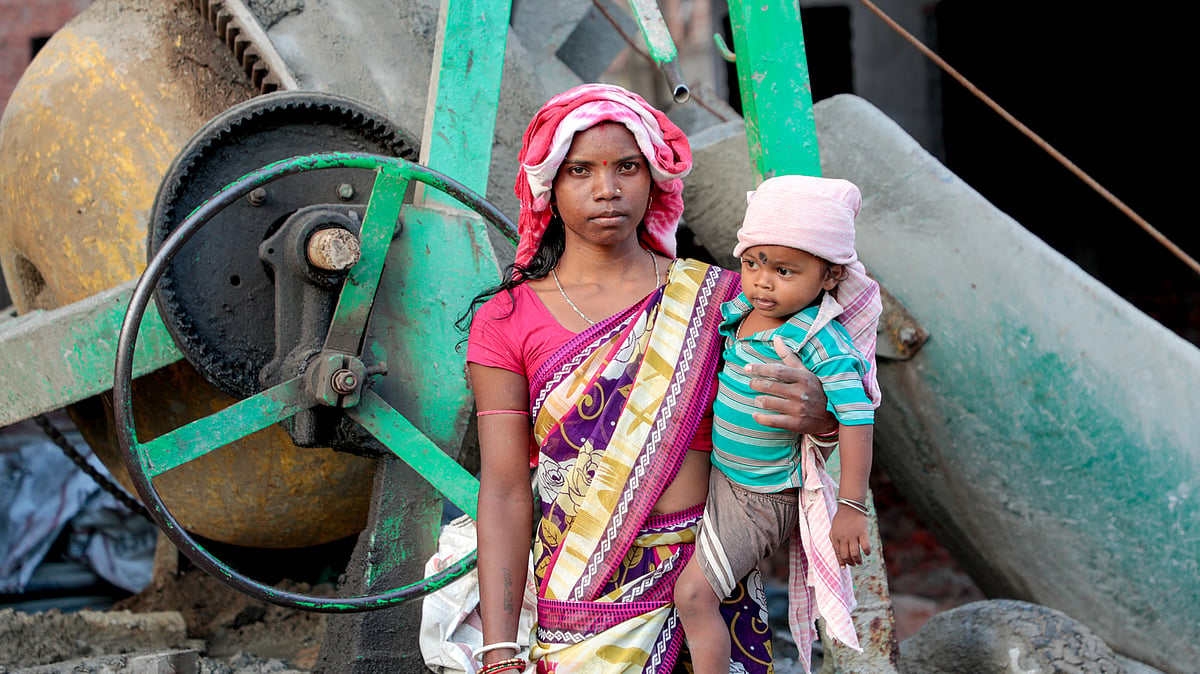

Even for the working women, most of them are not engaged in dignified or stable labour, especially in rural India, according to a report by Nency Agrawal, Samhitha Narayan and Soham Bhattacharya. The latest Periodic Labour Force Survey (PLFS) conducted by the Union Ministry of Statistics and Programme Implementation showed that more women were employed in 2023-24 compared to 2016-17. Workforce participation rate for women doubled 40.3 per cent in 2023-24 from 22 per cent in 2017-18, the report showed.
But this growth was driven by self-employment, an analysis of the PLFS data showed. The increase in self-employment for rural women, in turn, happened through the increase in the ‘unpaid helpers’ in family enterprises, the researchers highlighted. “These proportions rose from 9.6 per cent in 2017-18 to 17.7 per cent in 2022-23,” they wrote in an article for the Foundation for Agrarian Studies.
In 2022-23, 81 per cent of women were self-employed in agriculture and two-thirds of them were unpaid, the social scientists mentioned in an analytical piece in the Economic and Political Weekly (EPW).
Further, the female WPR growth in the period was the highest during the COVID-19 years of 2019-20, 2020-21 and the first part of 2021-22, when economic activities in general had come to a halt due to the pandemic lockdowns, the researchers wrote in an analytical piece in the EPW. This growth, they explained, was not an indicator of increased livelihood opportunities but of economic distress that traps women in low-paying, menial work.
They illustrated this crisis by comparing the share of ‘working poor’ among men and women during 2017-22 across the country, as reported by PLFS. Working poor is that section of the population who suffer from earning deprivation despite being in the workforce, making less than $1.9 (roughly Rs 165) a day, which is the international standard of income required to avoid poverty. In the six years, the share of women working poor ranged from 56.7-64.3 per cent. The share is startlingly high compared to the 14.8-18.2 per cent of men working poor during the period.
On an average, the women working poor earned Rs 2,051-Rs 2,565 a month, compared to the Rs 9,030-12,916 of their male counterparts. “The economic translation of this kind of employment for women is basically then: all work, no pay,” the researchers concluded.
Mental toll of unpaid labour
The unfair distribution of work and the double burden of paid and unpaid labour has a large impact on their mental health and global studies have identified the direct associations.
Chronic stress from unpaid work activates higher cortisol levels and prolonged high cortisol levels are linked to adverse mental health outcomes like depression, research has shown. The lack of leisure time, self-care and social interaction exacerbates this distress, potentially leading to depression and anxiety.
A study conducted in the United States found that inequitable housework division contributed significantly to higher depression rates in women. Similarly, a Swedish study (2008–2014) showed that women with higher unpaid work hours had a stronger association with high depression symptom trajectories than men. Longer total work hours were linked to a persistent “high stable” depression trajectory only in women.
Unpaid work also harms cognitive health, scientists have found. Data from a Korean study (2006-2018) revealed that full-time homemakers faced five times the risk of cognitive impairment compared to working women. Providing long-term or high-intensity care for sick relatives increases psychiatric morbidity, including depression and anxiety.
Young unpaid caregivers in the United Kingdom — mostly women — reported worse mental health, lower earnings and higher welfare dependency than their peers.
While employment is often used as a key measure of economic contribution, this fails to capture the extensive unpaid domestic and care work that sustains families and communities. So as women remain entrenched in the ‘social-reproductive squeeze’, as researchers call it, they enable the workforce to grow while being deprived of time for dignified income themselves.
The burden of unpaid work also impacts other indicators of women’s wellbeing and empowerment, such as literacy, teenage pregnancy and maternal mortality, among others. Research on these indicators often conclude with data on how women can contribute to the national gross domestic product if they have the same opportunities as men. This need to justify women empowerment through its contribution to ‘greater good’ is symptomatic of a society that invisibilises women’s labour.