
Chinese venture capital firm Lanchi Ventures is doubling down on investing in China’s artificial intelligence and robotics start-ups while raising a new fund amid increased global investor appetite for the country’s early-stage tech firms, its executives said.
Lanchi Ventures, formerly known as BlueRun Ventures China, would continue to be “all in” on AI and robotics, focusing on AI applications, multimodal AI models and firms targeting overseas markets, managing partner Jui Tan said in an interview with the South China Morning Post last week.
The firm manages over 15 billion yuan (US$2.1 billion), including a 5.5 billion yuan fund largely focused on AI. It has so far placed bets on Moonshot AI, the firm behind the Kimi large language models, AI agent maker Genspark, and robotics firms Galbot and AgiBot.
Do you have questions about the biggest topics and trends from around the world? Get the answers with SCMP Knowledge, our new platform of curated content with explainers, FAQs, analyses and infographics brought to you by our award-winning team.
Lanchi said it remained committed to investing in Chinese embodied AI start-ups because of the continuously improving abilities of robots and the abundance of applications in fields such as manufacturing.
“China has many scenarios that allow [robots] to acquire data, so I believe there isn’t a significant gap compared to the United States,” Tan said. “In fact, we might even perform better, possibly due to this substantial advantage in data.”

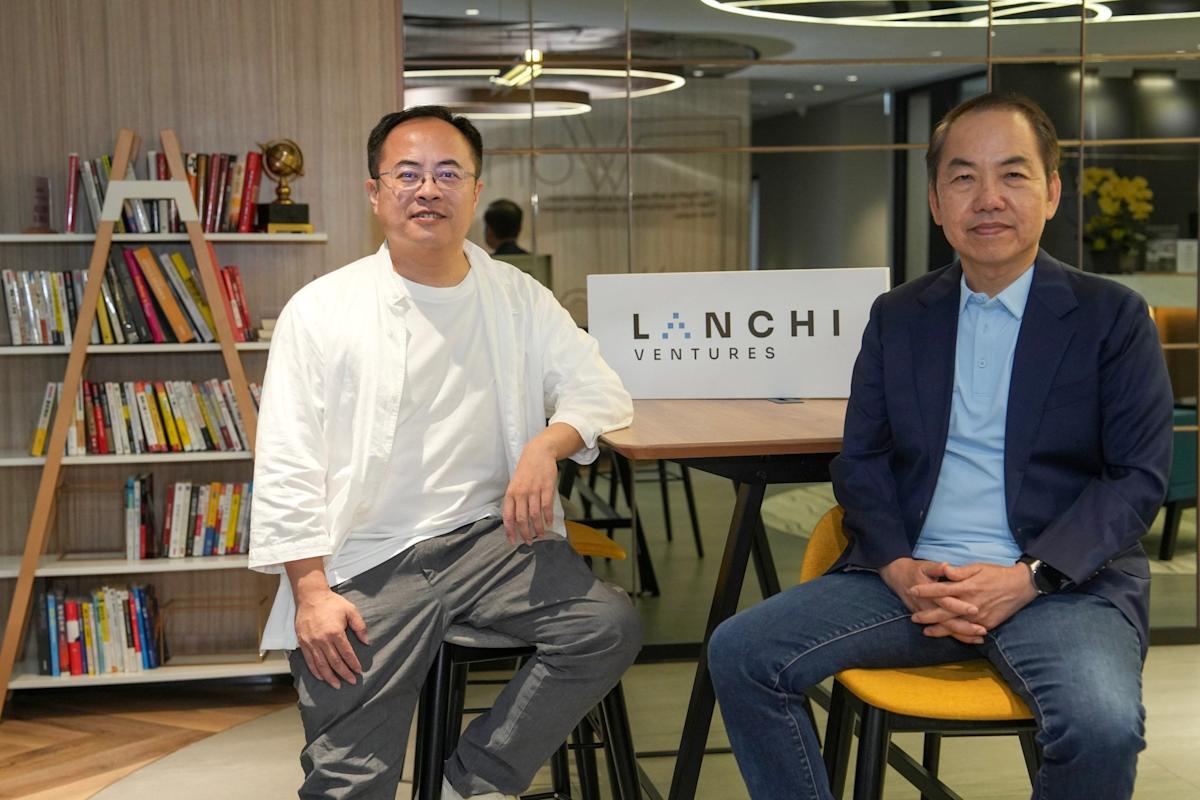
Terry Zhu (left) and Jui Tan, co-founders of Bluerun Ventures (now Lanchi Ventures), are pictured on July 18, 2024, at Citic Tower, Admiralty, Hong Kong. Photo: Sun Yeung alt=Terry Zhu (left) and Jui Tan, co-founders of Bluerun Ventures (now Lanchi Ventures), are pictured on July 18, 2024, at Citic Tower, Admiralty, Hong Kong. Photo: Sun Yeung>
AI is still in its early days, with many new applications and capabilities yet to emerge in the future, according to Tan.
While China was still catching up in advanced semiconductors, which once presented hurdles for Chinese AI investment amid US chip curbs, local AI firms have since adapted and found various solutions for computing power, Tan said.
“They can’t entirely bet on Nvidia or completely bet on Chinese solutions,” Tan said. “They all pursue multiple paths.”
While Lanchi’s current 5.5 billlion yuan fund still has “a lot of dry powder”, it is now in the process of raising a new fund to keep investing in China’s AI start-ups, with an eye out for “new capabilities and new boundaries” that could “significantly enhance productivity”, Tan said.