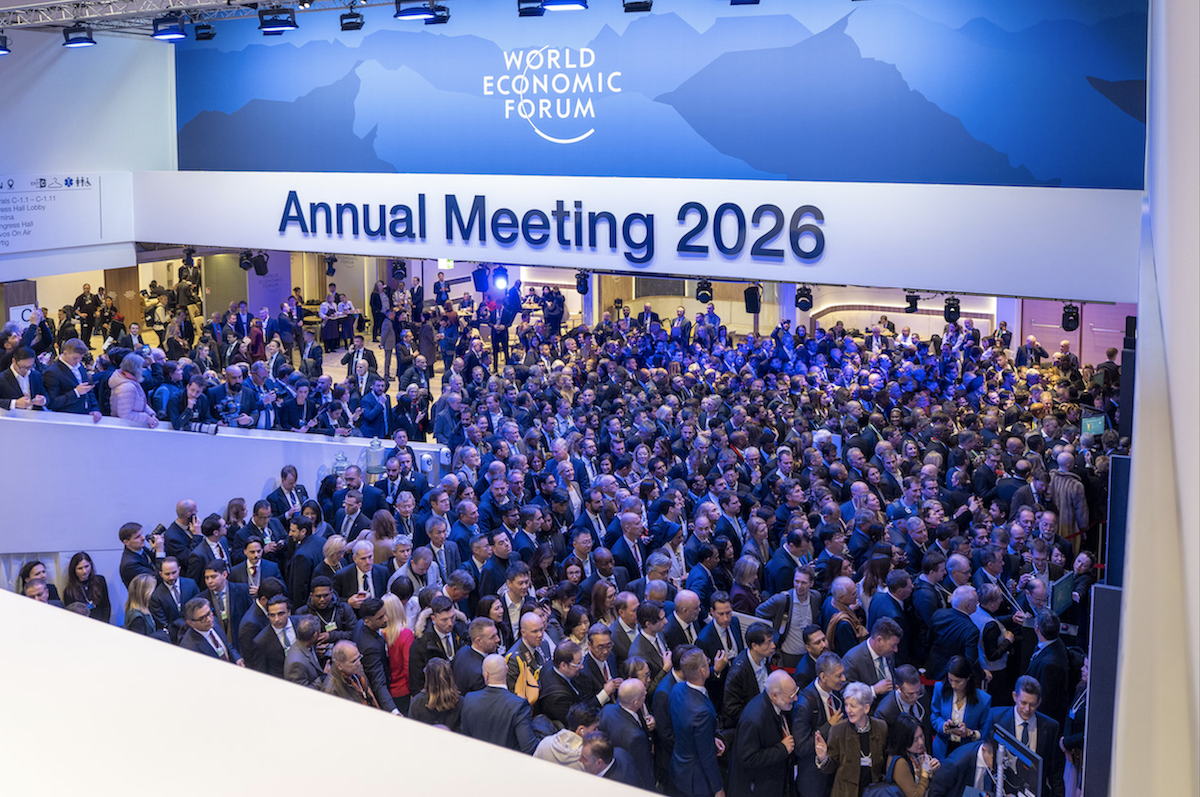
At Davos, entrepreneurs and investors from across Europe network and critique without regard to national borders. Back home at work at their startups, they’re hamstrung by the welter of financial and legal requirements in Europe’s 27 member states.
European Commission President Ursula von der Leyen took the European startup scene by surprise with the launch at the World Economic Forum of “EU Inc.” The aim is a single and simple set of rules to allow entrepreneurs from Rome to Vilnius to enjoy the same capital regime across the entire bloc – and register a company online in any member state within 48 hours.
“Ultimately, we need a system where companies can do business and raise financing seamlessly across Europe – just as easily as in uniform markets like the US or China,” von der Leyen said.
Europe has “all the assets it needs to attract investment – the savings, the skills and the innovation,” she said, but not a unified regulatory environment. “Too many companies” move abroad to grow and scale up, she added.
“So while on paper the market of 450 million Europeans is open to them, it is far more complicated in reality,” von der Leyen said. “And that acts as a handbrake on the growth and profit potential of companies.”
Officials in Brussels agreed to introduce “EU Inc.,” part of what is known in Europe as the “28th regime,” after a two-year campaign by EU-INC aimed at adopting a single regulatory regime. It had gathered 22,000 signatories, including from impact investors World Fund and Pale Blue Dot.
Overcoming fragmentation
Von der Leyen’s speech was widely welcomed by European impact leaders.
“Sometimes the most important news at Davos isn’t the headline-grabbing stuff,” wrote Lennard Kooy, founder and CEO at Lleverage, a Dutch startup that’s building an AI operating system for medium-sized companies.
“Anyone who’s built a company in Europe knows the fragmentation problem intimately. You launch in the Netherlands. Great. Now you need a new legal entity in Germany. New lawyers. New accountant. New everything. Repeat for every market. The US launches in 50 states on day one,” said Kooy.
“This shows that Europe’s politicians are being bold and serious about creating the conditions for innovation and scale-up to happen at home, rather than elsewhere,” Impact Europe’s Jana Bour, told ImpactAlpha. “The next step is to ensure the impact community is fully part of this journey, because what Europe ultimately needs to scale are the innovations that solve tomorrow’s social and environmental challenges.”
“The 28th legal regime has long been part of the plan, but with an enormous mobilisation from Europe’s startup community, a clear backing from the highest level of EU political ambition — and now a strong signal from the European Parliament, which agreed yesterday by a broad, pro-European majority on an important report — it genuinely has a chance to succeed,” she said.
“Hear, hear: the EU being pragmatic about entrepreneurship, not just bureaucratic about it. Shocking? Maybe. Necessary? Most definitely,” wrote Leonardo Fuligni, deputy director at the Rotterdam, Netherlands-based Erasmus Centre for Entrepreneurship.
A more stable and unified European legal framework may attract more non-European startups to the bloc, said Giorgio Mariano, head of investor relations at France-based nuclear fusion startup Renaissance Fusion.
“For deep tech in particular, like fusion, where companies need to raise large, long-term rounds, this is very good news,” said Mariano. “These sectors need patient, global capital and the ability to grow across borders without friction.” For the first time, Europe “has clearly chosen builders over bureaucracy,” wrote Asim Amin, founder and CEO of Plumm, a UK-based human resources platform with mental health at its core. “Execution will be everything. Speed will matter. Consistency will matter. But the signal is loud and clear: Europe is finally building for founders.”