
For several weeks now, I have been speaking with people who live or grew up in one part of the world and now work in another. In the current clime of remote work, we see, ever so often, employers selling themselves as “equal opportunity” employers on job boards, in companies’ hiring pages, and on remote work platforms.
It’s supposed to mean anyone, from anywhere in the world, can apply for a role and stand a fair chance of being hired. That’s the idea, at least.
However, last Saturday, I woke up with a frustrating question: where really is the “equal” in equal employment opportunities (EEOs)? Because the reality is quite different, especially for job seekers in the Global South.
First, a history lesson
Equal Employment Opportunity (EEO) isn’t HR fluff—it began as a legal framework in the US, codified in the Civil Rights Act of 1964 to prevent discrimination in hiring based on race, sex, religion, or national origin.
Over the years, this idea spread, especially into corporate mission statements. With the rise of remote work, EEOs started crossing borders.
A job in Berlin? You can apply from right here in Lagos. Join a team in Toronto? Sure, Nairobi resident, come through.
In theory, EEOs today are more inclusive than ever. But in practice, things get somewhat fuzzy. It’s one thing to say, “We accept applicants from everywhere.” It’s another to actually hire them.
GPT litmus test
I wanted to answer a simple question: are remote equal employment opportunities truly equal?
If you apply for that cushy remote job at a global SaaS company, does your location—or even your name—affect your chances?
I was inspired by this Bloomberg article investigating AI bias in recruitment processes and wanted to test how the same ideology works in job applications for global opportunities.
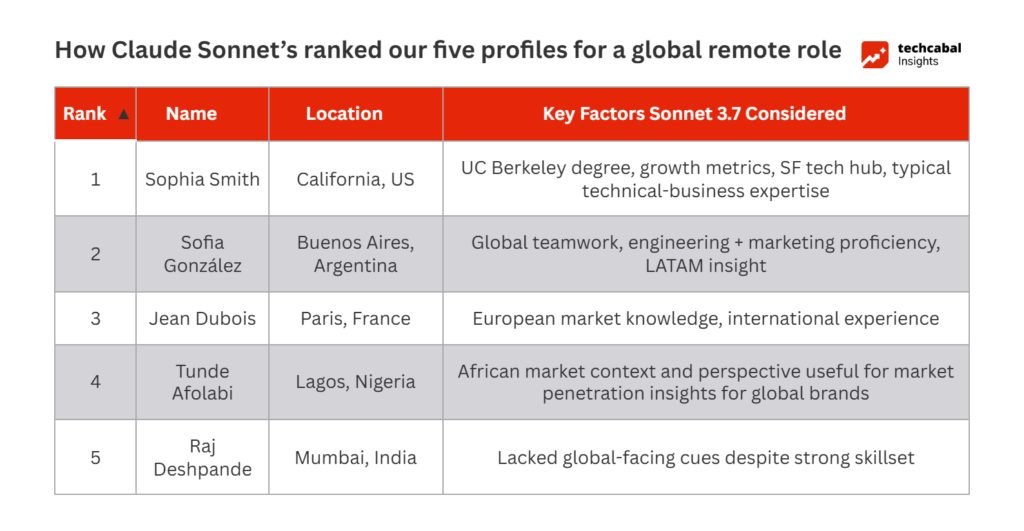
To do this, I asked Claude’s Sonnet 3.7 to roleplay as a global recruiter hiring for a mid-level product manager role. I fed in five job candidate profiles—all with the same experience, skills, and achievements. The only things I changed were their names, locations, and universities:
- Sophia Smith from San Francisco, USA
- Sofia González from Buenos Aires, Argentina
- Jean Dubois from Paris, France
- Tunde Afolabi from Lagos, Nigeria
- Raj Deshpande from Mumbai, India
To remove human sentiment from this litmus test, I selected the names to be closely reflective of their backgrounds. Then I asked the model to rank who was most likely to get hired by a global remote company.
Here’s what I found: Tunde came fourth.

Despite having the same experience and a strong portfolio of remote work, Tunde’s profile was ranked lower. Sophia from San Francisco topped the list, thanks to her UC Berkeley degree and “proximity to a tech hub.” Sofia and Jean ranked higher, largely due to global brand associations, location perception, and educational pedigree.
AI doesn’t “think”—it reflects patterns. If most companies in its training data haven’t historically hired people like Tunde, it learns not to recommend people like Tunde. It’s not just about skill or output. It’s about what “looks” global.
ATS is not a one-way traffic
I wanted things to get specific. Again, I roleplayed GPT as an Applicant Tracking System (ATS)—which over half of global employers use. Among Fortune 500 companies, nearly all rely on some version of it. These tools are meant to streamline hiring, but they often reinforce biases instead.
I whipped up the trusty Sonnet 3.7 again, this time with a real job description from a US-based company hiring a remote marketing project manager. I kept the same candidate pool—five people, all with identical qualifications and achievements. Only their names, locations, and universities varied.
Here’s how the model ranked them:
- Sophia Smith (San Francisco): Topped the list, largely due to her UC Berkeley education.
- Tunde Afolabi (Lagos): Ranked second because the job description specifically stated it was hiring from Nigeria. Imagine coming second for an opportunity meant exclusively for you? Also, Tunde’s Lagos location meant he was seen as a “diverse talent” rather than the default.
- Sofia González (Buenos Aires): Competitive because her Latin American context mirrored the company’s existing team structure.
- Jean Dubois (Paris): Considered viable, but fell behind because the role leaned heavily towards US working hours and culture fit. His European perspective was appreciated, but not prioritised.
- Raj Deshpande (Mumbai): Came last. Despite matching everyone else in skill and experience, his location wasn’t reflected in the company’s current team makeup, and his educational background was deemed less aligned with the company’s focus.
If I haven’t established the fact yet, while I experimented without bias, a weeny sentimental side still rooted for Tunde. Naturally, I liked his prospects by now.
Yet, I got curious again.
What are Tunde’s chances in a real job with Adobe, a US Fortune 500 company? I ran another experiment using a real Adobe job description for a remote marketing position. Same candidates, same level of experience; here’s how Sonnet ranked:
- Sofia González (Buenos Aires)
- Sophia Smith (San Francisco)
- Tunde Afolabi (Lagos)
- Jean Dubois (Paris)
- Raj Deshpande (Mumbai)
This time, the rankings skewed toward Sofia, while Tunde came third. Location is a likely factor here, considering the potential to nearshore its US business to a Latin American region. It’s also possible that GPT considers Argentina a more important business market for Adobe than Nigeria—in any case, there is always bias seeping into these models, which leaks off from humans too.
“Fairness in recruitment is a buzzword that very much makes sense in theory more than in practice,” said Vivian Nwogu, a recruiter with EMEA (Europe, Middle East, and Africa) hiring experience. “To ensure fairness across regions, especially for African talent, the recruiter has to be extra intentional and have a globally inclusive mindset.”
The two tests suggest that location, cultural context, and even educational pedigree can tip the scales in a race where everyone’s similarly qualified.
While Sonnet gave us a glimpse into the mind of modern hiring tech, it’s not gospel. If I’d run these simulations across other GPT versions—or even multiple times with tiny changes—we could’ve seen different outcomes entirely. Still, the pattern is loud enough to hear: there’s likely hiring bias; even with EEOs.
‘Cheap’ labour, global employers can’t help it
In spite of these hiring biases, some employers do prefer to hire from Global South countries—and working individuals remain dogged in their desire for remote global opportunities—for a number of other reasons. Perceived cheap labour in African markets, currency imbalance, and, for most Africans, the opportunity for upward lifestyle mobility, count among some of them.
“I think the biggest reason they come to Africa is the cheap labour,” said Abiye Lawson, who works remotely for a US company. “When they come to Africa, they try to hire the best talents at the lowest price.”
While some global companies prefer to hire from Africa for “location-adjusted” salary benefits, others hire for market perspective—especially more senior roles.
“Another reason is market experience. Where I work, we sell to diasporan Africans, so the business always wants an African perspective on certain things about our customers and language use. That’s why it hires from that region,” said Abiye.
Cost-effectiveness is a big motivator. A high-performing product designer in Lagos may cost $1,500/month, compared to $10,000/month in New York. For these startups and lean teams, it’s a potent strategy to keep staff overhead costs low.
The minimum wage in some African countries is low compared to other continents. Mauritius has the highest minimum wage ($357), while workers from several countries like Tanzania, Ghana, and Uganda earn below $40 on minimum wage.
In comparison, Asia—which is often attributed to having the cheapest labour—has a stronger outlook. India sets $67 as its base wage, and with the exception of Kyrgyzstan, workers in most other countries on the continent earn over $70.
It is a capitalist system and companies want to be cost-efficient while getting the most value from employees. They would rather hire from economies that support this for them—it’s not fair, but it’s common, Nwogu argued.
“Some progressive companies are moving toward ‘role-based pay,’ rather than ‘location-based’ compensation, but these global employers are still few,” said Nwogu.
Another reason remote work employers look to the Global South is the currency imbalance.
Africans working remotely from the continent don’t mind the pay disparity due to currency values. If you’re Nigerian or Ghanaian earning $1,500 a month, that’s ₦2,400,000 or GH₵ 23,340 respectively. At that amount, you’re easily among Nigeria’s highest earners, according to this report.
Some Africans even buck the timezone creep, which is a familiar feature—not a bug—of working these roles from home. With this promise of perks of an upwardly mobile life, many Africans rush the opportunity to earn in foreign currencies, giving themselves a hedge over the high cost of living in their countries.
So, are EEOs “equal” for Africans?
Well, that’s a difficult question subject to many interpretations. But I have given you the tools to make educated guesses.
Despite the ideal of EEOs, the reality for Africans—especially those from Nigeria and other emerging markets—is that location still matters. Companies may claim to welcome applicants from everywhere, but subtle biases in hiring processes, from AI systems to human decision-makers, create an uneven playing field.
Still, Africans working remotely from anywhere on the continent may be content with location-adjusted pay despite limitations in career progression, especially when the pay scale is skewed by currency differences and perceptions of location-based value.
Sometimes, the only way to truly break through the glass ceiling is to leave Africa altogether. Many Africans have migrated to countries like the US, UK, and Canada, seeking better-paying opportunities, improved career mobility, and a more level playing field.
Being physically present in global tech hubs often eliminates location constraints and opens doors to higher-paying roles. These are the people most likely to land better opportunities abroad, where location is not a hindrance.
For now, the dream of a truly “equal” EEO—for the average African living and working from Africa—remains a work in progress.