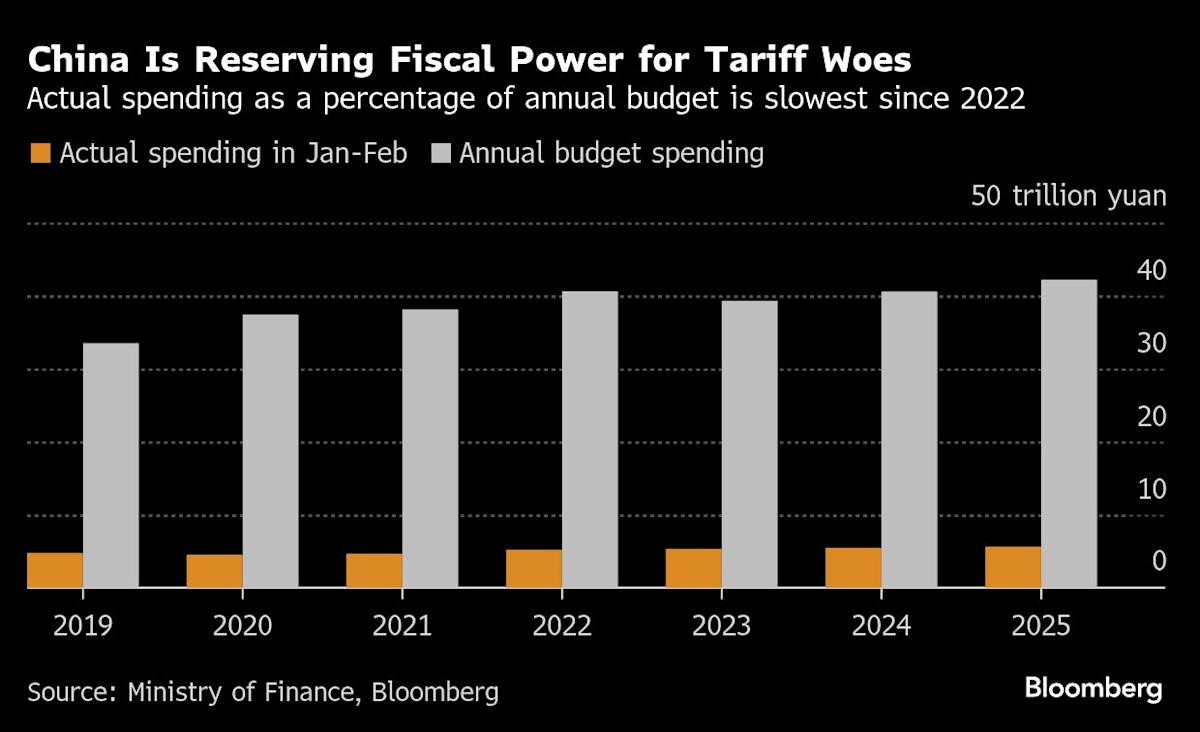

(Bloomberg) — China’s government appears in no rush to implement its budget, as Beijing preserves spending power to counter any damage inflicted by higher US tariffs.
Most Read from Bloomberg
The combined expenditure in the general public budget and the government fund account, China’s two main fiscal books, rose to 5.65 trillion yuan ($779 billion) in the first two months, an increase of 2.9% from the same period a year earlier, according to Bloomberg calculations based on data released by the Ministry of Finance on Monday.
That’s about 13.38% of the outlays planned for the full year by the government, the weakest start to a year since 2022.
“The spending progress slowed slightly, mainly because authorities need to reserve fiscal strength for uncertainties to come to ensure the economy continue to recover,” said Zhaopeng Xing, senior strategist at Australia & New Zealand Banking Group.
China’s consumption, investment and industrial production expanded more than economists had expected in January-February, buying Beijing some time before it needs to unleash more stimulus.
Policymakers have repeatedly said they have ample room and tools to aid the economy. It’s set to come under greater pressure in the coming months once the impact from US tariffs spreads to more Chinese firms while President Donald Trump threatens higher levies.
Total income under the two major budgets fell 2.9% to 5.02 trillion yuan in the first two months of the year, as tax revenue dropped and land sales plunged again.
The country’s property woes continued to put a squeeze on provincial finances, with real estate-related tax income contracting 11.4%, the most since August, according to Bloomberg calculations. Land sales by local governments slumped 15.7% following a marginal increase in December.
Non-tax revenue growth nosedived after a boost provided by a profit transfer from state-owned enterprises in late 2024, according to Goldman Sachs Group Inc.
Beijing is also cracking down on excessive fines imposed by local governments, threatening another revenue stream as it seeks to boost confidence in the private sector.
As revenue fell at a time when spending expanded, the broad budget deficit doubled from the same period last year to nearly 622 billion yuan.