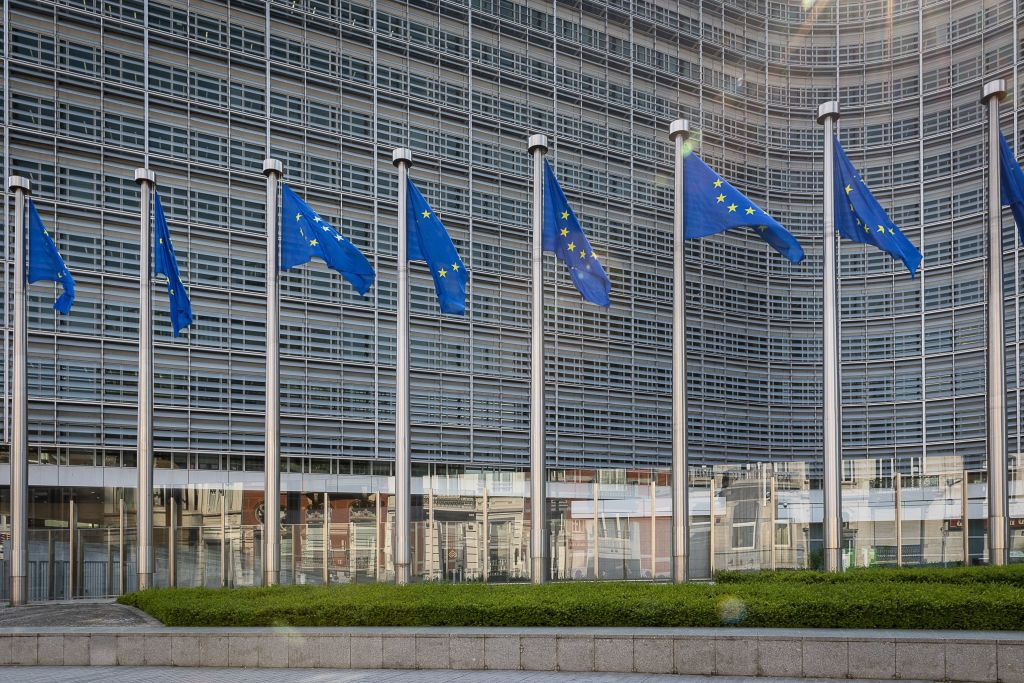
The European Commission proposed a Quantum Act on November 25 that would generally limit public quantum purchases to Union-controlled suppliers and require post-quantum cryptography in some public IT procurement, aiming to build European demand and reduce reliance on non-EU suppliers. The Council-published legal text defines “Union-controlled” by who controls a company, not by who owns it, so a European startup with foreign minority investors would not automatically lose eligibility.
The Act also creates the legal basis for an equity investment vehicle that Executive Vice-President Henna Virkkunen calls the Sovereign Tech Equity Fund (STEF). Its €50 billion (approximately $55 billion USD) target appears in her remarks as reported by Reuters, but Article 23 of the proposal sets no fixed budget. None of it is law yet. Parliament and the Council must agree on a text before it can take effect.
How Does EU Quantum Act Define EU-Controlled Suppliers?
The definition turns on control rather than on ownership share. Recital 26 of the proposal describes control as the ability to exercise decisive influence over a legal entity. The practical test for a bidder is therefore whether control sits inside or outside the Union, not what percentage a non-EU investor holds.
Two questions are likely to matter in negotiations: how “control” will be measured for venture-backed startups with large foreign funds on the cap table, and how the Article 31 authorization route for suppliers that are not Union-controlled would work in practice. A draft obtained by The Quantum Insider on November 10 described access for qualifying partners subject to safeguards for security, intellectual property and European technological interests.
Foreign Minority Stakes Would Not Disqualify Bidders, but Suppliers Must Prove Supply Security
The preference is not a blanket ban on outside vendors. The Union-controlled restriction applies to public procurement of quantum products and services, and suppliers covered by reciprocal international arrangements and the WTO Government Procurement Agreement still have routes, according to JBizNews. The Council-published legal text addresses those routes in Articles 20 and 31.
Public buyers would also have to assess suppliers on security of supply, interoperability and lifetime support, according to the QE Tech newsletter. The Commission would monitor quantum supply chains to identify critical suppliers and components under Articles 27 and 28.
Industry has asked for this lever. Anne Marie Engtoft Meldgaard of Sparrow Quantum told the QE Tech newsletter that “public procurement across member states is one of the strongest levers” for creating demand.
Public Buyers Under NIS2 Would Need Post-Quantum Cryptography Within Six Months of Entry Into Force
Certain digital purchases by public administrations covered by the NIS2 directive would have to include post-quantum cryptography requirements under Article 21 of the proposal. The requirement would apply to procurement procedures started six months after the regulation enters into force. Where suitable products are not yet available, buyers would need a documented plan for migrating later.
The proposal also defines crypto-agility in Article 2(17), meaning a system’s ability to swap cryptographic algorithms without a full redesign. That matters because of harvest-now-decrypt-later attacks, in which an adversary records encrypted traffic today and decrypts it once a large enough quantum computer exists. NIST finalized its first three post-quantum standards, FIPS 203, FIPS 204 and FIPS 205, in August 2024, which gives buyers named algorithms to specify.
Sources differ on how far the Commission could tighten the rules later. The draft obtained by The Quantum Insider said the Commission could set binding migration milestones if it judged them necessary. A Commission Q&A on the Act says the Commission could impose stronger requirements if technological developments call for them, but Article 21 of the Council-published text provides for implementing acts rather than delegated powers, so the mechanism is unclear.
For vendors outside quantum, the practical signal is on the security side. Ali El Kaafarani of PQShield expects buyers to ask more detailed supplier-readiness questions in 2027 and points to secure boot, firmware updates and device identity as design choices to settle now, since systems designed today may stay in service for about a decade, according to QE Tech.
Virkkunen’s €50 Billion Fund Target Appears Nowhere in Legal Text
The Act’s Article 23 provides a legal basis for an equity investment vehicle but sets no fixed budget. The €50 billion figure comes from Virkkunen’s remarks, as reported by Reuters, which makes it a target rather than money in hand. The proposal does not say how a €50 billion fund would be raised.
Commission official Thomas Skordas has described the Act as a framework, not a funding pot. At a European Parliament event on September 3, Thomas Skordas said the Act “is not about budget.” Reporting on the draft obtained by The Quantum Insider said money would depend on successor programs to Horizon Europe, the proposed European Competitiveness Fund, and national and private sources.
Virkkunen Has Paired Quantum With Chips, Cloud and Open Source Rules Since June
Virkkunen, the Commission’s Executive Vice-President for Tech Sovereignty, Security and Democracy, presented the Quantum Act after a June 3 tech sovereignty package that included a Chips Act 2.0, a Cloud and AI Development Act and an EU Open Source Strategy. The cloud proposal sets four levels of sovereignty criteria for suppliers and aims to triple European data center capacity within five to seven years, according to Computerworld’s coverage.
Her stated aim, as she told the Associated Press, is to avoid “risky dependencies on single dominant suppliers.” The Quantum Act extends that approach to quantum technology. Her portfolio also gives her responsibility for a long-term EU quantum chips plan, according to her Commission profile page.
Why Brussels Is Moving: Funding Gap and Supply Chain Dependence
Virkkunen said about a third of the world’s quantum startups are in Europe, as Reuters reported. Reuters also reported that EU quantum startups drew about €1.1 billion (approximately $1.2 billion USD) in private funding, against about €7 billion (approximately $7.7 billion USD) in the United States. The Commission’s call for input noted that cryogenics, lasers, control electronics and specialized materials depend heavily on non-EU suppliers.
The draft obtained by The Quantum Insider also set technical milestones, including about 100 error-corrected logical qubits per system by 2030 or soon after, scaling toward thousands per platform by 2035, and pilot metropolitan quantum networks subject to technological readiness. Those are draft figures, and it is not confirmed that they survived into the adopted proposal.
Parliament and Council Must Still Agree, and Industrial Accelerator Act Excludes Quantum
Parliament and member states will now amend the proposal. Final eligibility rules, the scope of the supplier preference, the post-quantum timetable and the financing of STEF are all unsettled. The Industrial Accelerator Act, which the Commission formally proposed on March 4, 2026, excludes quantum from its scope, according to Akin Gump.
The European Quantum Technologies Conference runs November 30 to December 3 in Dublin, and its organizers describe it as taking place in light of the impending EU Quantum Act.
Currency conversions in this article are approximate and based on the exchange rate as of November 25, 2026.
Frequently Asked Questions
Does the EU Quantum Act ban non-EU companies from public contracts?
No. The proposal would generally limit public quantum purchases to Union-controlled suppliers, but it defines that term by control rather than ownership and sets routes for partners under reciprocal arrangements and the WTO Government Procurement Agreement, according to Articles 2(21), 20 and 31.
Could a European startup with American or Asian investors still win public quantum contracts?
Possibly. Because the definition turns on control rather than ownership percentage, a minority foreign stake would not by itself disqualify a company. The decisive question is who holds decisive influence over it, and the Council and Parliament may tighten that test, as set out in Recital 26 and Article 2(21).
What does post-quantum cryptography mean for public IT buyers?
Post-quantum cryptography uses algorithms designed to resist attacks from large quantum computers. Under the proposal, NIS2-covered public administrations would have to include post-quantum requirements in certain digital purchases started six months after entry into force, or document a migration plan if products are not yet available, according to Article 21 of the proposal. NIST’s FIPS 203, 204 and 205 are the finalized U.S. standards buyers can reference.
How much money does the Sovereign Tech Equity Fund have?
None is allocated in the proposal. Virkkunen has named a €50 billion (approximately $55 billion USD) target, but Article 23 of the proposal sets no fixed budget and the source of the money is unresolved, as reported by Reuters.