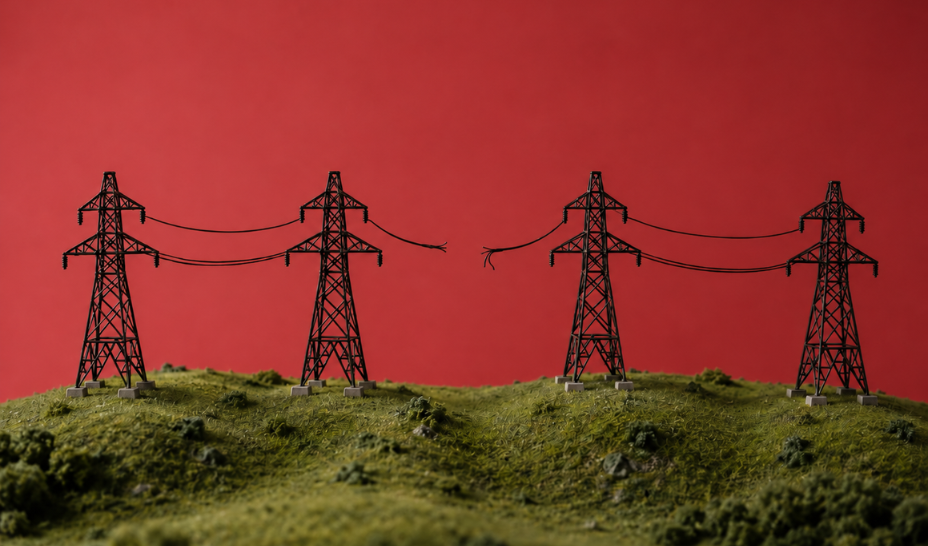

For most of the past decade, Europe’s energy question was one of supply. The continent poured capital into wind, solar and batteries, drove their costs down, and largely won that argument. But generating power is no longer the only hard part.
The bottleneck has quietly shifted to the infrastructure connecting supply with demand, and its impact is becoming increasingly visible in investment decisions. A factory, data centre or charging network can have its financing secured, its site selected and its customers lined up, yet still spend years waiting for a grid connection it cannot build itself. Increasingly, that wait determines where projects are built and whether they happen at all.
The grid keeps its own clock
Part of the problem is simply age. According to the European Commission, around 40% of the EU’s distribution grids are more than 40 years old. They also estimate that more than €1.2 trillion will be needed for distribution and transmission networks by 2040. But money is not the binding problem, time is.
The IEA reckons that planning, permitting and building new grid infrastructure can take five to 15 years, while the wind or solar farm waiting to plug into it can be ready in one to five. That gap is the whole story. When a plant is finished years before the infrastructure connecting it, electricity stops being just another operating cost. Grid access begins to determine where investment lands, and whether it lands at all.
We can see it already in data centres and heavy industry, and the same squeeze will spread as transport, heating and industrial processes electrify. The grid was built for a slower, more predictable world. The economy now being plugged into it is neither.
Every bottleneck has a price
Europe is already paying to work around network constraints. A report by ACER (European Union Agency for the Cooperation of Energy Regulators) found that in 2024, transmission system operators spent €4.3 billion on congestion management and other remedial actions. Some of that spending is the unavoidable cost of running a complex power system. But it also shows how expensive scarce network capacity can become.
For a venture investor, however, the €1.2 trillion headline is only the starting point. Most of that capital will necessarily flow to utilities, infrastructure funds and suppliers building cables, substations and transformers.
The venture opportunity sits alongside that build-out. When new lines take the better part of a decade, technologies that unlock more capacity from existing assets become significantly more valuable: software that shortens connection planning, improves visibility across local networks or makes flexible demand easier to manage.
That is the lens I use. A big market is never enough on its own. What matters is whether a technology removes a specific bottleneck, and whether the customer can put a number on the capacity, time or cost it saves. A product that frees up room on a constrained part of the grid, or pulls a connection date forward by months or years, gives the buyer an obvious reason to pay. That is a very different proposition from yet another energy dashboard.
Difficult to enter, difficult to replace
Grid technology is not classic SaaS. Utilities buy slowly, because reliability is everything and regulation shapes what they can procure. Hardware often has to prove itself in the field before anyone commits to a full rollout. Early growth is rarely tidy.
The compensation for that friction is durability. Every deployment leaves behind integrations, approvals, operating data and hard-won trust. Once a startup is woven into how a network is planned or run, it does not get swapped out because a competitor turned up with a nicer interface.
And the most valuable tools often need no new infrastructure at all. In their Electricity 2026 report, the IEA points to technologies such as dynamic line rating and advanced power-flow control that can increase usable capacity on existing networks on much shorter timelines than new high-voltage infrastructure.
The exact gain depends on the network, but the investment logic is clean: a modest layer of technology can defer a far larger physical upgrade.
For venture capital, that creates an unusual middle ground. A startup can benefit from a huge infrastructure cycle without carrying the balance sheet required to build the infrastructure itself. The hard part is proving that a pilot can become a repeat deployment across different networks.
Europe may be better suited to this market than it thinks
For years, long industrial sales cycles and heavy regulation were treated, almost reflexively, as reasons for venture capital to stay away. That made sense when software set the benchmark for every startup. It makes far less sense now that some of Europe’s biggest growth constraints sit squarely inside energy, industry and physical infrastructure.
Here, Europe’s supposed handicaps start to look more like advantages. The continent already has the customers, engineering talent and demanding operating environment required to build defensible grid technologies.
A startup that learns to sell to European utilities also learns to operate under some of the world’s toughest procurement, reliability and safety standards. That capability travels internationally far better than many investors assume.
AI will only sharpen the urgency, because data centres pile large, inflexible loads onto specific points on the map. But the thesis does not rest on AI. Electrification was already pushing the system this way; AI simply makes the mismatch impossible to ignore.
The next generation of energy winners will not all own power plants. Some will simply make the infrastructure between them work harder. Europe still needs more copper in the ground – but for venture capital, the opportunity is in the technology that makes every kilometre of it go further.