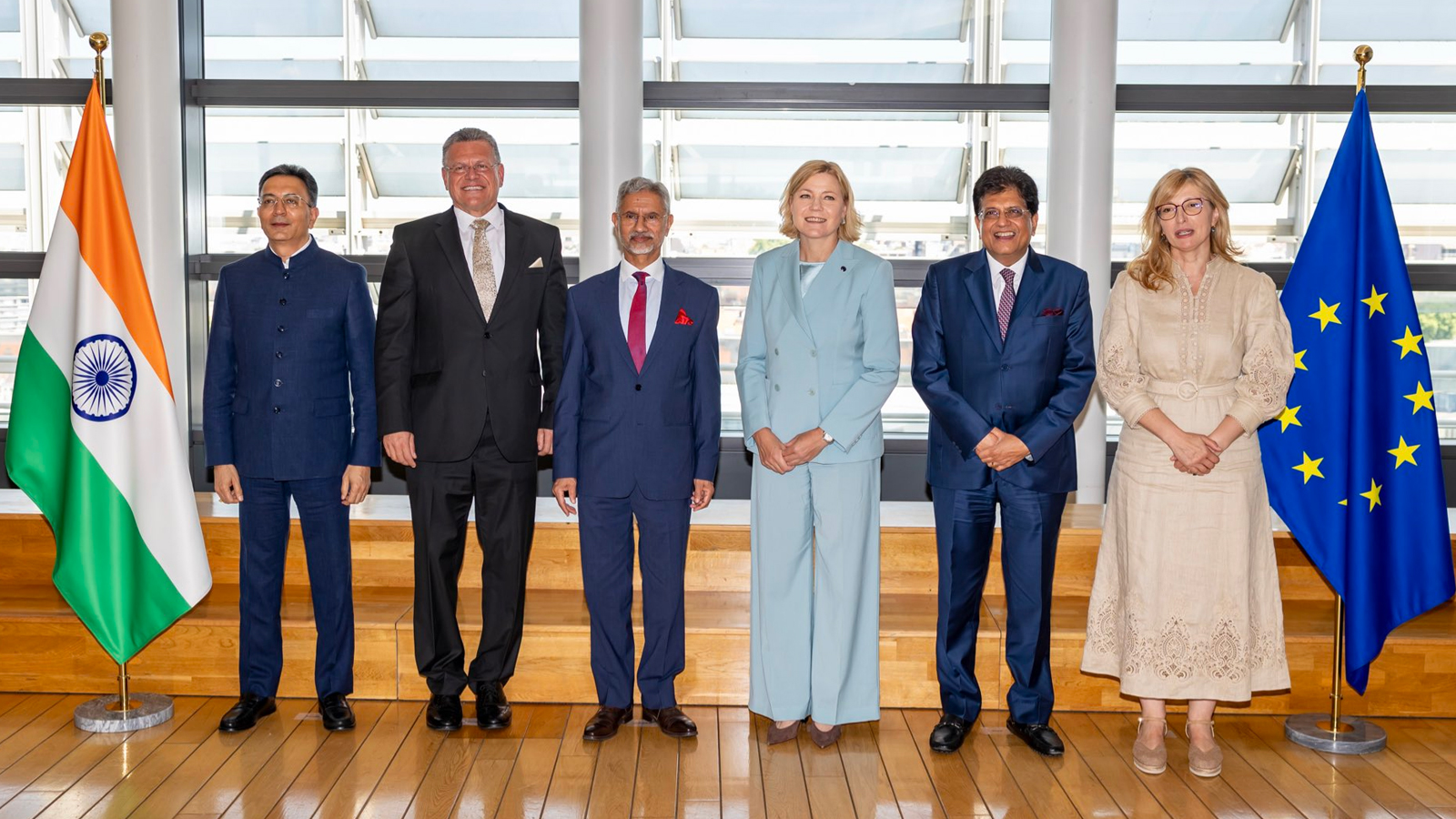

India and the European Union have agreed to significantly deepen cooperation in strategic technologies, clean energy, trade, innovation and resilient supply chains, while outlining an ambitious roadmap to upgrade the India-EU Trade and Technology Council (TTC) into a more outcome-oriented platform.
The decisions were taken during the third ministerial meeting of the India-EU Trade and Technology Council held in Brussels on Wednesday. The meeting was co-chaired by External Affairs Minister Dr. S. Jaishankar, Commerce and Industry Minister Piyush Goyal and Minister of State for Electronics and Information Technology Jitin Prasada on the Indian side. The European Union delegation was led by European Commission Executive Vice-President for Tech Sovereignty, Security and Democracy Henna Virkkunen, Commissioner for Trade and Economic Security Maroš Šefčovič and Commissioner for Startups, Research and Innovation Ekaterina Zaharieva.
Established in April 2022 by Prime Minister Narendra Modi and European Commission President Ursula von der Leyen, the Trade and Technology Council serves as the principal platform for India and the EU to strengthen cooperation in trade, trusted technologies and security. The two sides reiterated their commitment to elevate the strategic partnership following the adoption of the “Towards 2030: A Joint India-European Union Comprehensive Strategic Agenda” during the 16th India-EU Summit held in New Delhi on January 27, 2026.
Recognising the growing convergence of trade, technology and economic security, India and the EU agreed to transform the existing TTC structure to deliver concrete outcomes through stronger engagement with industry and focused work on strategic value chains. Officials have been tasked with finalising the governance framework later this year.
Digital technologies and semiconductors
Under the Working Group on Strategic Technologies, Digital Governance and Digital Connectivity, both sides agreed to expand cooperation in artificial intelligence, semiconductors, high-performance computing, quantum technologies, digital trust services and next-generation telecommunications.
Building on the Administrative Arrangement on Advanced Electronic Signatures and Seals signed earlier this year, India and the EU will continue technical work to improve interoperability and mutual recognition of e-signatures. They also agreed to explore linking the EU Digital Identity Wallet with India’s DigiLocker through pilot projects based on mutually agreed use cases.
The two partners also plan to develop a Joint Artificial Intelligence Roadmap and continue sharing best practices on AI governance and adoption, with healthcare emerging as a potential focus area. Cooperation in high-performance computing will expand through joint research projects covering climate change, natural hazards and bioinformatics, while discussions will also be initiated on collaboration in quantum technologies.
Semiconductors emerged as another major area of cooperation. India and the EU agreed to organise a joint roundtable during Semicon India 2026 and strengthen collaboration in research, capacity building and investment across semiconductor and electronics ecosystems. The two sides will also explore cooperation between Semiconductor Design Facilities under the India Semiconductor Mission and EU Pilot Lines under the EU Chips Act to facilitate access to advanced process design kits and cost-effective silicon prototyping.
The meeting also highlighted collaboration on digital skills through possible engagement between the EU Digital Skills Academies and India’s NIELIT Digital University Platform, alongside continued efforts to facilitate the mobility of skilled ICT professionals.
Research, clean technologies and innovation
Significant progress was reported under the Working Group on Clean and Green Technologies, with India and the EU announcing the start of formal negotiations on India’s association with Horizon Europe, the EU’s €93.5 billion flagship research and innovation programme.
If concluded by the end of 2026, the agreement would allow Indian researchers and innovators to fully participate in Horizon Europe from 2027, marking a major institutional milestone in bilateral scientific cooperation.
The two sides also agreed to establish the first India-EU Innovation Hub dedicated to electric vehicle charging technologies and testing. The initiative, led by the European Commission’s Joint Research Centre and the Automotive Research Association of India, will bring together research institutions, testing facilities, standards experts and startup ecosystems from both sides.
The meeting reviewed progress under the €60 million joint research investment announced last year. Four collaborative projects have already been selected, with another scheduled to begin in 2027. These projects focus on renewable hydrogen production from agricultural and industrial waste, marine pollution monitoring using AI-driven technologies and advanced biosensors, and recycling of electric vehicle batteries to recover critical raw materials.
The two sides also agreed to exchange knowledge on Hydrogen Valleys and strengthen cooperation on hydrogen safety standards later this year.
Trade, resilient supply chains and market access
Under the Working Group on Trade, Investment and Resilient Value Chains, India and the EU reaffirmed their commitment to building secure, diversified and sustainable supply chains across strategic sectors, including agri-food, active pharmaceutical ingredients and clean technologies.
The partners agreed to strengthen cooperation through contingency planning in the agri-food sector, continued dialogue on pharmaceutical supply chains and joint efforts to promote resilient clean technology ecosystems covering solar energy, offshore wind, renewable hydrogen and low-carbon technologies.
India and the EU also welcomed progress in resolving priority market access issues under the TTC framework. They agreed to continue discussions on sanitary and phytosanitary measures, technical regulations, Quality Control Orders, organic products and mutual equivalence arrangements to facilitate trade.
Reaffirming their support for the multilateral trading system following the 14th WTO Ministerial Conference, both sides stressed the need for meaningful World Trade Organization reforms to address contemporary trade challenges. They also discussed carbon border adjustment measures and agreed to ensure Indian entities have timely access to accredited verifiers.
New initiatives for startups and industry
Recognising the growing importance of deep technology and innovation-driven industries, India and the EU agreed to explore establishing a dedicated platform under the TTC to advance the proposed Blue Valleys initiative. The framework aims to create sector-specific industrial clusters by bringing together regulators, businesses, startups and research institutions.
The partners also agreed to launch a Deep-Tech Startup Partnership involving stakeholders such as the European Innovation Council and Startup India to promote cross-border market access and commercialisation opportunities.
The India-EU Business Forum, launched during the 16th India-EU Summit, will now be held annually, alongside regular sector-specific industry engagements. The two sides also agreed to place greater emphasis on industrial partnerships and skills development under the TTC framework.
The next ministerial meeting of the India-EU Trade and Technology Council will be hosted by India in New Delhi in 2027.
Following the meeting, External Affairs Minister Dr. S. Jaishankar described the discussions as productive, stating that trusted and reliable partnerships such as that between India and the European Union are increasingly important at a time when the global economy faces supply chain disruptions, market access challenges and technology gaps. He said the ministers reviewed cooperation across strategic technologies, digital connectivity, clean energy, trade, investment and resilient supply chains, while also focusing on emerging technologies, skilling, deep-tech startups, green hydrogen, electric vehicles and batteries. He expressed confidence that the outcomes of the meeting would further strengthen the momentum generated by the India-EU Free Trade Agreement, the Security and Defence Partnership and the Mobility Framework.
Earlier in the day, EAM Jaishankar participated in the India-EU Business Roundtable, where he highlighted the growing trust between India and Europe and underscored the need for businesses from both sides to realise the full potential of expanding cooperation in investment, research and development, and innovation.