

Japan’s investment case is entering a more demanding phase. Market drivers including easing deflation, corporate reforms and Japan’s strategic role in the global technology supply chain are now familiar with many investors. After the strong
market rally since April 2025, investors are wondering if the investment case for Japan is sustainable.
Japan’s equity valuations need to be viewed alongside stronger corporate fundamentals and a changed macro backdrop of rising inflation. Despite strong earnings growth expectations for the market, we continue to see pockets where share prices
understate earnings potential. Meanwhile, still high corporate cash levels, regulatory initiatives, and rising shareholder activism leave further scope for reform. Nonetheless, the next phase calls for active, non-consensus investing anchored
in valuation discipline.
View valuations alongside stronger corporate fundamentals
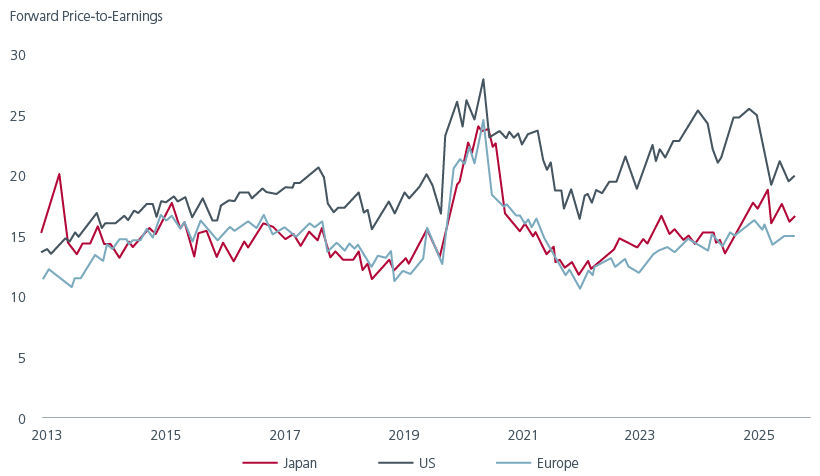
The Japanese market is no longer as broadly undervalued as it was several years ago. The MSCI Japan Index trades at around 15.6x forward P/E1, modestly above its historical average of about 15x. Fig. 1. However, today’s valuations should
be viewed alongside materially stronger corporate fundamentals. Profitability and capital efficiency have improved, governance standards have strengthened, and companies are increasingly focused on capital allocation and shareholder returns. Japan’s
transition away from deflation has also changed the operating environment. Positive nominal growth, stronger wages and greater corporate pricing power can support structurally higher profitability than during the deflationary era.
Importantly, the headline market multiple masks considerable valuation dispersion. Some AI- and technology-related companies enjoy elevated valuations on the back of strong earnings growth and investor enthusiasm, while less-favored areas of the market
continue to offer attractive stock-specific opportunities. This dispersion reinforces the importance of valuation discipline and bottom-up stock selection.
Fig. 1. 12-month forward price to earnings (x)
Source: Eastspring Investments (Singapore). Nomura as at 31 August 2026. Universe is MSCI Japan, US, Europe Index. The use of indices as proxies for the past performance of any asset class/sector is limited and should not be construed as being
indicative of the future. Any projection or forecast is not necessarily indicative of the future or likely performance.
Meanwhile, consensus expectations point to continued earnings growth, although the outlook varies meaningfully across different parts of the market. Bloomberg consensus estimates currently point to 11.9% earnings per share growth for MSCI Japan in
FY2027, compared with 25.7% for MSCI Japan Growth and 3.7% for MSCI Japan Value (data as of 19 Oct 2026).
This divergence partly reflects the different composition of the growth and value indices. The MSCI Japan Growth Index has material exposure to technology and industrial businesses that benefit from strong expectations around AI, semiconductors and
data center investments. By contrast, the MSCI Japan Value Index has considerably greater exposure to financials, autos and trading companies.
The Value Index’s lower earnings growth forecast is weighed down by expectations for slower net income growth among trading companies as commodity prices peak or grow more slowly. Meanwhile, earnings from Banks and Autos are expected to be broadly
in line with the MSCI Japan Index.
While AI-related businesses have a stronger earnings growth outlook, investors are already paying a premium for that growth. Current MSCI data illustrate the valuation dispersion: MSCI Japan Growth traded at 18.4x forward P/E versus 13.6x for MSCI
Japan Value (as at 30 September 2026).
The key investment question, therefore, is not simply where earnings are growing fastest, but where the market may be underestimating future earnings growth relative to what is already priced in. In our view, earnings outside AI remain supported by
structural and company-specific drivers, including improved pricing discipline, automation and productivity investment, restructuring and better capital allocation.
Corporate reforms still have room to run
Corporate reform has driven a multi-year transformation in Japanese equities and created significant shareholder value. While the corporate reform story is well established, we believe its value-creation potential is far from exhausted. Despite record
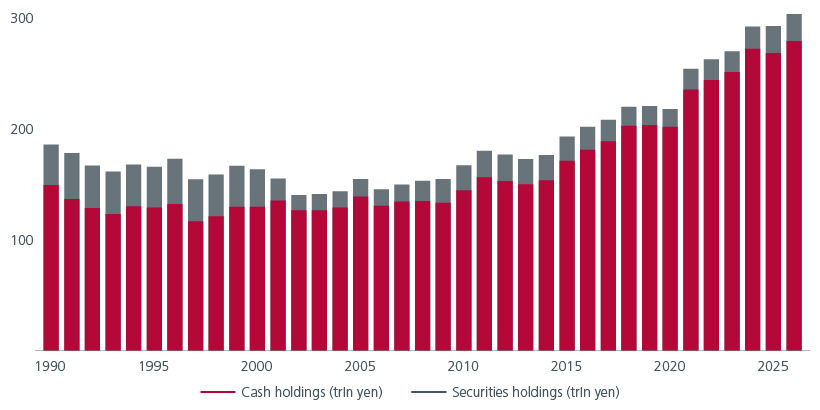
dividends and share buybacks in 2025, Japanese companies continue to hold substantial cash reserves. Fig. 2. Reports suggest that 57.7% of TOPIX companies are net cash positive, compared with 45.7% in MSCI Asia ex-Japan, 24.3% in MSCI US and just
16.8% in MSCI Europe2 . This financial strength provides considerable optionality. Cash can be deployed into growth investments, restructuring, acquisitions, higher dividends or share buybacks as management teams become increasingly
focused on return on capital.
Fig. 2. Japanese companies continue to hold substantial cash reserves
Source: CLSA Securities. Reuters. Data for 2026 is at end March.
Shareholder activism is also becoming more entrenched in Japan. Japan recorded 51 activist campaigns in 2024 – more than Europe and the UK combined3, and 56 in 20254 , second only to the US. This momentum continued in 2026. As
of 8 June, activists submitted 150 proposals across 55 companies. Importantly, proposals have broadened beyond demands for excess cash distributions or board changes to encompass core strategic issues, including M&A, leveraged buyouts and
fundamental portfolio restructuring5. The combination of attractive valuations, abundant corporate cash and intensifying shareholder pressure should continue to support corporate reforms and unlock value for Japanese equities.
BoJ normalisation will not derail the market rally
The Bank of Japan (BoJ) raised interest rates in June and again in September 2026, taking the policy rate to a 31-year high of 1.25%. With Japan emerging from decades of deflation and real wages beginning to rise, the BoJ is expected to continue gradual
policy normalisation. The prospect of a stronger yen, however, has raised concerns about the sustainability of profits for Japanese companies, and subsequently about prospective equity market returns.
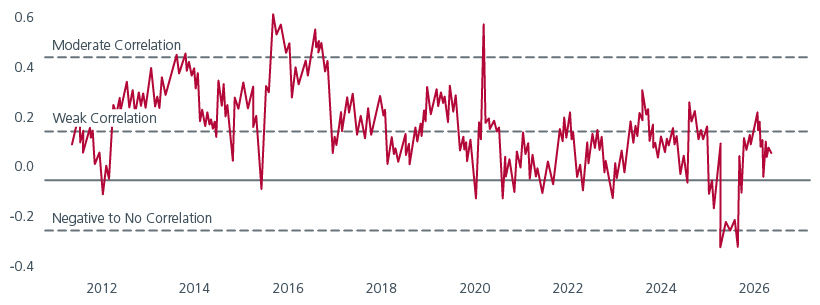
In practice, while investors’ preconception that the Japan equity market is a “weak yen trade” tends to surface during periods whenever the yen moves significantly (e.g. the yen carry trade unwinding in August 2024, Liberation Day
tariff in April 2025), the correlation between market returns and the yen’s movement has not been prevalent or consistent, suggesting that fundamentals and other factors have played a bigger factor in influencing market returns.
Fig. 3. 100-day correlation between the Topix and USD/JPY
Source: Goldman Sachs Global Investment Research, Schroders, as of 12 May 2026. The use of indices as proxies for the past performance of any asset class/sector is limited and should not be construed as being indicative of the future or likely
performance.
The forces behind yen appreciation as well as a stronger yen itself are not necessarily negative for Japan. Amid elevated energy prices, currency strength can help moderate imported inflation. Higher interest rates may also benefit banks and other
rate-sensitive sectors, while stronger real wage growth could support consumer spending and domestically oriented companies.
Japan’s real wages rose for an eighth consecutive month in August 2026, although the improvement in household spending and consumer confidence has so far been more gradual. After several years in which rising food, energy and import prices
eroded household purchasing power despite nominal wage growth, it may take time for sustained increases in real incomes to translate into greater confidence and higher discretionary spending.
Some catalysts that could help improve consumer demand include:
- Sustained real wage growth: Continued real income gains would reinforce household purchasing power and consumer confidence.
-
Proposed consumption tax cuts on food: The Takaichi government has proposed to reduce the consumption tax on qualifying food from 8% to 1% for two years from April 2027, subject to parliamentary approval. If passed, this
could provide more direct support to household disposable income. - Lower imported inflation: A stronger yen and/or lower energy prices would ease pressure on household budgets, allowing wage growth to translate into real purchasing power.
The next phase of investing
Japan’s deep and diverse equity market still offers opportunities across a far broader range of industries and themes. However, as familiar market narratives become increasingly reflected in share prices, future returns are likely to depend
more on identifying companies that can exceed expectations, as well as the next catalysts before they become consensus. The next phase of investing in Japan should favour active stock pickers who are willing to apply a disciplined value approach
to uncover overlooked companies. Given the market backdrop, we currently see interesting opportunities in selected retail and service companies, industrials and banks. We are also finding selected opportunities among businesses exposed to
AI-related investment where we believe their sustainable three-to-five-year earnings warrant meaningful upside from their current valuations. Nevertheless, with investors’ expectations having risen sharply both on AI and the broader
Japan market, selectivity and valuation discipline have become increasingly important.