Set Trending Topics as a preferred source on Google.
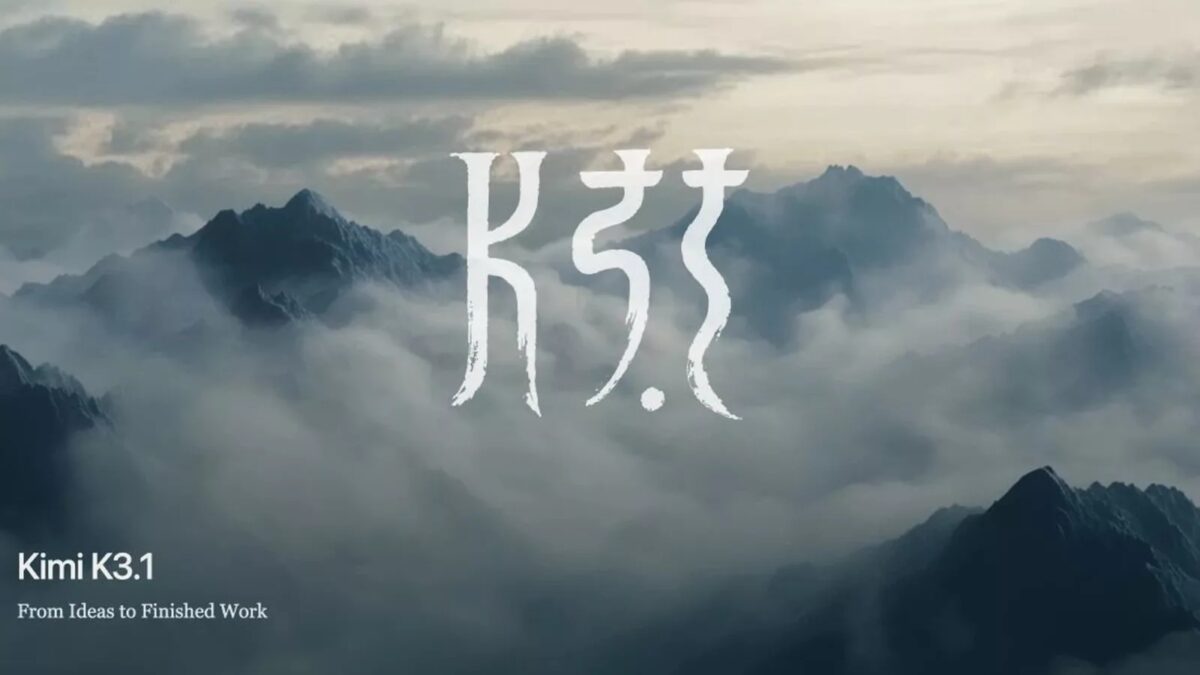
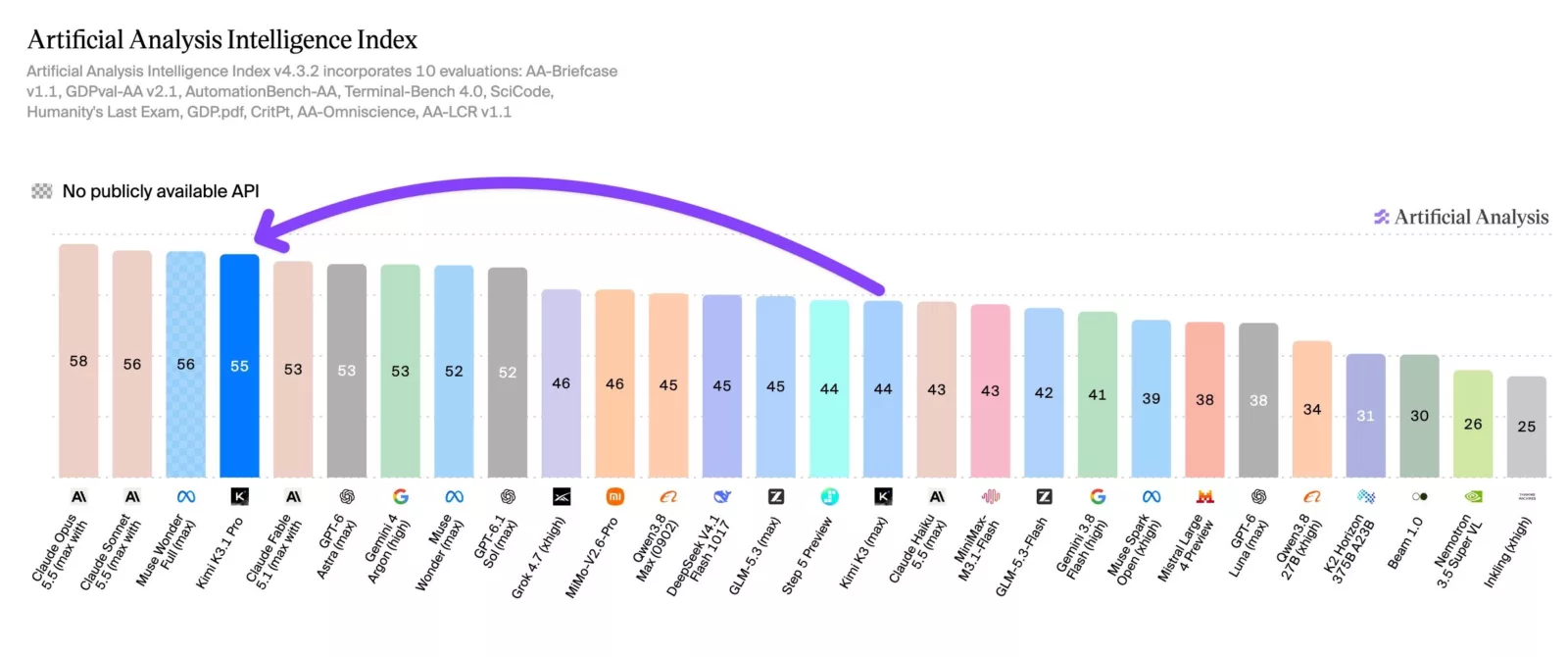
The gap between open and closed A.I. models is shrinking to just a few points: The Chinese A.I. start-up Moonshot AI has just unveiled Kimi K3.1 Pro. On the Intelligence Index of the independent benchmarking service Artificial Analysis, the model scores 55 points, placing fourth. Only Anthropic’s Claude Opus 5.5 (58 points) and Claude Sonnet 5.5 (56) and Meta’s Muse Wonder Full (56) rank higher. OpenAI’s GPT-6 Astra and Google’s Gemini 4 Argon, with 53 points each, already trail behind. That is an 11-point jump from its predecessor, Kimi K3 (44 points).
The bigger news is still to come: Moonshot plans to publish the model’s weights by early November. According to Artificial Analysis, Kimi K3.1 Pro would then be the world’s strongest open-weight model, and the gap between the best open and the best proprietary model would narrow from 12 points to 3. Among open models, Kimi K3.1 Pro would take a clear lead: According to Artificial Analysis’s figures, Xiaomi’s MiMo-V2.6-Pro currently tops the open models with 46 points, followed by DeepSeek V4.1 Flash with 45 and the predecessor Kimi K3 with 44. The best open model from the United States, Meta’s Muse Spark Open, scores 39 points.
A Big Leap for A.I. Agents
The model makes its biggest gains in agentic tasks, meaning the autonomous completion of multistep workflows. The key results according to Artificial Analysis:
- GDPval-AA: With 1,846 Elo points (up 312 from K3), Kimi K3.1 Pro ranks third behind Claude Opus 5.5 (1,866) and Muse Wonder Full (1,857). The test measures how well models handle realistic knowledge work.
- Terminal-Bench 4.0: The model achieves the highest score of any model at 67 percent, up from 13 percent for Kimi K3 and ahead of Claude Sonnet 5.5 at 64 percent. Moonshot itself reports a slightly lower figure of 65.7 percent, just behind Claude Opus 5.5.
- AutomationBench-AA: On agentic workflows in SaaS software, the score rises from 58 to 73 percent.
- Knowledge and science: Gains here are more moderate, for example from 47 to 52 percent on Humanity’s Last Exam and from 59 to 61 percent on SciCode.
- Hallucinations: The hallucination rate falls from 53 to 44 percent, while accuracy rises from 48 to 51 percent.
Cheaper Than Its Predecessor
Little has changed in the underlying architecture. Like Kimi K3, the model has 2.8 trillion parameters in total, 104 billion of which are active per request. The context window spans one million tokens, and the model handles text and images. Moonshot did, however, put significantly more computing power into post-training.
API prices are $2 (about €1.78) per million input tokens, $10 (about €8.92) per million output tokens and $0.20 (about €0.18) for cached tokens, a third less than Kimi K3 across the board. Because the model generates about 14 percent more text, the cost per task on the index stays roughly the same at $1.98 (about €1.77). There is also a Highspeed version, which Moonshot says is two to three times faster and costs twice as much. Kimi K3.1 Pro is available now in the Kimi apps and through the API.
Fewer Hacking Skills
One step Moonshot took ahead of the open-weight release stands out: The company says it removed training data related to cyberattacks. In an internal test on exploiting real software vulnerabilities, the success rate fell from 90.5 to 81 percent as a result, The Next Web reported. No open model should push the frontier of offensive cyber capabilities, according to Moonshot.
The Competition in Open Models
Moonshot is not alone in the race for the best open-weight model. Meta recently released Muse Spark Open, albeit with a restrictive license. Nvidia has made its open model twice as smart with Nemotron 3.5, according to Artificial Analysis. In China, DeepSeek is the main rival, and its V4.1-Flash even beats Kimi K3.1 Pro on some coding tests. In Europe, Mistral is among those betting on open models.
Benchmarks Aren’t Everything
Whether Kimi K3.1 Pro will actually become the best open model is not yet settled. Artificial Analysis’s projection assumes that Moonshot releases the weights as planned and that nothing changes among competitors in the meantime. Many of the results also come from Moonshot itself and have not been independently verified. Security researchers also warn that open-weight models cannot be recalled once downloaded and that their safeguards lag behind those of closed models. The topic is politically sensitive as well: In July, the White House accused Moonshot of using banned Nvidia chips and copying an Anthropic model to build Kimi K3, without presenting evidence. The U.S. government recently banned DeepSeek, another Chinese A.I. lab, from all federal agencies.