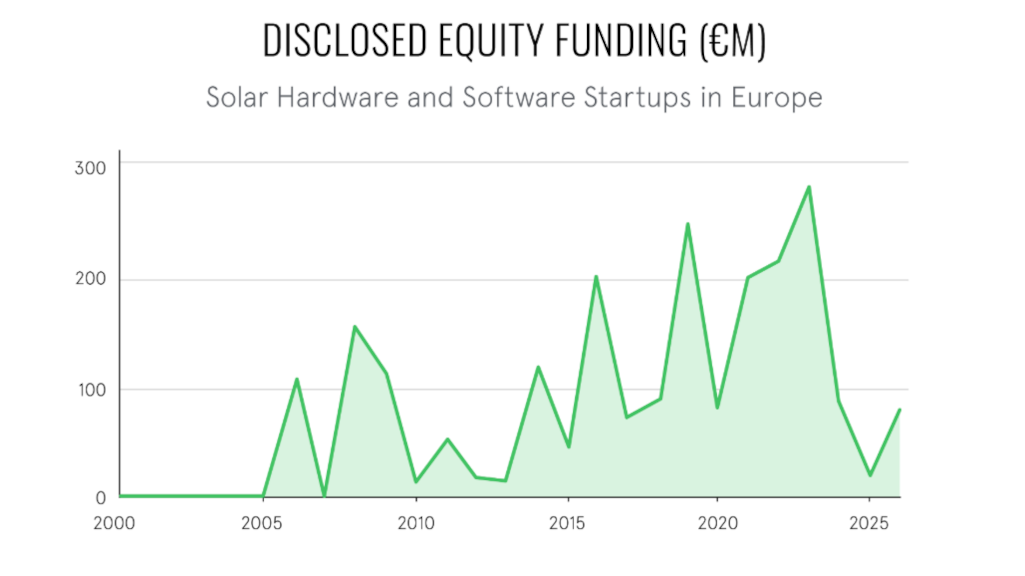
Disclosed equity funding for European solar hardware and software startups has reached €82 million so far in 2026, more than three times the €24 million raised in 2025, which marked the lowest level in a decade. That is still well below the all-time high of €285 million recorded in 2023, according to an analysis of Crunchbase data by Avnet Silica.
“A reasonable price for European security” – Fronius CSO on Made-in-Europe rules
Avnet Silica, an electronics distributor that works with design engineers on new product development, tracked venture capital activity for companies developing solar hardware and software across the full product lifecycle, from materials, cells and modules through to energy management and end-of-life recycling. While billions continue to flow into utility-scale projects, the pattern of startup investment offers a narrower view of where capital is funding the next generation of technology in Europe, and it shows a market that now picks its investments far more carefully.
Early-stage deals dominate
Early-stage companies have received 93 percent of this year’s funding, and five deals above €10 million have already closed, making 2026 the joint highest year on record for large early-stage transactions. The median funding round across all stages has climbed to €15 million, the highest level in more than 15 years. This suggests that venture capitalists are concentrating their money on fewer, larger investments, where in earlier growth phases they spread smaller bets across the sector.
Investors have largely steered clear of both ends of the market, steering away from untested seed ideas and from late-stage rounds that demand large sums. Instead, they are focusing on early-stage companies with proven technology and strong growth potential.
M&A activity picks up
As venture capital becomes more cautious, corporate acquisitions are offering startups another way to secure funding and grow. Four mergers and acquisitions involving European solar hardware and software startups have been completed so far this year, making 2026 the second-highest year on record, behind only 2021 with six deals.
Acquisitions also allowed larger firms to strengthen their position across the solar value chain. In June 2026, Sunotec Group took a majority stake in Germany’s Kaufmann Electric to help ease grid connection bottlenecks and speed up the delivery of infrastructure for its solar parks. By taking over Kaufmann’s substations, solar cables and energy connectors, Sunotec brought a critical part of its supply chain in-house.
Security as a new investment driver
Harvey Wilson, Senior Manager Industrial Vertical Markets EMEA at Avnet Silica, believes the market could change quickly. He sees Europe’s push for energy independence and a changing regulatory environment as possible triggers, and argues that energy security goes well beyond generation capacity and less reliance on foreign imports. It also covers the security of components, supply chains and the data being transmitted.
A key factor here is the EU’s Cyber Resilience Act, which sets cybersecurity rules for connected products. To keep selling connected products in Europe, manufacturers will have to prioritise fully compliant, secure-by-design components, a requirement Wilson expects to trigger a significant increase in domestic manufacturing and investment.
Pascal de Boer: “The most interesting driver is cybersecurity itself”
The regulation is also beginning to change how companies in the sector use their resources. “Security is becoming one of the most important drivers of innovation within European clean technology. Some companies are absolutely on top of the changes required under the Cyber Resilience Act and have whole teams dedicated to their implementation, while others are aware of it and slowly making their way around to doing something about it. But really, the time to act is upon us,” Wilson says. He expects the new rules to influence which products win customers and which companies grow over the next few years.
For a sector that has gone through a sharp funding correction in the space of two years, 2026 brings mixed signals. Capital is flowing again, but on tighter terms, into fewer companies and towards those tackling specific problems in the system. The next round of funding figures will show whether the Cyber Resilience Act gives the market the boost that Wilson is counting on. (hcn)