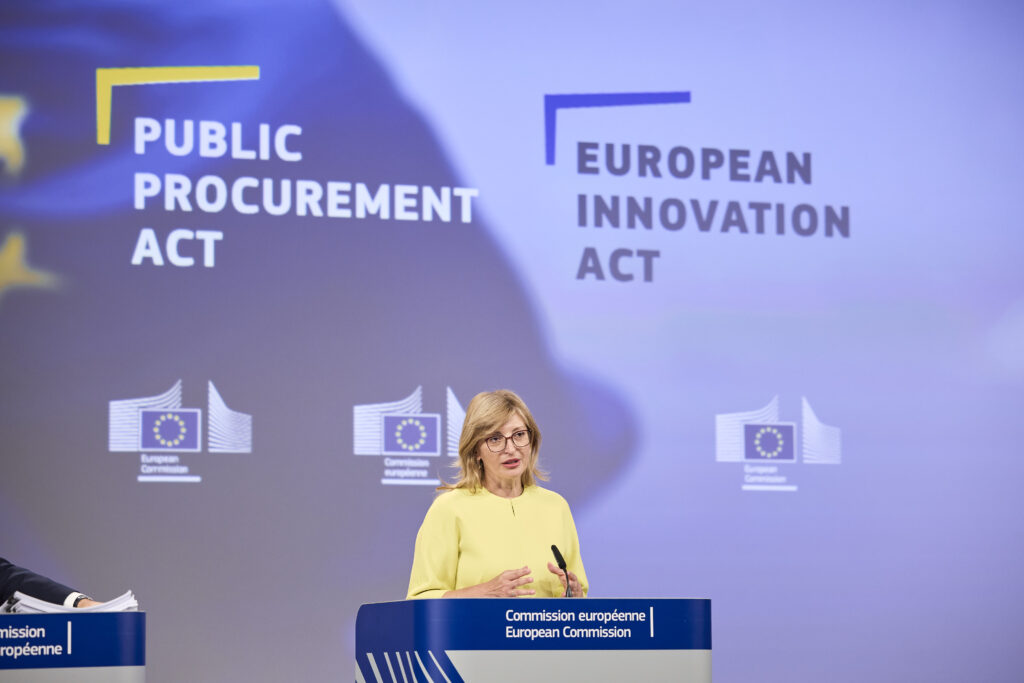

Brussels – The European Union has an “abundance” of research, talent and creativity, but “all too often” innovations developed on the continent end up becoming economic successes elsewhere. This is one of the issues the European Commission aims to tackle with the new European Innovation Act, presented today (9 September) by the Commissioner for Start-ups, Research and Innovation, Ekaterina Zaharieva. The aim is to make it easier for innovative European companies to grow beyond national borders, secure funding and compete in global markets.
According to the Commission, the problem stems primarily from the fragmentation of rules across Member States and the difficulty start-ups and scale-ups face in attracting capital. The European Innovation Act, one of the initiatives of the EU Startup and Scaleup Strategy, therefore aims to strengthen the European innovation ecosystem and ensure that ideas originating in Europe can be developed and commercialised on the continent.
Funding European innovation
The first area is funding. “Many startups and scaleups have innovative ideas, patents and other intellectual property, but these assets are often difficult to value, which makes it harder to attract investment,” Zaharieva said. The Commission is therefore proposing a common European framework for the valuation of intellectual property and a digital marketplace connecting buyers and sellers, accompanied by specialist support to bring ideas to market.
According to the European Commission, these measures “could generate around 35 million euros in administrative cost savings and unlock 10.2 billion euros a year in additional funding” through venture capital and debt secured by intellectual property.
Simpler procurement for start-ups
The second area concerns public procurement for research and development. The proposal introduces a common procedure for Member States, aiming to increase legal certainty and accelerate the market entry of new technologies, including those addressing shared challenges such as health, education, and clean mobility. The Commission also aims to simplify joint procurement between public purchasers from different countries. The measures are expected to generate 1 billion euros a year in savings for public purchasers and 25.92 billion euros in additional annual revenue for businesses, according to the Commission.
So, the aim is to make it easier for start-ups to participate in public tenders and to accelerate the market entry of their technologies. Many young companies, explains Zaharieva, may have “the best technology or the most effective solution to a problem”, even though they do not yet have the scale or track record of established firms. “Start-ups ask us not only for funding, but also for help in finding their first customers,” she adds.
A proposal that goes hand in hand with the revision of European public procurement rules, presented at the same time by the Commission’s Executive Vice-President Stéphane Séjourné, to simplify procedures.
“With the European Innovation Act, we are tackling fragmentation head-on: one framework for IP valuation, one digital marketplace connecting buyers and sellers, and one simpler route for public procurement of cutting-edge research and development,” Zaharieva said. “By 2028, we will create a genuine single market where ideas scale faster, finance circulates more freely, and Europe’s strategic autonomy grows stronger.”
A common framework for experimentation
At the same time, the Commission is proposing a common European framework for regulatory sandboxes, i.e., controlled environments in which companies, researchers, and public authorities can test new products, services, or technologies for a limited period under the supervision of regulators. Similar instruments already exist in some sectors, but their fragmented application across Member States creates uncertainty. The aim is therefore to offer innovators more scope to experiment, whilst ensuring that the public interest is safeguarded.
English version by the Translation Service of Withub