
Bangladesh’s business climate is constrained by regulatory bottlenecks, policy inconsistency, weak trust, and institutional inefficiencies, undermining both investment potential and long-term investor confidence, analysts and top business leaders said today.
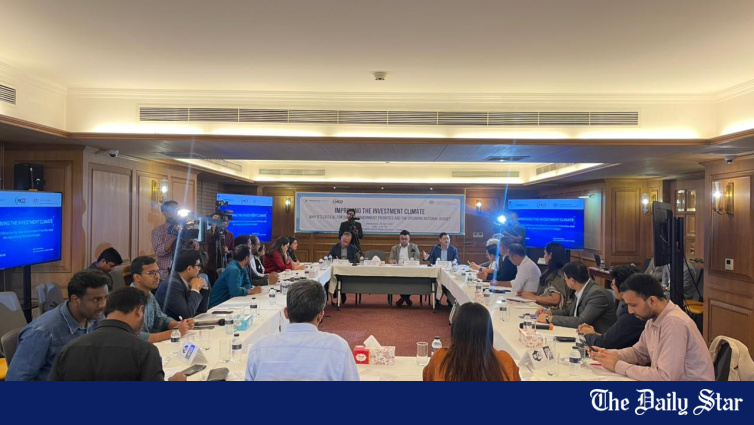
They made the remark at a dialogue on the investment climate and the upcoming national budget, organised by the Metropolitan Chamber of Commerce & Industry, Dhaka (MCCI), at its auditorium at Police Plaza in the capital.
At the event, M Masrur Reaz, chairman and CEO of Policy Exchange Bangladesh, said private investment has fallen, while foreign direct investment remains below 1 percent of GDP, far behind regional competitors.
“This slowdown comes at a critical juncture. With ambitions of reaching a $1 trillion economy and creating millions of jobs, the government’s targets hinge almost entirely on increased investment,” he said.
“The real challenge is not competition but market entry itself, as firms must be prepared for a decades-long commitment given operational hurdles—from licensing delays to compliance burdens—that can deter even established players,” said Zinnia Huq, chief financial officer of Unilever Bangladesh.
Bangladesh’s struggle to attract foreign direct investment (FDI) stems largely from a lack of trust and policy predictability, said Nuria Lopez, chairperson of the European Union Chamber of Commerce in Bangladesh.
She noted that despite the country’s strong potential, foreign investors remain hesitant due to an unfavourable business environment and the absence of a clear, consistent government vision.
“The root problem is that Bangladesh does not have the trust of investors,” she said, adding that policy inconsistency and regulatory uncertainty continue to undermine confidence.
Lopez pointed to growing concerns over Bangladesh’s future market access, particularly in the European Union, as the country approaches graduation from least developed country (LDC) status.
Unlike regional competitors such as Vietnam and India, Bangladesh has yet to secure effective free trade agreements, leaving investors unsure about long-term export prospects, she said.
Taxation is another major concern, she said, noting that compliant firms—especially multinationals—often bear a disproportionate burden, while others remain outside the tax net.
“This creates an uneven playing field and discourages new investment,” she added.
Barrister Margub Kabir of Margub Kabir and Associates emphasised that trust—central to any investment decision—rests heavily on how disputes are resolved.
“Bangladesh’s persistent weakness in contract enforcement, once ranked among the lowest globally, reflects a slow and overburdened judicial system,” he said.
Mahmud Hasan Khan, president of the Bangladesh Garment Manufacturers and Exporters Association, said efforts to improve the business environment must begin with fixing core infrastructure.
Farooq Ahmed, secretary general of the MCCI; Sumitra Kumar Mutsuddi, head of corporate at BSRM; and Sumaiya T Ahmed, head of sustainability at Pran-RFL Group, also addressed the event, among others.