
For most of the last decade, choosing an electronic signature platform was a procurement decision settled on price and convenience. The contract got signed, the PDF landed in an inbox, and few people asked the follow-up question: where, physically and legally, does that signed document now live?
That question is becoming harder to avoid in Europe. Certyneo, founded in 2024, is built on the premise that it is moving from an afterthought to a standard line item in the buying process.
The jurisdiction problem underneath the signature
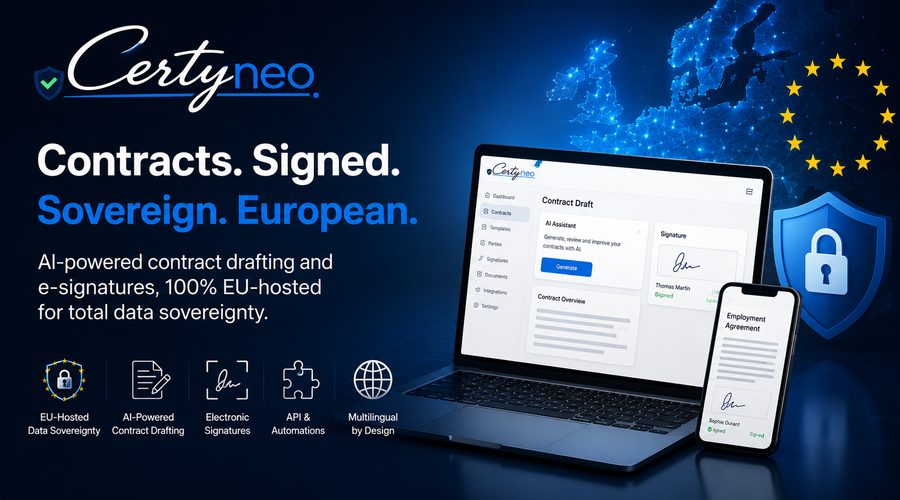
The company’s central argument is legal rather than technical. Its entire platform runs on sovereign infrastructure inside the European Union, with no data transiting the United States, which in its framing removes exposure to the extraterritorial reach of the US Cloud Act and FISA.
For a small business, that may read as abstract. For a public administration, an operator of vital importance, or a company working in healthcare, banking, defence or legal services, it is the difference between a processing chain that can be audited end to end under European rules and one that cannot. That is the specific buyer Certyneo is aiming at, and it is the part of the pitch pointed directly at the large American platforms that dominate the category.
Signatures designed to outlive the platform
The more unusual commitment is what happens if a customer leaves. Certyneo’s signatures follow the ETSI EN 319 142 standard, specifically PAdES Long-Term Validation, with RFC 3161 timestamping. In practice that means a signed document can be verified by an independent third party, a lawyer, a bailiff or a court, without any access to Certyneo’s own systems. Ten years of legal archiving is included.
Software companies do not usually engineer away their own lock-in. The reasoning here is that in a market where the product is legal proof, a signature that depends on its vendor still being in business is not really proof at all. It also happens to be a direct answer to the objection any finance director raises when replacing an incumbent: what happens to everything we already signed.
Drafting and signing collapsed into one step
Certyneo’s second bet is that the contract and the signature belong in the same place. Alongside the signature workflow, the platform includes an AI contract generator, where a user describes what they need and, by the company’s account, can be signing within a couple of minutes. It covers the EU and OHADA legal spaces and starts on the free tier.
Around that sit the mechanics teams actually need day to day: defined signing order with multiple signatories and validators, real-time tracking of whether an envelope has been opened, read, signed or declined, reusable templates with pre-positioned fields, multilingual contract and signature workflows, and a documented REST API with webhooks. Integrations with Slack, HubSpot, Salesforce, Pipedrive, Zapier and Make push signing events into existing tools without custom code. The AI drafting sits at the front of that pipeline rather than beside it, which is what makes the single-platform claim more than packaging.
Built around specific departments, not a generic “business” user
Rather than pitching one universal product, Certyneo organises itself by the documents each function actually handles. Human resources gets employment contracts, amendments, final settlements and terminations, where the advanced eIDAS level supplies the standard of proof expected if a document is later contested in a labour dispute. Legal and compliance teams get NDAs, mandates and engagement letters with a timestamped audit trail and archiving intended to hold up before French and European courts.
Real estate covers mandates, leases and condition reports, with guaranteed multi-party signing order, page-by-page initialing and deposit collection at the moment of signature, without bolting on a separate payment provider. Sales teams get quotes, purchase orders and SaaS contracts wired into the CRM. Finance and accounting get multi-validator workflows with return-for-correction and audit-ready exports.
Pricing as part of the argument
The commercial position is deliberately plain: no per-signer cost, no surcharge for automatic reminders, and no quota reduction at the end of the month. The free plan is described as indefinitely usable and includes eIDAS simple-signature compliance. Paid tiers run from €9 a month for individuals to €19 for growing teams and €39 for higher-volume senders, with Business Pro at €99 and an enterprise tier above it, none carrying an annual commitment and all covered by a 14-day refund policy that requires no justification. Teams already on DocuSign or Yousign are offered assisted migration at no cost.
On results, the company publishes only anonymised, aggregated figures from its user base, with no customer names attached: a law firm cutting average signing time by 78 percent, a real estate agency tripling mandates processed per agent and compressing viewing-to-signed-mandate from four days to under six hours, and an HR and recruitment firm reducing administrative burden by 65 percent.
The bet
Certyneo is not arguing that European companies will abandon American e-signature tools over a feature gap. Its bet is narrower and more specific: that as data sovereignty moves from a compliance checkbox to a procurement requirement, the question of where a signed contract is hosted stops being a technicality and starts being the deciding factor. Whether that shift arrives fast enough to build a business on is the open question. But for a company founded in 2024, competing on jurisdiction and verifiability rather than price alone is a clear position.