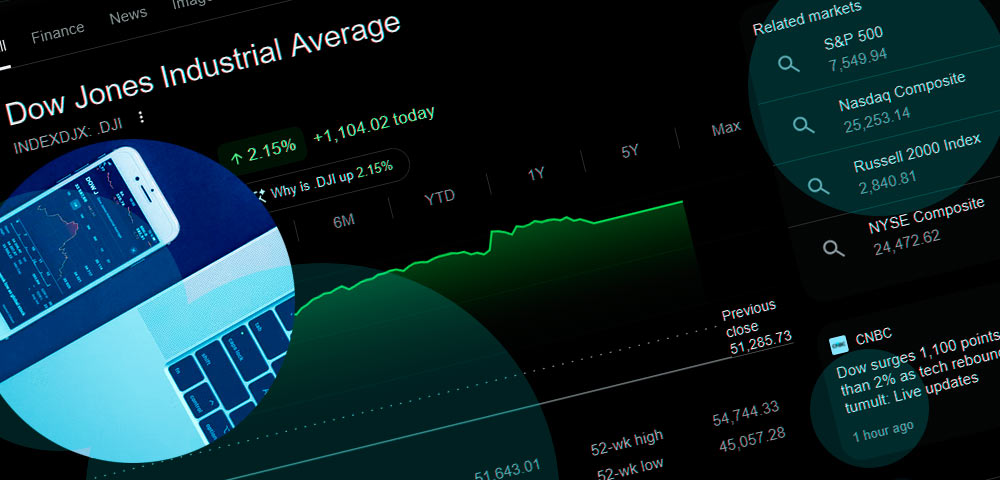

The Dow Jones Industrial Average surged 1,104.02 points, or 2.15%, to close at 52,389.75 on November 9, 2026, recovering much of last week’s losses as falling oil prices and renewed buying in industrial and technology stocks supported US equities.
The S&P 500 gained 2.35% to 7,549.94, while the Nasdaq Composite advanced 2.74% to 25,253.14. The Dow finished above its November 3 election-day closing level, although the broader market has yet to recover fully from the recent sell-off.
- The Dow Jones Industrial Average surged 1,104 points (+2.15%) to 52,389.75 on November 9, supported by falling oil prices and gains in industrial and technology stocks. The S&P 500 rose 2.35%, while the Nasdaq gained 2.74%.
- Goldman Sachs and JPMorgan maintain year-end 2026 S&P 500 targets of 8,000, while Morgan Stanley expects the market correction to approach its final stages. S&P Global estimates 18.7% medium-term upside potential across Dow constituents.
- The Dow Jones base-case forecast for year-end 2026 is 51,500–54,500, with a bullish target of 55,000–56,000 and downside risk toward 49,000–51,000. Inflation data, Federal Reserve policy and corporate earnings remain the main drivers.
As of November 10, the outlook for the Dow depends on whether lower energy prices and resilient corporate earnings can offset persistent inflation, elevated interest rates and uncertainty surrounding artificial intelligence investment.
Dow Jones Recovery Supported by Falling Oil Prices and Industrial Stocks
US crude oil futures declined 4.38% to $86.85 per barrel on Monday, while Brent fell 5.85% to $92.57. Lower energy costs eased inflation concerns and improved sentiment toward companies exposed to industrial production, transportation and consumer spending.
Caterpillar and Goldman Sachs contributed to the Dow’s advance, reflecting renewed interest in cyclical companies following last week’s technology-led correction.
Technology shares also recovered. Advanced Micro Devices gained approximately 13%, Broadcom rose nearly 9%, and the iShares Semiconductor ETF advanced more than 7%.
NVIDIA remained an exception, losing around 4% amid an independent investigation involving its chief executive. The rebound extended beyond technology. Ten of the S&P 500’s eleven sectors advanced, with industrials leading gains.
Broader market participation is important for the Dow because its performance depends on industrial, financial, healthcare and consumer companies rather than exclusively on large technology stocks.
Investment Banks Maintain Positive US Stock Market Forecasts
Major investment banks remain broadly constructive on US equities, although their forecasts differ on the timing and durability of a recovery.
- Goldman Sachs maintains a year-end 2026 S&P 500 target of 8,000, supported by corporate earnings growth. Its longer-term forecast places the index at 8,700 over a 12-month horizon, reflecting expectations that earnings expansion will contribute more to returns than rising valuation multiples.
- JPMorgan also projects an S&P 500 level of 8,000 by the end of 2026. The bank expects corporate profitability and investment in AI infrastructure to support earnings, while warning that high interest rates and geopolitical risks could limit valuation expansion.
- Morgan Stanley considers the market correction to be approaching its final stages. However, the bank continues to identify the 7,100–7,300 range as potential S&P 500 support and sees the possibility of another test of recent lows before a sustained recovery.
Oppenheimer maintains that corporate earnings and economic fundamentals remain sufficiently strong to support further equity gains. The bank considers last week’s sell-off disproportionate to the immediate deterioration in business conditions.
Standard Chartered also identifies signs that US equities may be approaching a bottom, but expects restrictive monetary policy to remain a challenge. Its outlook includes the possibility of two additional Federal Reserve rate increases by the first half of 2027.
These forecasts apply primarily to the broader US stock market, not directly to the Dow Jones Industrial Average.
A separate S&P Global Market Intelligence assessment estimates approximately 18.7% weighted medium-term price-return potential across the Dow’s 30 constituents, based on individual company analyst forecasts. This is not an official year-end index target.
Dow Jones Industrial Average Forecast for November and December 2026
Following the November 9 rebound, three scenarios define the near-term outlook.
| Scenario | Dow Jones forecast | Market conditions |
|---|---|---|
| Bearish | 49,000–51,000 | Persistent inflation, higher Treasury yields and renewed selling |
| Base case | 51,500–54,500 | Stable earnings, lower oil prices and continued volatility |
| Bullish | 55,000–56,000 | Softer inflation, improving market breadth and stronger risk appetite |
These are conditional market scenarios, not official price targets from investment banks.
Base case: Dow Jones trades between 51,500 and 54,500
The central outlook assumes corporate earnings remain resilient while inflation prevents the Federal Reserve from adopting a more accommodative policy.
Financial, industrial and healthcare stocks could support the index, although uncertainty around borrowing costs and economic growth may limit further appreciation.
A sustained move above 54,500 would strengthen the case for a broader recovery.
Bullish case: Dow Jones approaches 56,000
Further declines in oil prices, easing geopolitical risks and stronger earnings expectations could extend the rally.
A recovery in capital spending and industrial demand would particularly benefit the Dow’s cyclical constituents.
Under these conditions, the index could advance toward 55,000–56,000 before year-end, representing approximately 5%–7% upside from its November 9 close.
Bearish case: Dow Jones retests 49,000–51,000
A higher-than-expected inflation reading could reinforce expectations of additional Federal Reserve tightening.
Rising bond yields would put pressure on equity valuations, while renewed weakness in technology spending could spread to industrial companies.
The recent recovery would become vulnerable if the Dow failed to maintain support around 51,000.
US Inflation and Federal Reserve Policy Will Determine the Next Move
The October consumer price index, scheduled for release on November 10, is the immediate test for the market.
Investors will also assess producer prices later in the week and upcoming corporate earnings to determine whether inflation and financing costs are affecting business profitability.
The October employment report showed 165,000 additional jobs, supporting confidence in economic growth but also reducing the urgency for monetary easing.
For the Dow, lower oil prices are beneficial, but persistent wage and services inflation could keep Treasury yields elevated.
Dow Jones Stock Market Outlook: Can the Rally Continue?
The Dow’s recovery above 52,000 indicates that investors remain willing to increase equity exposure after sharp declines. Gains in financial and industrial stocks also suggest that market participation is broadening. Nevertheless, one strong trading session does not establish a new upward trend.
Investment banks continue to expect positive US equity returns into 2027, supported by earnings growth. The main disagreement concerns whether another period of selling is necessary before the market can advance sustainably.
The near-term outlook favors consolidation between 51,500 and 54,500, with potential upside toward 56,000 if inflation moderates and corporate earnings remain strong.
For 2027, the decisive factors will be earnings growth across Dow constituents, the direction of Federal Reserve policy and whether the recovery expands beyond technology into industrial, financial and consumer businesses.