
Questions about inflation, rapidly evolving government policies, and the next phase of the artificial intelligence (AI) revolution highlight the potential for greater dispersion in companies’ business fundamentals.
Such a fluid backdrop favors an investment strategy that focuses on what’s to come, instead of what has already happened.
Putting experienced investment analysts in charge of stock selection in their area of expertise should lead to a portfolio that is better positioned to capture how a company’s prospects and risk/reward profile might change over time.
Empowering these analysts with the tools of the digital age can help them to uncover risks and opportunities that others might miss.
The promise and pitfalls of alternative data in investing
The ever-expanding universe of alternative data can enhance investment research and decision-making by providing more timely and granular views of what is happening in a company, industry, or the broader economy.
Artificial intelligence (AI) could accelerate the discovery of investment insights from nonstandard data. Large language models (LLMs) excel at categorizing and recognizing patterns in complex textual information, while agentic AI makes it easier to develop custom data scrapes from the web.1
Vendor datasets and information scraped from public websites can contain valuable signals related to customer sentiment, pricing behavior, supply chain health, hiring priorities, and other business indicators. Alternative data can also help analysts drill deeper into specific geographies, business lines, or product categories to unearth important trends.
However, not all datasets are equally useful. Strong alternative data can offer unique perspectives on aspects of a company or the economy, provide early insight into the direction of a key indicator, or help test what corporate management teams have communicated to the market.
Data access alone isn’t a durable investment advantage. Markets are dynamic and highly competitive. The benefits of many alternative data sources tend to erode over time and with wider adoption.
Any sustainable investment edge from alternative data tends to reside in people and processes.
Keys to unlocking alternative data’s power
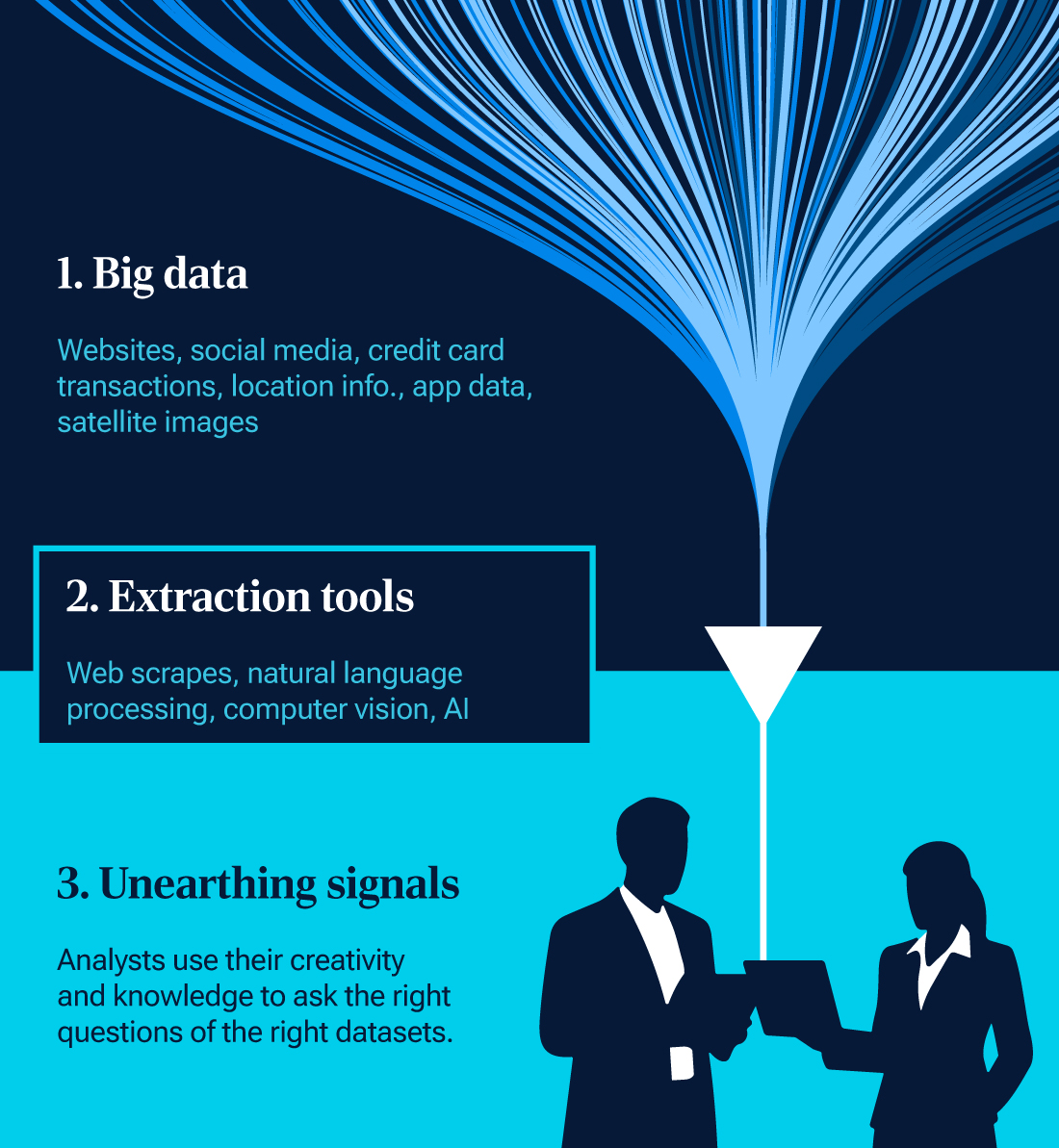
More information means more noise. Extracting useful signals from the flood of alternative data, in our view, requires significant resources and close partnership between fundamental analysts and data specialists.
- Fundamental strength: Experienced research analysts know the businesses they cover inside and out, from what drives a company’s unit economics and growth prospects to the needs of its customer base and how its competitive landscape might evolve. Deep domain expertise positions analysts to identify which questions matter most for a stock and where alternative data might reveal a gap between fundamentals and market expectations.
- Strength in numbers: Our Investment Data Insights (IDI) team specializes in innovative sourcing and analysis of pertinent datasets. Team members have quantitative expertise in common but hail from diverse backgrounds, including AI, machine learning, and astrophysics. These different ways of thinking encourage innovation and creative problem-solving. Their role includes evaluating potential data sources, identifying each dataset’s biases and blind spots, and monitoring signal quality and effectiveness over time.
IDI’s data analysts are embedded with our sector analysts. Together, they develop and maintain bespoke models and tools aligned with the questions the analysts are trying to explore.
Blending data from a variety of sources provides a multifaceted view of what’s happening in a company or industry and what might come next. It also reduces reliance on any single signal and helps find complex relationships within and across datasets.
Mining craft: Unearthing investment insights from alternative data
(Fig. 1) Deep understanding of data sources and companies helps surface signals
For illustrative purposes only.
Time arbitrage: A durable investment edge
Hedge funds pioneered the use of a wide range of alternative data, often to get an edge on predicting a company’s next quarterly results or how investor expectations and sentiment might shift between reporting dates.
Playing a different game can be advantageous.
Trading over shorter time frames and at higher frequency is an intense arms race where today’s alpha can quickly become tomorrow’s beta.
Over longer periods, business fundamentals matter more than the market narrative of the day.
Using alternative data to pursue deeper questions about a company’s three- to five-year prospects can help analysts to uncover short-term dislocations that create favorable risk/reward opportunities for patient investors.
Case study: Connecting the dots amid AI-driven change
Lee Sandquist
Associate portfolio manager and industrials analyst
Our corporate access team organizes a yearly trip to Silicon Valley for analysts and portfolio managers to meet with management teams from roughly 50 public and private technology companies.
The 2022 tour, which occurred shortly after ChatGPT’s launch, left me with a big question: If generative AI requires increasingly dense arrays of powerful graphics processing units (GPUs), what would that mean for the rest of the supply chain?
Fieldwork helped frame the opportunity for the connectors that transmit data in electronic systems.
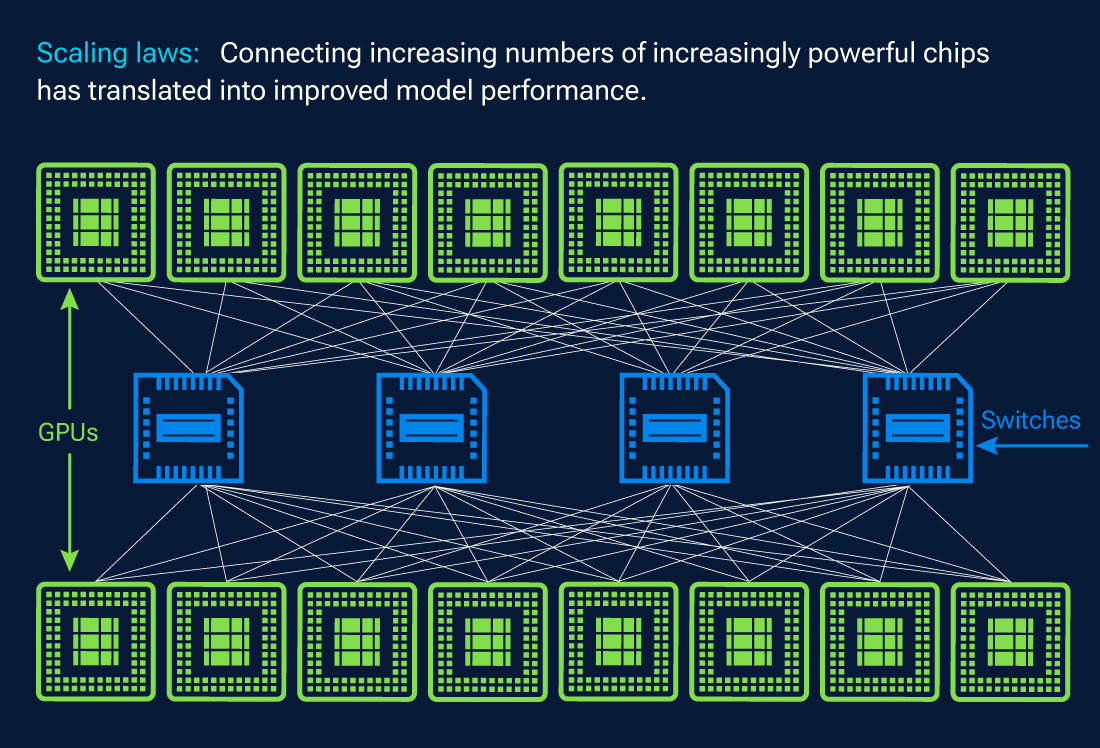
Conversations with engineers at various data center trade shows suggested that AI system architecture wouldn’t require one connector per GPU as in the past but rather discrete links between each GPU and all the others. This shift pointed to a step-change in demand for electronic connectors and a growth rate that would be multiples of GPU deployment.
Alternative data helped strengthen my confidence in this investment thesis.
Many industrial companies boast extensive product portfolios that require significant detective work to understand. I’ve worked closely with the IDI team to build tools that incorporate product pricing, inventory, and other data scraped from public websites. These dashboards provide a more granular and timely view of which parts of a business are accelerating or decelerating.
As the AI-driven growth story in connectors has become better understood, the key question has shifted to sustainability.
The copper cabling used widely in AI datacenters has physical constraints. Faster transmission speeds require shorter copper cables to prevent excess heat and ensure signal quality, eventually limiting how many GPUs can be interlinked in a cluster and opening the door to competing connection technologies.
Wiring the AI brain
(Fig. 2) A step change in interconnection complexity and demand
For illustrative purposes only.
At the same time, data center operators likely prefer the cost and reliability of copper connectors, suggesting that this transition, when it comes, won’t be a zero-sum game.
Web-scraped product pricing and inventory data provide valuable signals related to how the connector mix in AI datacenters might shift and the magnitude of the potential challenges and opportunities for the companies I cover.
That said, alternative data is only one element in an investment case. Company meetings, conversations with industry experts, and close collaboration with our technology analysts also feed into the discovery process.
When I toured an under-construction data center earlier this year, my focus was on self-collected alternative data—the logos and labels on newly delivered and discarded boxes as well as the brands of installed hardware and equipment.
All these efforts help me to test and refine my investment thesis about how long the interconnection companies that I cover can outgrow GPU demand.