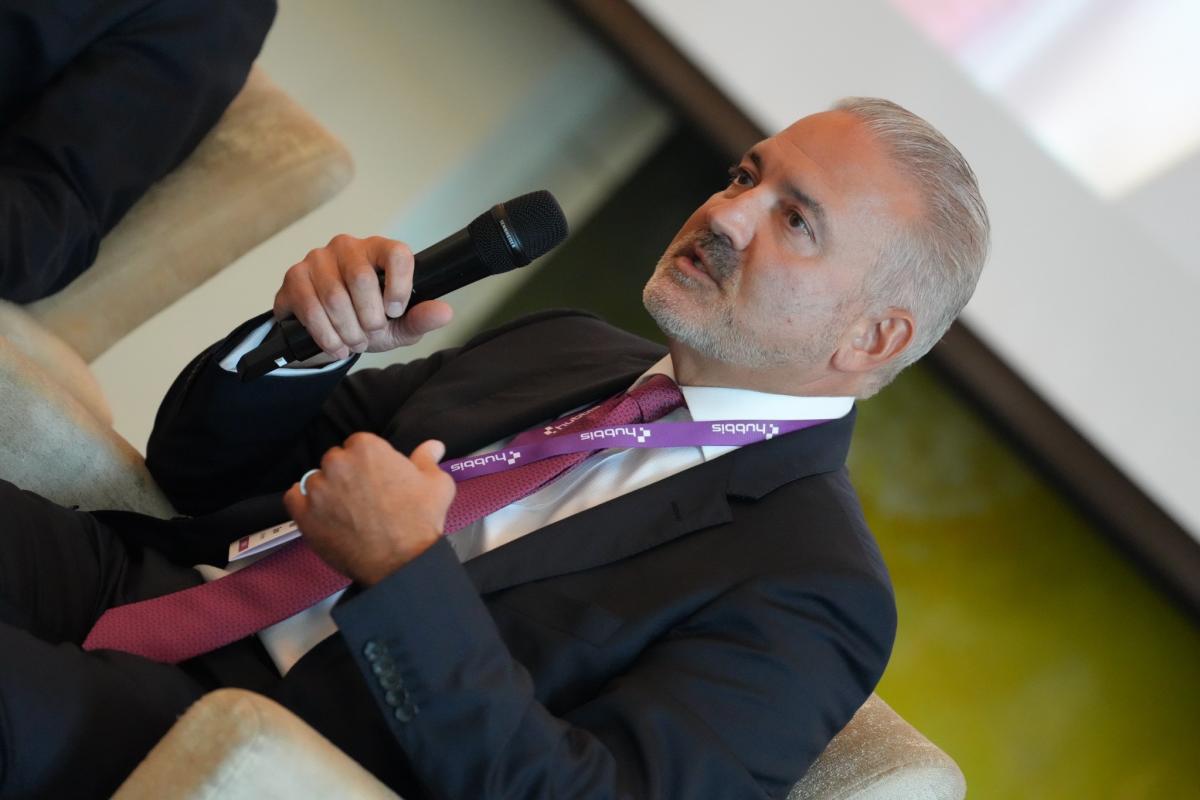

Every family office is different, but the ones that endure share a common foundation: governance, structure and the willingness to separate the investment business from the operating business that created the wealth. Rossen Djounov, Global Head of Client Solutions at GAM Investments, made that case at the recent Middle East Private Capital Forum 2026, drawing on nearly two decades of experience across London, Asia and Zurich to describe how family offices in the Gulf are institutionalising, and where the process still has room to develop.
The panel, hosted by Hubbis in the United Arab Emirates, explored how family offices in the region are professionalising their capital structures and investment processes. Djounov, who is relocating to Dubai, offered a comparative perspective shaped by his work with family offices across multiple regions, addressing the generational dynamics that shape priorities, the practical question of what a family office’s first hire should be, and why Dubai’s infrastructure has compressed a process that took other jurisdictions far longer.
Key Takeaways
- Family office priorities vary significantly depending on generation, location and longevity, according to Djounov, with governance, succession planning, philanthropy and impact investing becoming increasingly relevant as families and their investment structures mature.
- Investment management is an expensive and complex business, and Djounov cautioned against treating it as a simple extension of entrepreneurial success.
- The first hire for a family office should not necessarily be a CIO, with Djounov arguing that a trusted operator with experience in structure, taxation and business formation is a more appropriate starting point.
- The separation of operating businesses from investment activities was a critical early step in the region’s family office development, and one that took time for families to adopt.
- Dubai’s regulatory, talent and infrastructure environment has reached a level of sophistication that Djounov described as surpassing some established financial centres, compressing the institutionalisation timeline for Gulf-based family offices.
Every Family Office Is Different
When asked whether next-generation family members bring distinct investment philosophies, Djounov began with a qualification. “Meeting one family office means you’ve only met one family office,” he said. “They all come very, very different with very different priorities.”
He described a pattern in which the character of a family office shifts according to which generation is leading it. First-generation offices, he said, are typically established by “a highly successful entrepreneur who feels they know it all, so they’re better than anyone else, and they are highly involved in the investment management.” The assumption, Djounov noted, is that investment is straightforward. “Investment to the families seems like a very simple business, but it’s very complicated,” he said. “It’s like setting up an investment management business and everything that comes with it.”
The second stage, he said, involves hiring professionals and expecting them to generate returns. Djounov observed that families may initially assume hiring experienced investment professionals is sufficient to establish a successful family office. However, he emphasised that investment management also requires substantial infrastructure, talent and governance.
The further a family office moves from its founding generation, the more its priorities evolve. Djounov contrasted Gulf-based offices with their European and American counterparts. “When you go to the family offices in Europe or in the US, and they’re fifth, sixth generation, they’re basically focused on completely different things,” he said. He identified philanthropy and impact investing as areas where major differences emerge across regions, along with the level of sophistication that comes with “longevity, knowledge, and the corporate governance.”
Beyond the Portfolio
Djounov stressed that the investment portfolio is only one dimension of what a family office needs to address. “What’s imperative here as well is to see beyond the investment piece of the portfolio,” he said. “How do we actually engage the family? How do we serve the family? And how do we focus on wealth transition to the next generation.”
He described these questions as arriving “in spades” and “accelerating fast” in the Gulf region. In Europe, he said, many of these transitions have already taken place. Djounov observed that questions surrounding family engagement, succession planning and wealth transition have been addressed for longer in more established European family offices, while these priorities are gaining momentum in the Gulf.
Separating Operating From Investing
Djounov offered a historical perspective on how family offices in the region have developed. He recalled that 15 to 20 years ago, many families in the Gulf were investing directly from their operating businesses. “People were thinking of family offices. They were investing from their operating businesses,” he said.
That created practical difficulties, particularly when dealing with regulated counterparties in other jurisdictions. Djounov described the challenge of explaining to European compliance teams why a company that appeared to be an auto parts franchise was making financial investments. “It was difficult to explain to European legal and compliance why some sort of company is investing in your company or auto parts company is investing in financial products,” he said. Djounov linked this historical practice partly to the region’s former tax environment, noting that some families had previously held investment assets within their operating businesses. “They just have one company which happens to have started from, I don’t know, franchise on auto parts, and they’re putting every investment there,” he said.
Over time, he said, families recognised the need to distinguish between operating businesses and investment activities. “It took time for people to realise that operating businesses are different from investment businesses,” he said. Carving out capital and creating dedicated investment infrastructure was a necessary step before the institutionalisation of the investment function could begin.
The First Hire Is Not a CIO
When asked directly whether a family office’s first hire should be a chief investment officer, a chief financial officer or a general counsel, Djounov argued against starting with the investment function.
Djounov argued that families should first seek professional advice on suitable corporate and legal structures before developing their investment proposition. Structure, taxation and location all need to be resolved before investment decisions are made. “Investment is like the icing on the cake,” he said.
The right first hire, in Djounov’s view, is “a good operator, business person, which could be a lawyer, could be an accountant, could be someone.” He noted that in practice, these roles are often filled by someone the family already trusts. “Typically, these businesses have started with someone the family trusts, someone they have worked with over a long period of time. It may be their investment banker who has sold in the business that comes and helps set up, private banker that they have worked with over a number of years,” he said.
Dubai Has Already Caught Up
Djounov was asked whether Gulf-based family offices have lessons to learn from the experience of Singapore, which went through a similar wealth and family office boom over the past two decades. His response was that the learning has largely already taken place.
“Not many lessons left to learn,” he said. He described the UAE’s regulatory infrastructure as strong, noting that governments across the region have studied international models and improved upon them. “The government, everywhere in the region, has learned the lessons from around the world, evolved them and implemented them to be better,” he said.
Djounov drew a direct comparison with Hong Kong, where he had previously been based. “I used to feel it doesn’t get more sophisticated and more efficient than Hong Kong, for example. Dubai is better, more efficient, more sophisticated. You can then get things done faster than in Hong Kong,” he said.
The talent dimension, he added, has also matured. “Many people here have worked elsewhere, certainly studied, graduated, have experience from anywhere in the world,” he said. The result, Djounov argued, is that the Gulf has institutionalised its wealth management infrastructure over a compressed period. “Almost over a very short, condensed period of time, we have institutionalised the business,” he said. “Because we brought our skill set, our knowledge, our connectivity, if you like, with the rest of the world here, and are applying it now.”
Where further institutionalisation is still needed, Djounov said, is in the relationship between the infrastructure and the families themselves. “Perhaps what needs to institutionalise is the relationship with the families and their understanding of the benefits of corporate governance and the dependent talent that the people they employ brings to the benefit of the family,” he said.