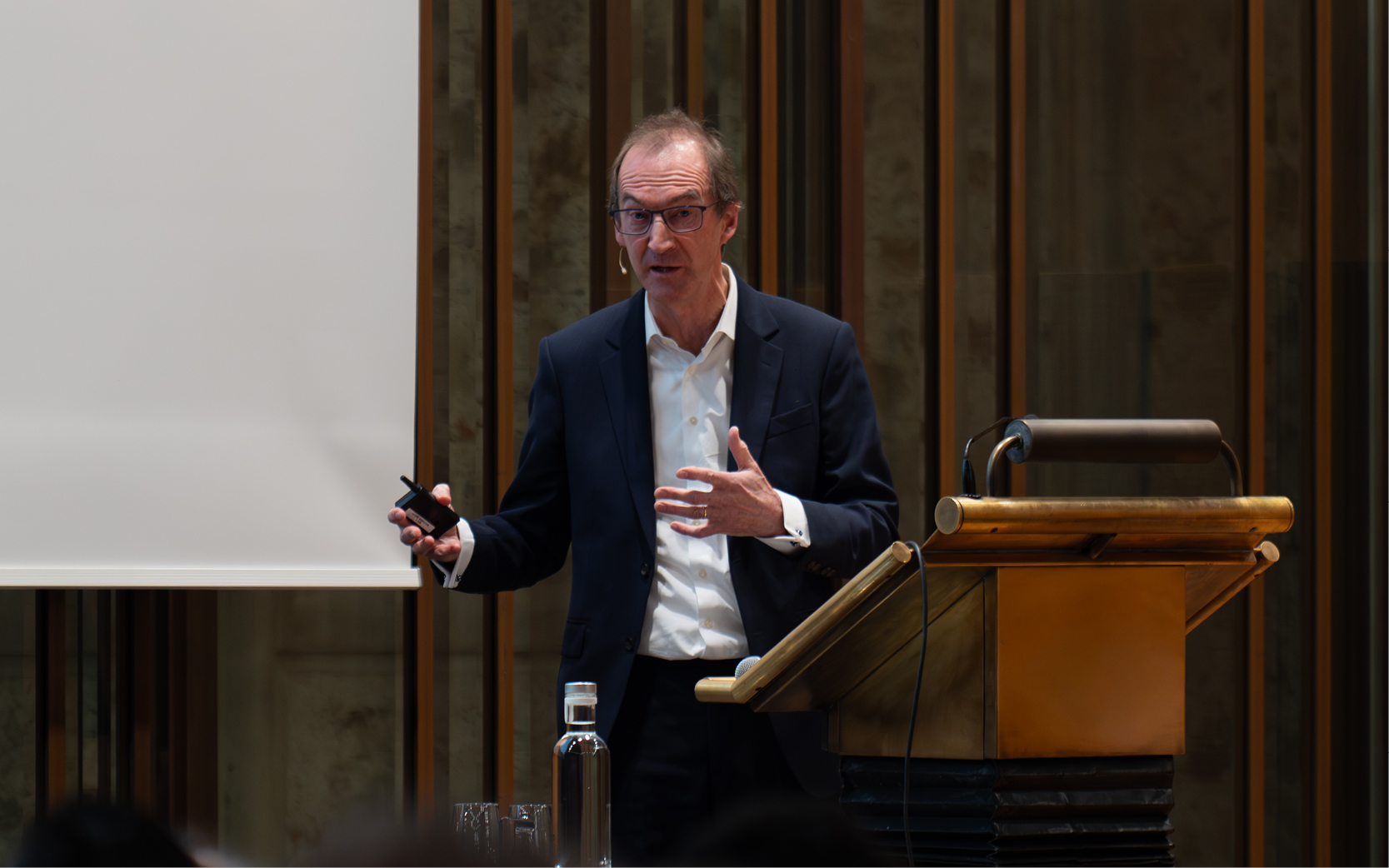
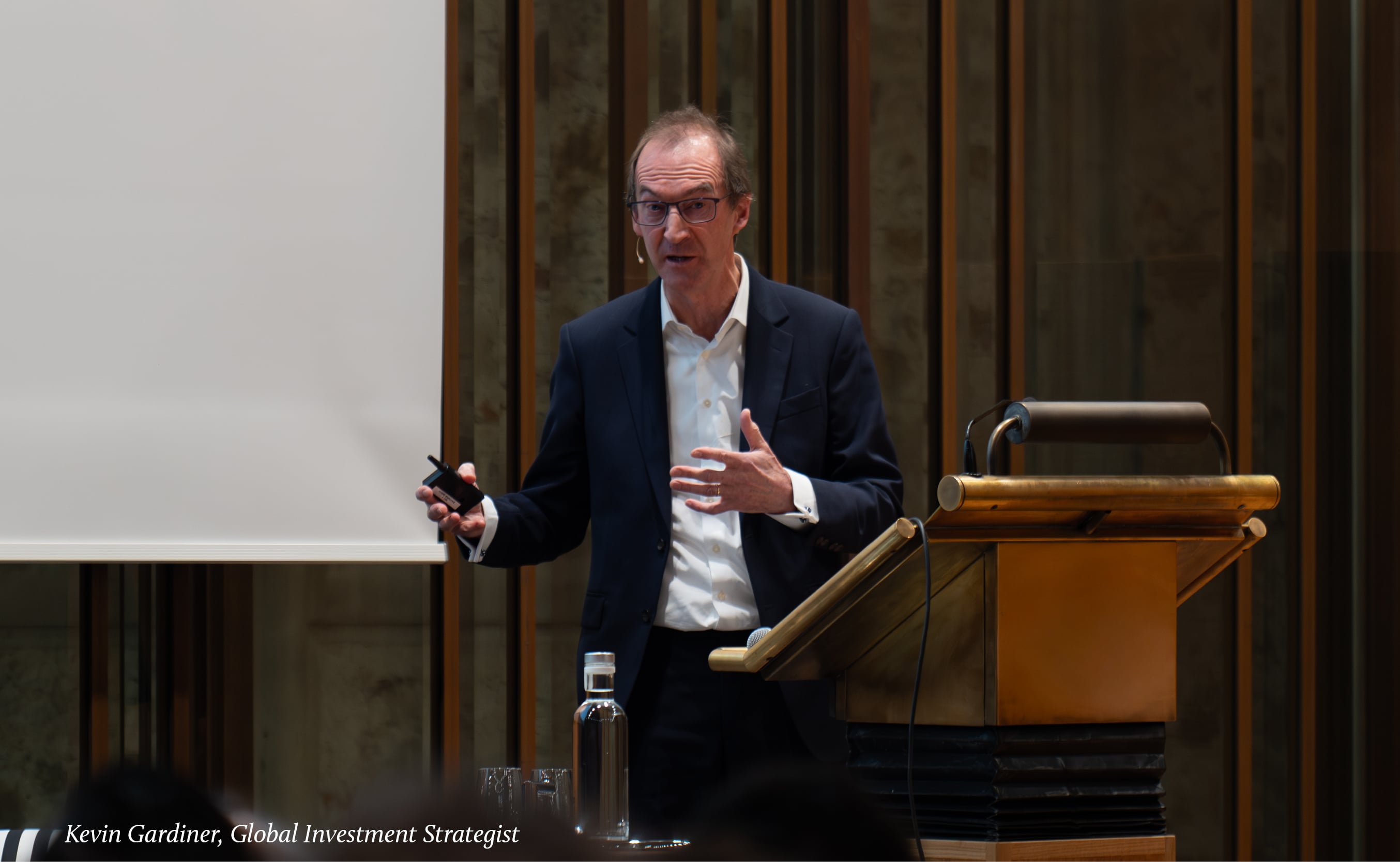
“When something dramatic is happening, your instinct is to act, but reacting to noise is rarely the right strategy.“
– Kevin Gardiner, Global Investment Strategist
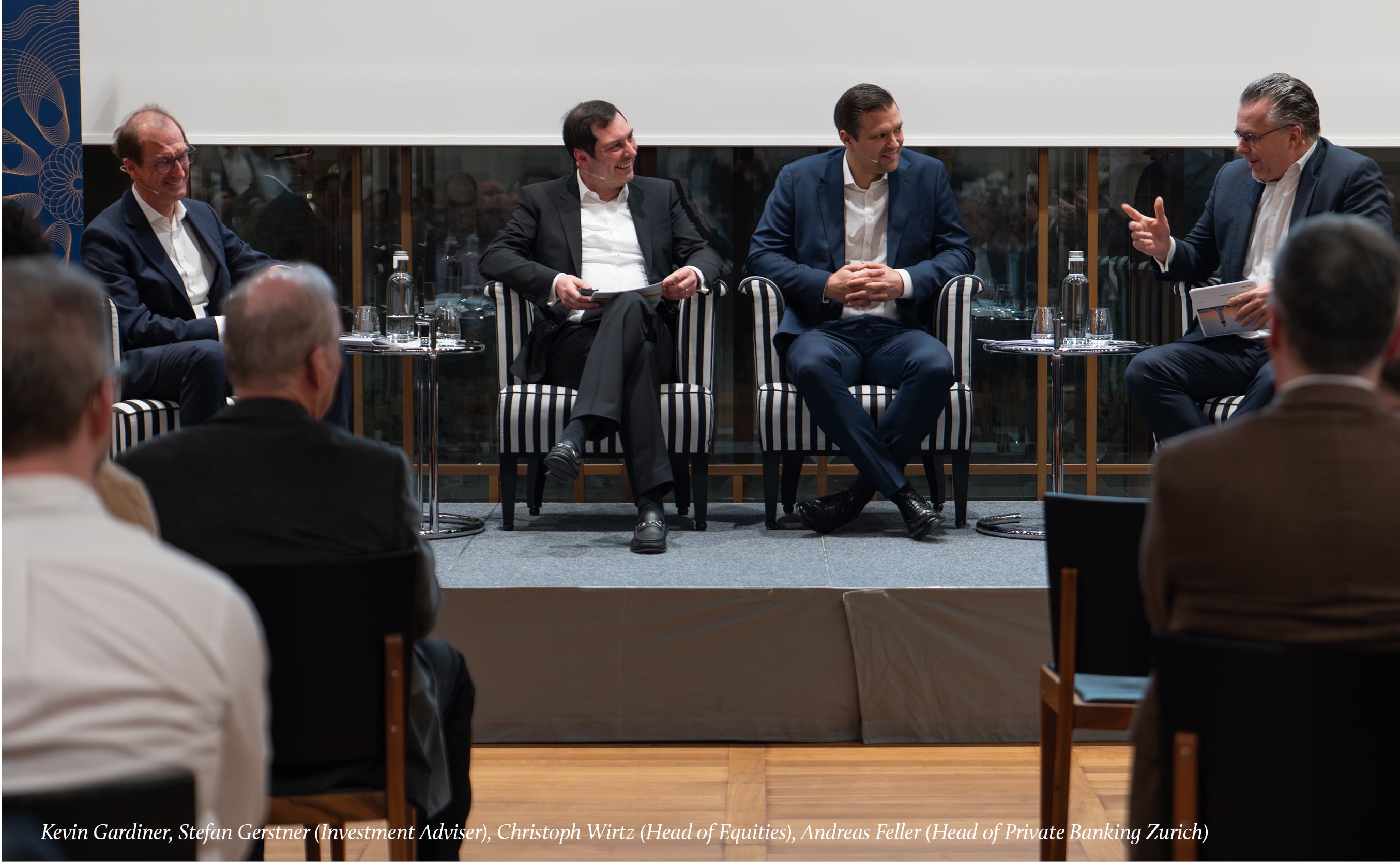
That observation, shared at this year’s Investment Outlook event in Zurich, captures the essence of today’s investment landscape. The world certainly feels noisy: geopolitics is unsettled, political rhetoric is louder than usual, and markets are confronted with competing narratives about inflation, interest rates and the implications of rapid technological change. Yet beneath the surface, the economic picture remains surprisingly steady.
The global economy enters 2026 in a state that is resilient but unspectacular. Growth continues at a near‑trend pace, private balance sheets remain in good health, and the business cycle shows few of the excesses that typically precede a downturn. This steady expansion is occurring despite heightened political turbulence, rather than because conditions are unusually calm.
Against this backdrop, the investment message is a familiar one: stay invested, stay patient, and avoid being pulled off course by the noise. In the sections that follow, we explore why the global backdrop remains more stable than the headlines suggest, and where investors should remain particularly attentive in the year ahead.
A steady business cycle
Economic activity across major regions remains broadly aligned with long‑run trends. The US grew by around 2% last year, China by roughly 5%, and Europe by about 1%—figures that tell a story of “near‑trend normality” rather than boom or bust.
One explanation for this stability lies in the behaviour of the private sector. Households and businesses, particularly in the US, are largely funding spending through cashflow rather than borrowing. Even with elevated investment in artificial intelligence infrastructure, aggregate cashflow continues to cover investment requirements. This stands in stark contrast to the leverage‑driven expansions of the late 1990s and early 2000s, and it reduces the likelihood of a recession triggered by the need to unwind financial excesses.
Alongside this, governments continue to run substantial fiscal deficits, and the Federal Reserve has quietly returned to quantitative easing—not to counter recession, but to pre‑empt potential frictions in short‑term funding markets. With both public demand and private balance‑sheet strength underpinning activity, the base case remains continued, if unspectacular, expansion.
Inflation: lower, but not low
Inflation has unquestionably fallen from its post‑pandemic highs, yet it now shows signs of settling at slightly elevated levels. The most plausible range for the year ahead appears to be 2–4%, rather than an effortless return to the Federal Reserve’s 2% target.
This stickiness matters. Markets have priced in deep and rapid rate cuts, but the economic backdrop may not justify them. Growth is firm, labour markets remain tight, and fiscal policy remains expansionary. As Paul Volcker—known for relying more on instinct than models—might remark, inflation risks still outweigh deflation risks. The danger is that central banks cut too quickly.
Our own view is that interest rates are unlikely to fall as far as markets expect, and when they do fall, they may not stay down for long.
Bond vigilantes?
Despite large deficits, government bond yields have been remarkably calm. This may feel counterintuitive given political rhetoric, but history offers an explanation: there is no reliable long‑term relationship between government borrowing and bond yields.
Looking across countries or across history, from 18th‑century Britain to the post‑war US—yields respond far more consistently to inflation and growth dynamics than to fiscal arithmetic. Markets occasionally react to poorly presented budgets, but these episodes are usually fleeting. The notion of “bond vigilantes” enforcing discipline may be colourful, but it is rarely accurate.
The important implication for investors is that the bond market remains anchored not by politics, but by macroeconomic fundamentals. For now, these fundamentals point to stability rather than disruption.
Currencies, gold and the future of the dollar
Currency markets have been quieter than the headlines might suggest. The dollar weakened last year, but from levels that were stretched rather than extreme. Its valuation today sits close to long‑run averages.
Gold, meanwhile, has surged—reflecting not only geopolitical uncertainty but also the renewed appeal of assets outside the traditional financial system. Yet gold remains volatile, and cryptocurrencies even more so. For long‑term inflation protection, no asset—stocks, gold or digital currencies—offers a perfectly smooth hedge.
As for the perennial question of whether the dollar’s reserve‑currency status is at risk, the practical reality is unchanged: there is no viable alternative. To be a reserve asset, a currency must be available in large quantities to foreign holders. The renminbi cannot fulfil this role while China maintains structural surpluses and capital controls. The euro, for now, lacks institutional completeness. The dollar remains in place not because it is flawless, but because nothing else is yet capable of replacing it.
The geopolitical landscape shifts, what about the investment landscape?
Geopolitical analysts increasingly argue that the world has moved from a simple “two‑body problem”—the West versus the East—to a “three‑body problem” in which Europe has become a strategically ambiguous third force. In physics, adding a third object makes the system mathematically unpredictable.
From an investment perspective, however, the world has always been a multi‑variable system. Economists routinely juggle dozens of moving parts. An extra layer of political uncertainty may complicate the picture further, but it does not redefine the investment environment.
The more immediate challenge for markets is how to navigate another period under a highly idiosyncratic US president. Here, objectivity is essential. Investors must separate personal views from portfolio decisions. Trump’s rhetoric is often dramatic, but he frequently uses language to trigger negotiations rather than to signal literal intentions.
“We mustn’t allow our thoughts about political figures to affect our investment judgement. All that matters is the global economy, valuations, interest rates and risk appetite.”
– Kevin Gardiner
Many of the questions he raises, such as Europe’s defence under‑spending, are uncomfortable but legitimate. Markets have lived through similar episodes before, and positive outcomes remain entirely possible.
Trade policy has been another source of concern, but the economic reality is more measured. Recent tariff announcements have added friction to global supply chains, yet the scale of the measures, often comparable to typical annual currency fluctuations, suggests disruption rather than derailment. Tariffs add “sand in the wheels,” but are not enough to make them fall off.
Equities: strong earnings, stretched valuations
Corporate profits have been extraordinarily strong, surpassing even optimistic expectations set during the post‑pandemic recovery. Yet share prices have risen even faster. On most metrics, valuations are now close to historic highs.
A significant share of earnings momentum comes from companies directly involved in artificial intelligence—semiconductors, data centres, software infrastructure. The broader corporate sector has yet to experience the productivity revolution that markets appear to be pricing in.
Here, a note of caution is warranted. Much of the popular conversation around AI overlooks a critical point: many business problems are not computable. Algorithms excel at rule‑based tasks but cannot replicate the non‑algorithmic reasoning central to human intelligence. As Kurt Gödel and Roger Penrose have argued, systems of logic have inherent limits. For now, AI’s commercial impact may remain narrower than the more exuberant narratives suggest.
Staying the course
Against this backdrop, our investment stance remains disciplined. We continue to stay invested across markets, but we are keeping portfolios close to their long‑term strategic allocations. We are avoiding large tactical positions—either bullish or bearish—because the short‑term environment is simply too noisy for high‑conviction calls.
The most important principle in such periods is a simple one:
“Don’t just do something — stand there.”
– Kevin Gardiner
Long‑term investing rewards patience and composure. The world may feel noisy, but noise is not the same as danger. Growth continues, private balance sheets are healthy, central banks remain cautious, and the global economy—despite everything—keeps moving forward.