
Brazil Biofuel Market Report 2026
Brazil is developing into one of the most calculated biofuel markets globally‚ reaching record levels of capital inflows as energy systems accelerate their decarbonization efforts. A strong agricultural base‚ the world’s most integrated network of ethanol infrastructure‚ and a nascent SAF sector position Brazil well in global and domestic capital flows as leading investors search for opportunities in renewable energy.
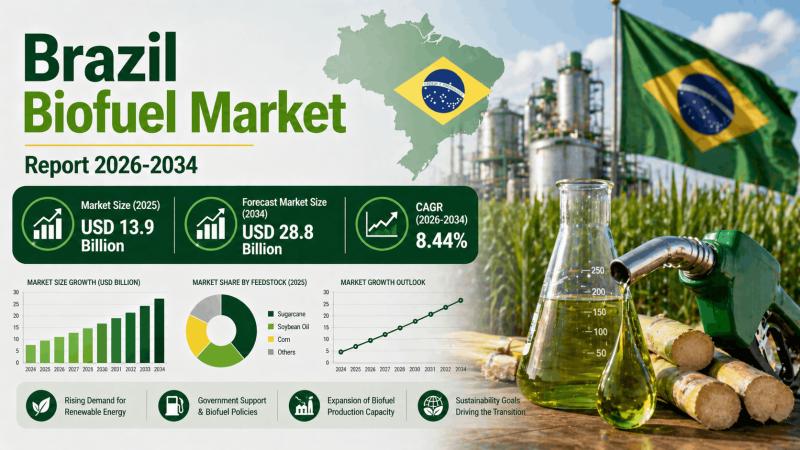
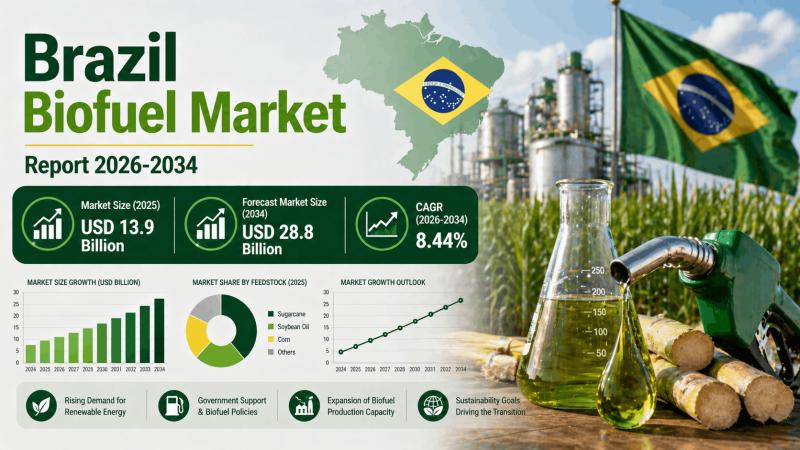
According to IMARC Group, the Brazil biofuel market size reached USD 13.9 billion in 2025 and is expected to reach USD 28.8 billion by 2034, exhibiting a CAGR of 8.44% during 2026-2034. This growth trajectory is anchored in expanding ethanol output, rising biodiesel blending mandates, and a wave of multi-billion-dollar commitments targeting next-generation biofuels and SAF.
Read the full report for more information: https://www.imarcgroup.com/brazil-biofuel-market
Brazil Biofuel Market at a Glance
Renewable biofuels are fuels created from plant‚ algae and organic waste. The two biofuels in the country are biodiesel‚ a mixture of vegetable oils and/or animal fats produced by the chemical process of transesterification‚ and ethanol produced from sugarcane or sugarcane juice. These are used as gasoline and diesel fuel mixtures‚ to reduce carbon emissions from road vehicles and industrial machines.
The dominant characteristic of the Brazilian biofuel industry is the integration between feedstock base‚ processing capacity and governance. The Brazil biofuels industry covers biodiesel‚ ethanol‚ and new generation biofuels such as cellulosic ethanol and SAF using sugar crops‚ coarse grains‚ vegetable oils‚ agricultural residues‚ and other feedstocks as raw materials. This diversification helps ensure resilience across price cycles‚ creating one of the most cost-competitive renewable fuel platforms around.
Investment Momentum: Why Capital is Flowing into the Brazil Biofuel Market
Investor activity in the Brazil biofuel market has accelerated sharply, signaling strong confidence in the country’s renewable energy roadmap. Several landmark commitments illustrate the scale and pace of investment:
• In June 2024, Mubadala Capital announced plans to invest USD 13.5 billion in Brazil’s biofuels sector over the next decade. The investment includes a project by Acelen to produce biofuels and the conversion of a Petrobras refinery in Bahia.
• In August 2024, the Brazilian government allocated R$6 billion (approximately USD 1.09 billion) to promote the development of biorefineries for sustainable aviation fuel and marine biofuels. The initiative draws joint contributions from the National Bank for Economic and Social Development (BNDES) and FINEP, with funding open to Brazilian companies focused on fuel production or R&D.
• In October 2024, Grupo Potencial announced plans to invest USD 108.86 million to expand biodiesel production at its Paraná facility, targeting the position of world’s largest producer of soy oil-based biodiesel. The expansion will increase annual output from 900 million to 1.62 billion liters.
These commitments highlight a structural shift. Capital is no longer flowing into traditional ethanol capacity alone but is increasingly directed toward advanced biorefineries, SAF, marine biofuels, and integrated renewable platforms.
How is Brazil Shaping the Future of Sustainable Aviation Fuel?
SAF is one of the most planned segments of the Brazilian biofuel market. As airlines are expected to reduce their emissions‚ Brazil is well positioned to produce aviation biofuels based on the existing supply of feedstock. In addition‚ national policies are seen as favorable for the aviation biofuel sector.
The federal government allocated R$6 billion to biorefineries producing SAF and marine biofuels through BNDES and FINEP to offer long-tenor finance to projects unable to attract financing due to their long payback periods. When combined with private-sector equity such as USD 13.5 billion of Mubadala Capital’s planned investment‚ Brazil is building one of the largest SAF supply ecosystems outside North America and Europe.
This SAF push is aligned with global commitments made by the aviation industry to utilize SAFs to reduce emissions. With strong demand coming from European and Asian airlines‚ Brazil‚ with its ability to produce SAF using sugarcane‚ soybean oil and other agricultural waste‚ is positioned to export SAF to decarbonize the global aviation market.
What is Driving the Brazil Biofuel Market?
Several structural and policy-driven forces are accelerating market expansion. The most influential growth drivers include:
• Rising domestic and export demand for ethanol and biodiesel, supported by global decarbonization mandates
• Government blending mandates that progressively raise biofuel content in transport fuels
• Strong feedstock base, anchored in sugarcane, soybean, and corn production
• Flex-fuel vehicle penetration, which gives consumers the option to choose between ethanol and gasoline
• Investment in advanced biofuels, particularly cellulosic ethanol and SAF
• Carbon credit and ESG-aligned financing, supporting long-tenor capital availability for renewable fuel projects
• Energy security priorities, reinforcing the role of domestically produced renewable fuels
These drivers create a self-reinforcing growth cycle where policy, capital, and feedstock availability work together to support sustained expansion.
Ethanol: The Backbone of Brazil’s Biofuel Leadership
The Brazil biofuel market is almost entirely ethanol. Brazil is the world’s largest ethanol producer‚ and continues to expand production to meet growing domestic and international demand‚ including countries with carbon emission reduction goals.
Brazil produced 35.4 billion L of ethanol in 2023‚ up 15.5% compared to 2022. Anhydrous ethanol blended with gasoline production went up 13.5% compared to 2022 and hydrated pure ethanol sales increased 16.8%. Production was highest in the Southern region‚ which produced 17.2 billion liters or 48.5% of the total.
Flex-fuel vehicles are by far the most common vehicles sold in Brazil and consumers can choose either ethanol or gasoline. Ethanol blending mandates and incentives have ensured that ethanol is one of the most certain forces for growth in the Brazil biofuels market.
Biodiesel: Mandates Driving the Next Wave of Capacity Expansion
Government policy in Brazil‚ which includes the mandatory blending of an increasing percentage of biodiesel into diesel fuel‚ supports rapid biodiesel industry growth.
In March 2024‚ Brazil’s Chamber of Deputies approved a draft law to gradually increase the biodiesel blend to 20% in 2030‚ starting at 15% in 2025. The bill also mandates a traceability program to monitor fuel quality and allows the market to use a higher blend. It will help Brazil accelerate its energy transition and economic development‚ while reducing dependence on fossil fuels.
Higher blending mandates mean a higher demand for feedstock‚ especially soybeans. As the most common feedstock for Brazilian biodiesel‚ they create new investment possibilities like Grupo Potencial’s biodiesel plant in the state of Parana‚ and foster investment in oilseed crushing and logistics infrastructure as well as biodiesel refineries.
Evaluate Market Opportunity with the Business Sample Report: https://www.imarcgroup.com/brazil-biofuel-market/requestsample
Advanced Biofuels: The Rise of Cellulosic Ethanol
Brazil’s use of second-generation biofuels has considerably outpaced first-generation biofuels. Cellulosic ethanol‚ a prominent second-generation biofuel‚ differs from first-generation biofuels in that it is derived from agricultural crops’ byproducts‚ as opposed to those that can be used as food sources. This conserves resources‚ reduces greenhouse gases and strengthens energy security.
In May 2024‚ Brazil’s Raízen opened its second cellulosic ethanol plant in São Paulo in response to growing European demand. At 440 million liters/year‚ the R$1.2 billion facility doubles the company’s annual capacity of cellulosic ethanol production. Raízen also announced the expansion of its operations‚ with four new plants and a possible return to contractual sales next year.
The trajectory also positions Brazil as the global leader in next-generation biofuels‚ with investments in cellulosic ethanol likely to lead to a step change in the role of renewables in global markets‚ notably in aviation‚ shipping and heavy industry‚ where advanced biofuels are likely to be the dominant decarbonization option.
Which Segments and Regions Lead the Brazil Biofuel Market?
The Brazil biofuel market is segmented across type, feedstock, and region.
By Type
The value chain includes biodiesel‚ ethanol and second generation biofuels‚ with ethanol in particular accounting for the majority in terms of volume and biodiesel enjoying roll on blending mandates.
By Feedstock
Feedstock is divided into four categories: coarse grain‚ sugar crop‚ vegetable oil and other. Most ethanol production from sugars is produced from sugar crops‚ mainly sugarcane. Coarse grains and agricultural residues are becoming increasingly important pathways as advanced biofuel production expands.
By Region
In addition to the Northeast‚ the North‚ and the Central-West‚ the Southeast and South are the largest regions due to industrial concentration‚ infrastructure particularly associated with refineries‚ and proximity to sugarcane and soybean producers. This economic growth is expected to continue for the Central-West and Northeast‚ driven by agricultural production and biorefineries.
Key Players Shaping the Brazil Biofuel Market
Brazil’s biofuel ecosystem includes a mix of integrated energy majors, specialized biofuel producers, and global investors. Notable companies and stakeholders shaping the market include Raízen, Petrobras, Cosan, Acelen, Grupo Potencial, BSBIOS, Granol, ADM do Brasil, Bunge, Caramuru Alimentos, ECB Group, and Ourofino Química, alongside global capital partners such as Mubadala Capital and development institutions including BNDES and FINEP.
These players are competing on scale, feedstock integration, refining flexibility, and the ability to deliver low-carbon-intensity fuels suitable for export markets.
Speak to an Analyst: https://www.imarcgroup.com/request?type=report&id=13520&flag=C
What Does This Mean for Investors?
For institutional investors, energy majors, and strategic capital allocators, the Brazil biofuel market offers a rare combination of scale, policy stability, and technological optionality. Three takeaways stand out:
• Long-duration demand visibility through legislated blending mandates and global decarbonization commitments
• Diversified pathways for capital, ranging from ethanol and biodiesel capacity expansion to advanced biofuels, SAF, and marine fuels
• Public-private financing alignment, with BNDES, FINEP, and global investors converging on biorefinery and SAF infrastructure
Companies that secure feedstock access, scale advanced biofuel technologies, and align with international sustainability standards stand to capture outsized value as the Brazil biofuel market progresses toward its projected USD 28.8 billion size by 2034.
Outlook
The Brazilian biofuel industry is expected to enter a decade of more impact than ever before‚ with a strong ethanol market‚ increased biodiesel blending mandates‚ increased investment in SAF‚ and multi-billion dollar capital commitments redefining Brazil as a global renewable energy player. With an expected 8.44% CAGR through 2034‚ Brazil is positioned as not only a domestic biofuels power‚ but the backbone in the global transition to low carbon fuels as well‚ with the most growth in demand expected to be in the aviation sector over the next 10 years.
Media & Sales Contact
IMARC Group,
134 N 4th St. Brooklyn, NY 11249, USA
Email: sales@imarcgroup.com
Tel No: (D) +91 120 433 0800
United States: +1-201971-6302
About IMARC Group
IMARC Group is a global management consulting firm that helps the world’s most ambitious changemakers to create a lasting impact. The company provides a comprehensive suite of market entry and expansion services. IMARC offerings include thorough market assessment, feasibility studies, company incorporation assistance, factory setup support, regulatory approvals and licensing navigation, branding, marketing and sales strategies, competitive landscape and benchmarking analyses, pricing and cost research, and procurement research.
This release was published on openPR.