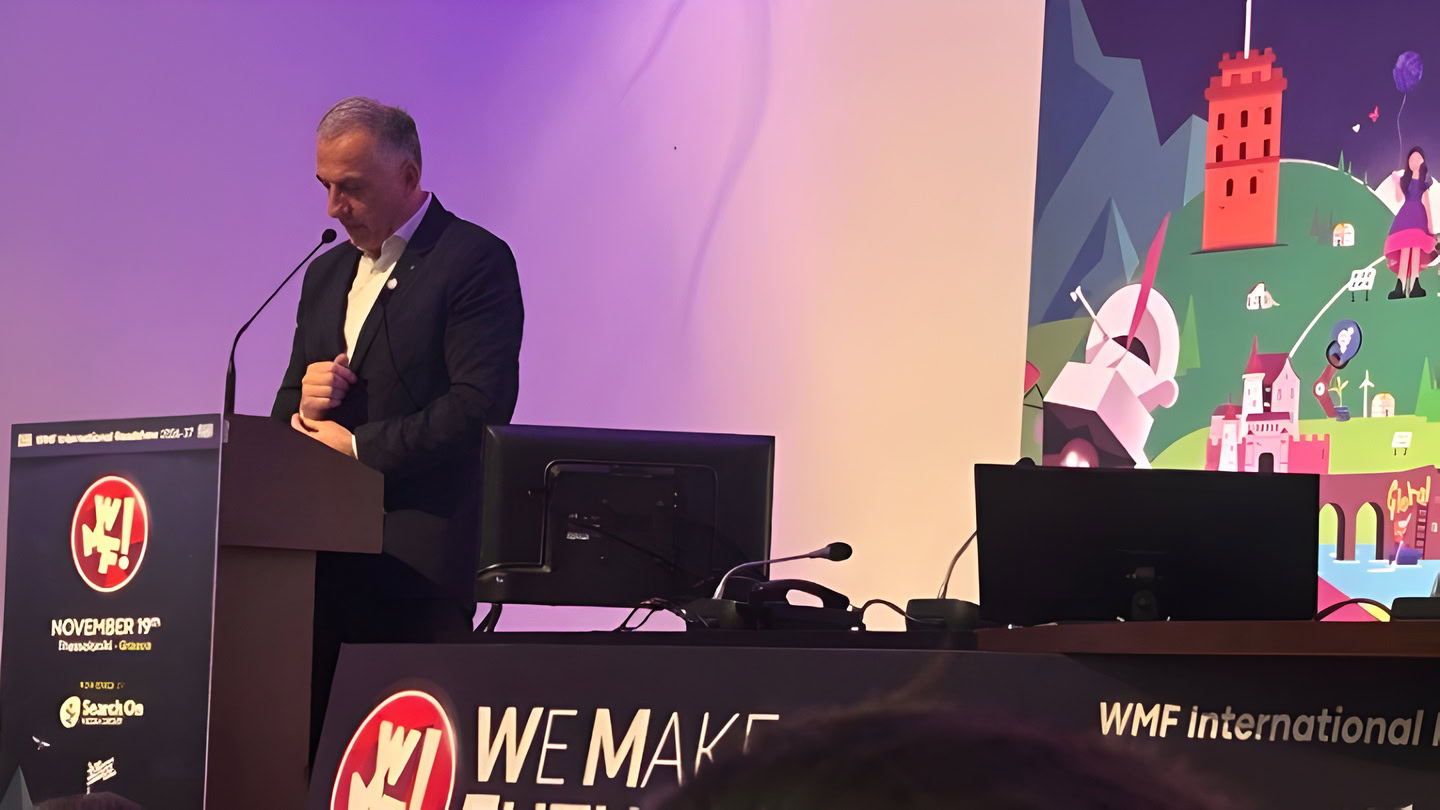
Greece’s innovation ecosystem is expanding, with research and development spending reaching a record €3.66 billion, more than 1,000 startups registering with the national Elevate Greece registry and 86% of newly qualified PhD graduates choosing to remain and build their careers in the country, Deputy Development Minister responsible for Research and Innovation Stavros Kalafatis said.
Speaking at the opening of the sixth WMF Startup Competition & Conference in Thessaloniki, Kalafatis said Northern Greece had developed a productive innovation ecosystem built on an integrated chain of knowledge, research and entrepreneurship.
The Greek-Italian Chamber of Thessaloniki organised the event through its business centre, in collaboration with Italy’s WeMakeFuture! Festival, the Thessaloniki Chamber of Commerce and Industry (TCCI) and Enterprise Greece.
Kalafatis described the country’s progress as a new form of practical patriotism, reflected in measurable economic and employment results.
Read more: Greek Foundation Launches AI and XR Innovation Competition
“We are turning knowledge into added value, high-tech exports and well-paid jobs that keep our young people in their homeland,” he said.
He noted that national research and development expenditure had reached a record €3.66 billion, equivalent to 1.54% of GDP and representing a 67.7% increase compared with 2018.
This performance places Greece fourth among European Union member states in public research intensity, he added.
The investment has also generated more than 20,000 new highly specialised jobs in research, bringing total employment in the sector to approximately 70,000.
Kalafatis also highlighted the growing number of young researchers choosing to remain in Greece, with 86% of newly qualified PhD graduates now opting to work and pursue their careers in the country.
Meanwhile, Elevate Greece, the National Startup Registry, has exceeded 1,000 registered companies, providing institutional support and credibility for the country’s startup ecosystem.
Tax incentives and new development funding
Kalafatis said the government needed to encourage greater private-sector participation to accelerate the transition of research from laboratories to commercial markets.
He highlighted Greece’s enhanced tax incentives for research and development expenditure, describing them as among the strongest in Europe.
The government increased the tax super-deduction for R&D expenditure from 130% to 200%, with deductions reaching up to 315% for green, digital and collaborative investments involving research centres and startups.
He also invited established businesses across Northern Greece to become the first customers of products and solutions developed by Greek startups.
Under the new development law, the government has introduced a separate €150 million funding scheme dedicated exclusively to integrating artificial intelligence and green technologies into small and medium-sized enterprises.
Kalafatis also pointed to continued financing through the Hellenic Development Bank of Investments and the EquiFund II programme.
At European level, Greece actively supports the EU Inc. initiative, particularly following the approval of the negotiating position of the 27 EU member states at the Council of the European Union in October.
The initiative aims to allow innovative European companies to establish and operate within 48 hours and expand across the single market without unnecessary barriers, while respecting national and EU legislation.
Domestically, the government is also upgrading university technology transfer offices and preparing the institutional framework for Prime Minister Kyriakos Mitsotakis’ commitment to establish an independent Ministry of Higher Education, Research and Innovation.
Thessaloniki strengthens its position as an innovation hub
Kalafatis said Thessaloniki had become a focal point for the convergence of major public infrastructure projects and internationally significant private investments.
The city has attracted substantial Recovery and Resilience Facility funding to modernise its research infrastructure.
The Centre for Research and Technology Hellas (CERTH) already ranks among Europe’s 15 leading research institutions and is developing a specialised artificial intelligence hub.
The hub will connect with Daedalus, Greece’s national supercomputer, and Pharos, the European artificial intelligence factory.
Kalafatis said CERTH ranked fourth in Europe for artificial intelligence research.
He also highlighted the Thessaloniki Innovation and Technology Centre (Thess INTEC), which he described as a potential flagship innovation project for Northern Greece.
The project has overcome previous obstacles, secured its funding and will soon move forward, he said.
Thessaloniki positions itself as a startup entrepreneurship centre
Deputy Interior Minister responsible for Macedonia and Thrace Konstantinos Gioulekas also highlighted Thessaloniki’s growing innovation infrastructure, including CERTH, the Alexandria Innovation Zone and the developing Thess INTEC project.
Opening the conference, Gioulekas said collaboration with organisations such as Enterprise Greece could help take entrepreneurship to the next level.
He said innovative ideas could generate new business activities and, more importantly, give talented young people opportunities to turn their ambitions into reality.
He welcomed the event’s return to Thessaloniki, describing the city as the capital of Macedonia.
Gioulekas also referred to an initiative by the Ministry of Macedonia and Thrace to establish stronger business partnerships across the Balkans.
He said the ministry had approached representatives of neighbouring countries, identified potential partners and begun developing cross-border cooperation.
Greek-Italian Chamber of Thessaloniki president Nikolaos Margaropoulos said the conference’s six consecutive years demonstrated the strength of Greek-Italian cooperation and the potential of Greece’s innovation ecosystem.
Fourteen Greek startups will present their projects during this year’s competition.
Behind each short presentation lies considerable work and, in many cases, numerous sleepless nights, he said.
Thessaloniki Deputy Mayor for Innovation, Startup Entrepreneurship, Volunteering and Youth Spyros Tzelepis said competitions and similar events helped introduce entrepreneurship to younger generations.
He described Greek universities and the country’s education system, particularly in Thessaloniki, as an inexhaustible source of talented people seeking to develop their ideas.
WMF Head of Global Partnerships Vito Esposito, speaking via video link, said Thessaloniki held particular significance for the organisation because it hosted its first international roadshow in 2021.
He welcomed the opportunity to return as part of WMF’s international tour.
Michalis Rahmanis, head of business advisory support at the Thessaloniki Chamber of Commerce and Industry, said innovation, sustainable entrepreneurship and the adoption of new technologies played a decisive role in strengthening competitiveness and creating a modern, outward-looking business environment.
Central Macedonia Deputy Regional Governor for Digital Governance Nikos Tzollas also stressed the importance of building a new entrepreneurial culture centred on young people and startups.
He highlighted the growing cooperation among public and private institutions across the region, saying their shared commitment and common vision had strengthened collaboration in recent years.
Enterprise Greece European Programmes adviser Dimitris Karydis said Greece’s innovation ecosystem had developed considerably, with the achievements and international distinctions of Greek startup teams providing the strongest evidence of that progress.
The sixth WMF Startup Competition & Conference concludes with 14 Greek startups presenting their ideas to an audience of business executives, investment firms and business angels.
The three highest-ranked startups will secure places at the international WeMakeFuture! Festival in Bologna, Italy, on June 10-12, 2027.
(Source: AMNA)