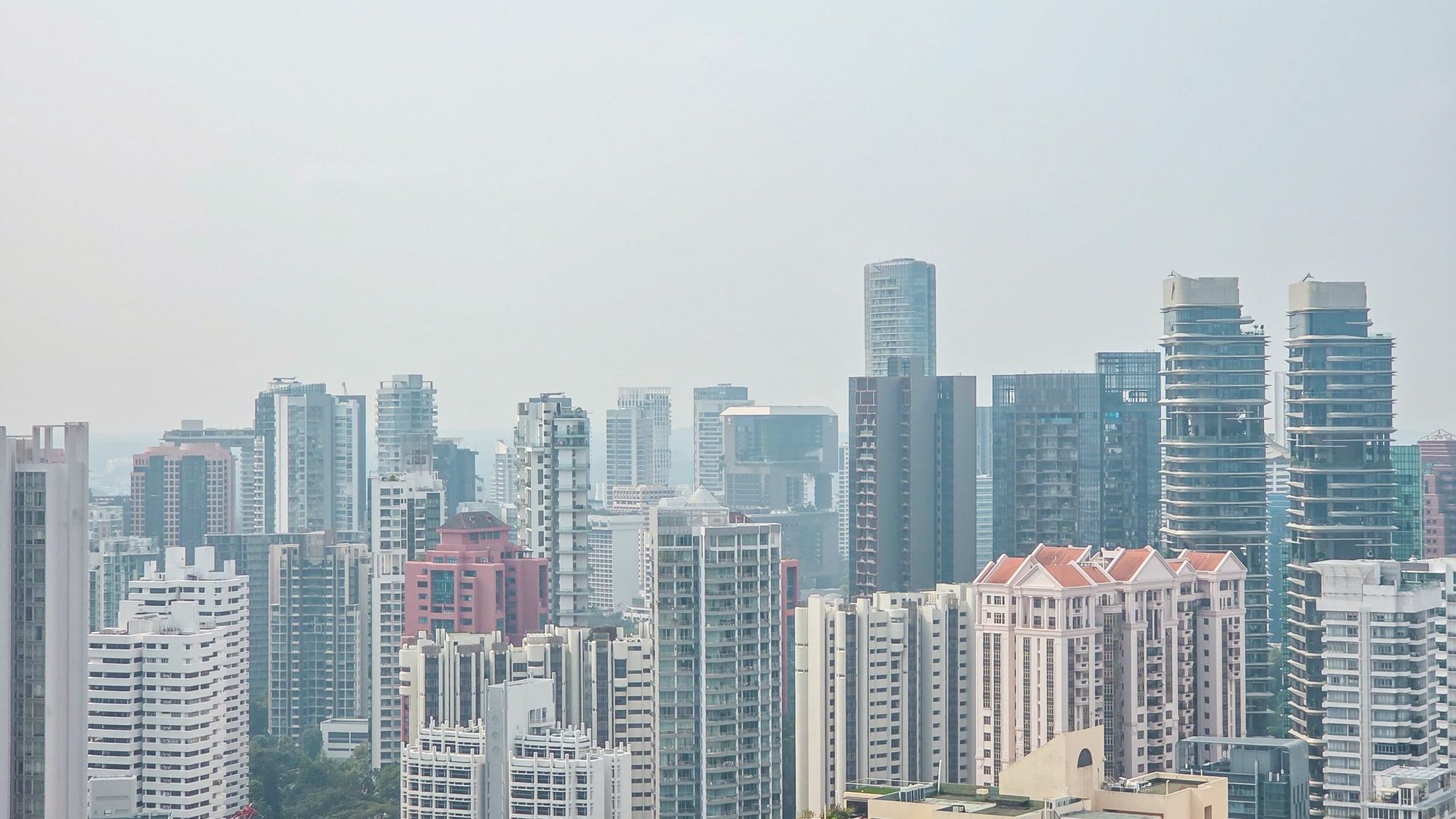

Singapore big-ticket real estate transfers hit a record S$42.4 billion in the first nine months of 2026, as investors seek a safe haven amid global uncertainty and low borrowing costs.
As geopolitical uncertainty has mired broadsheets and headlines this year, Singapore’s big-time investors are decisively parking their capital in Singapore real estate assets, which they consider to be a safe haven for their capital.
Singapore big-ticket real estate transfers reported their strongest year to date in 2026, according to a Knight Frank report. These large institutional transactions reached a total S$42.4 billion in the first nine months of 2026, which is a record year for the city.
Knight Frank considers big-ticket sales to be transactions at least worth S$10 million, a bulk or land sale of S$10 million, or an institutional transfer where a REIT or fund exchanges an asset.
The tally so far in 2026 already exceeds the S$40.7 billion recorded in the whole of 2025; and we’re expected to end the year at S$50 billion according to Knight Frank.
This year’s new annual record also exceeds the previous peaks of S$40.7 billion in 2025, and the S$35.5 billion recorded in 2017.
This underscores a recovery from the post-Covid period. Previously, transactions had fallen from 2022 to 2023, in the aftermath of the epidemic; at the time transactions dipped from S$30.9 billion to S$21.1 billion in around one year.
It seems counterintuitive that this all-time high came about despite the war in Iran, which shocked global markets in February.
Up until about now, the market in Singapore hadn’t priced in these shocks and uncertainties just yet. In fact Singapore might see an unintended uplift, as Singapore is one of the safest and most predictable prime global economies.
A Flight to Quality
Melvin Chay, Interim Head of Capital Markets at Knight Frank said:
“Against a persistent backdrop of global economic and geopolitical uncertainty, Singapore has been and continues to remain attractive to domestic and international capital seeking high-quality, income-generating assets in a stabilised modern market at the crossroads of South-east Asian business flows.”
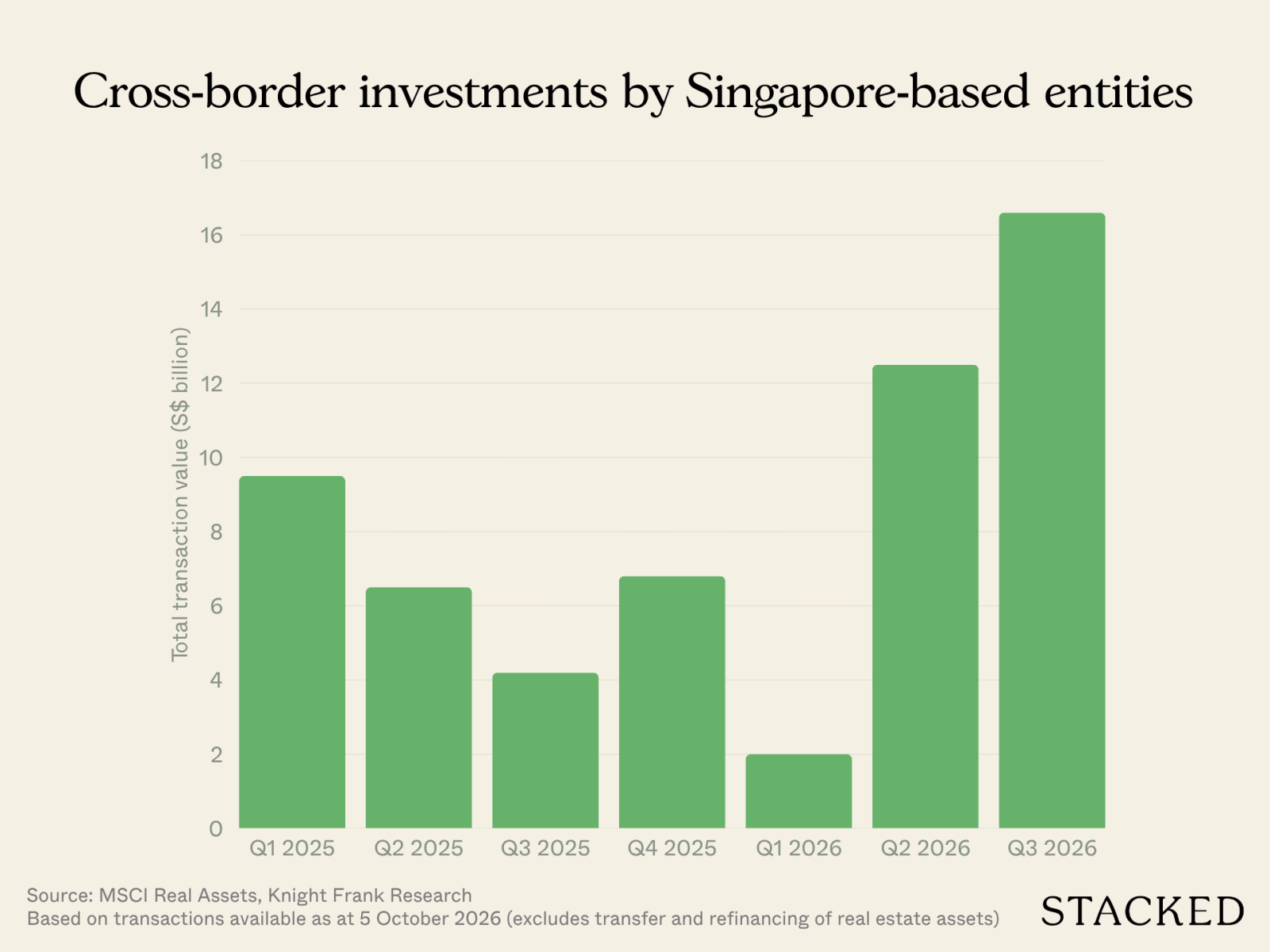
Borrowing is also cheaper here: the benchmark SORA rate used to price loans is about 1.2%, against nearly 4% in the US. That makes Singapore one of the cheapest major property markets to borrow in. Benchmark rates sit at 3.75% in London and 4.35% in Sydney, for example.
It’s also some of the lowest rates in Asia, Stacked previously reported. Previously Ethan Ng at Cashew mortgage brokerage said even when rates here are considered to be high, they still beat those in Malaysia, China or Thailand.
As such, investors’ strong liquidity is being met with favourable borrowing costs in the present year. Knight Frank added that the prospect of healthy returns was also good this year, which incentivises borrowing:
“In today’s pay-to-play market, investors with capital certainty and the ability to execute decisively are best placed to secure quality assets,” said Chay.
All of this isn’t to say that there’s no risk. The Singapore government is known to change property rules often, and foreign investors are essentially barred from buying up residential properties, based on the 60% ABSD rules.
A strong currency also makes it difficult to enter for foreign buyers, and rising prices generally mean falling yields.
Investors Are Trying to Get in Before Interest Rates Rise More
The interest rate on loans to buy a commercial property in Singapore hovered from 1.08% at the beginning of the year, dipping to a low of around 1.04% by mid-year before rising slightly back up to 1.20% now.
Note that these are often higher for large investment transactions. The current rate for higher quantum properties is about 1.6% to 1.7%.
According to Ng, Q3 saw rising rates as the markets just started to price in spiking energy prices, as well as the Fed’s interest rates in September. He previously projected that rates could go up to 2% by the end of the year for the clients that he sees (with the caveat that these are mostly smaller loan quantum borrowers).
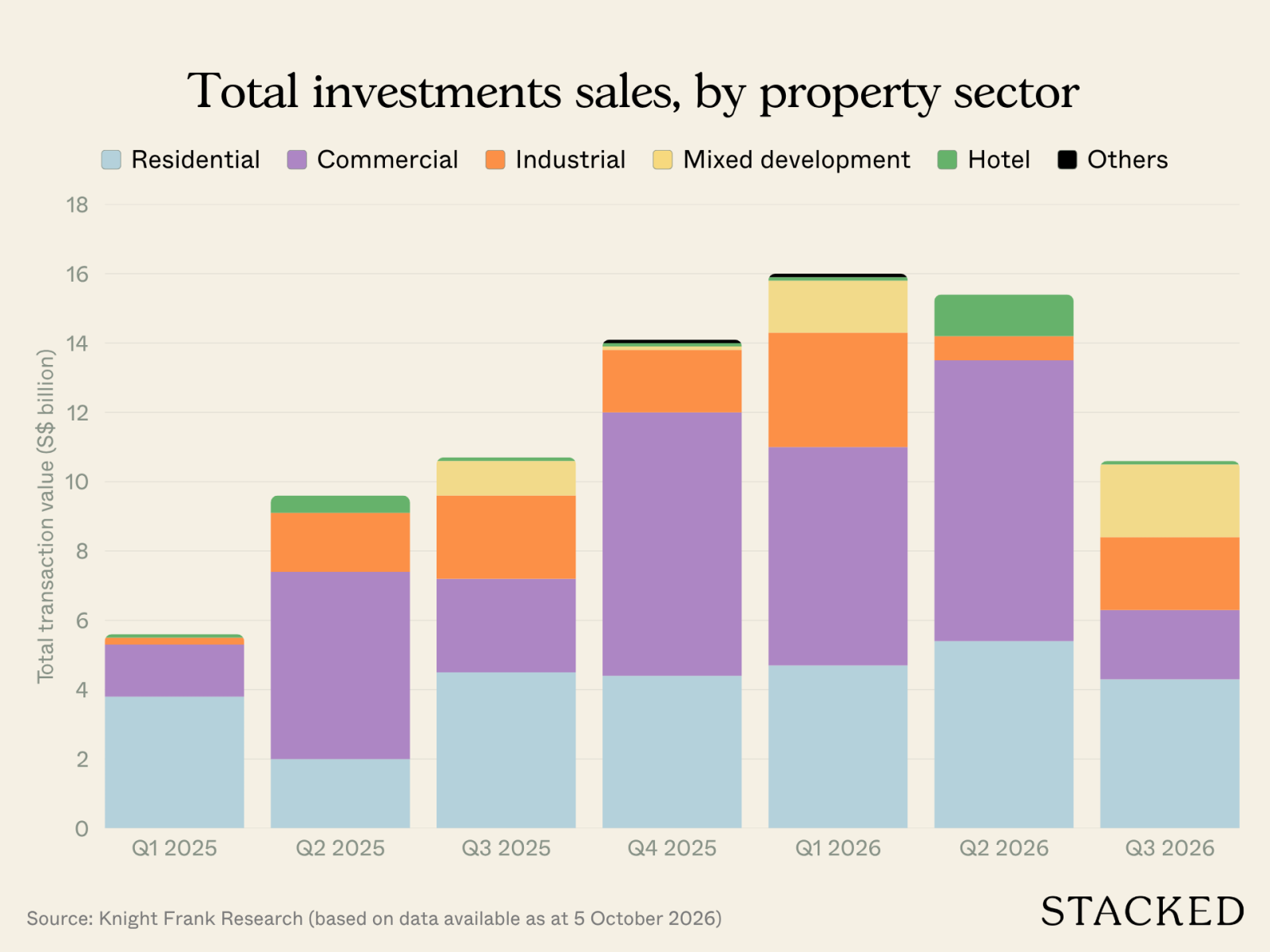
We saw these interest rate trends mirror interest rates throughout the three quarters of this year so far, with transactions totalling S$16.2 billion in the first quarter, S$15.5 billion in second, and then dipping to S$10.7 billion in the third.
“As there are expectations of rate hikes leading to increased borrowing costs, parties involved in ongoing negotiations might be motivated to complete their transactions by year-end,” the report read.
With some exceptions, private bank mortgages are priced off the 3M SORA rate, which averages interbank rates over the past three months.
So when the Fed raises rates, as it did in September, SORA-based loans take around three months to catch up.
Borrowers on fixed rate packages, however, won’t feel the change until their fixed rate expires (however long this is based on the specific loan package).
What Sectors in Singapore Did Investors Invest the Most this quarter?
Residential investments rose to make up the bulk of the sales in the third quarter, as commercial decreased in volume. Since the end of 2025 up until now, the commercial sector consistently reported the largest transaction volume.
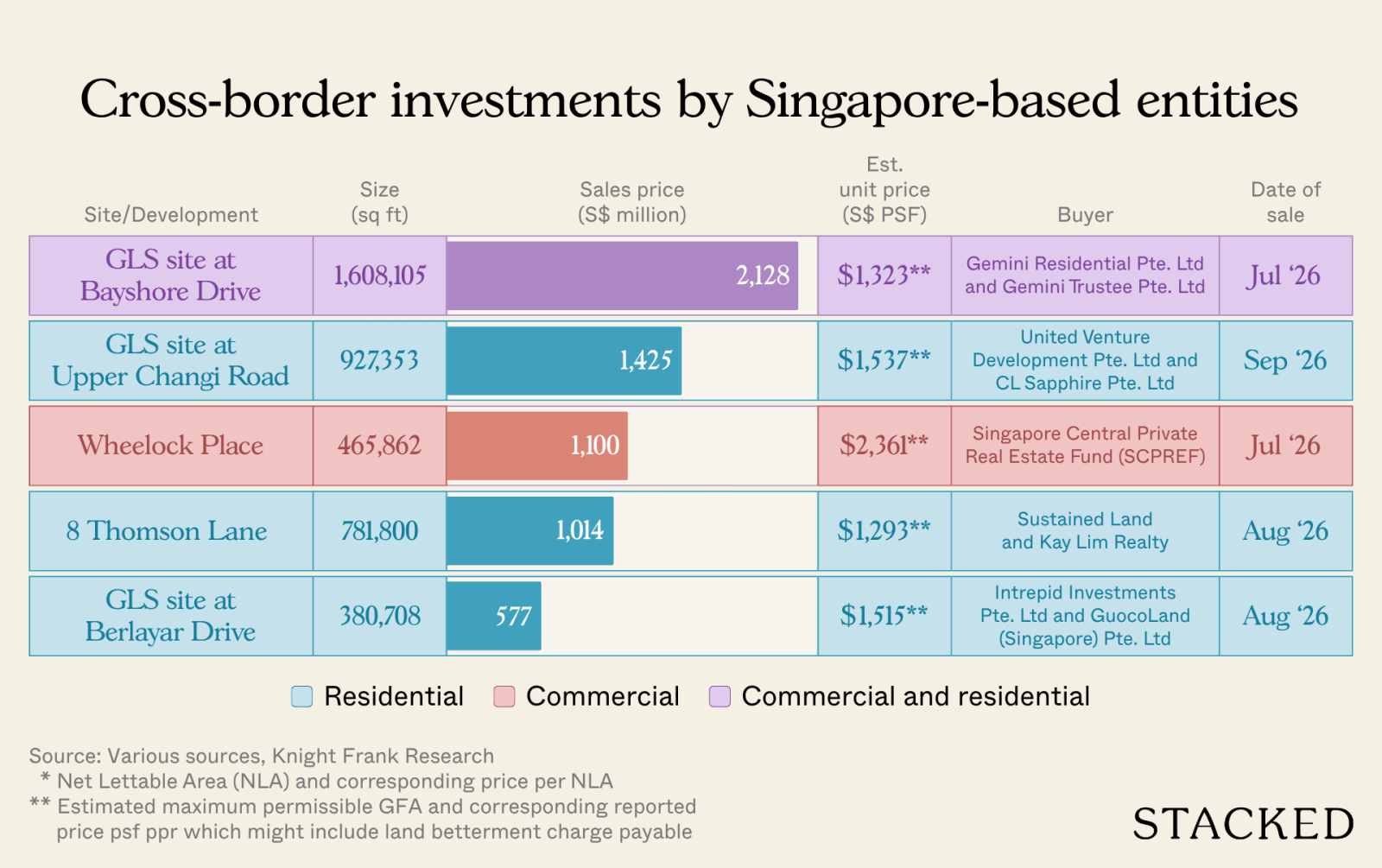
This quarter, commercial activity did include one of the top deals across the sectors: Singapore Central Private Real Estate Fund (SCPREF), managed by Hongkong Land, acquired Wheelock Place for S$1.1 billion. It was the third most expensive deal last quarter.
The whole residential sector totalled S$4.3 billion in investments out of the S$10.7 billion in the third quarter.
This was made up of four private residential GLS sites, including one at $1.4 billion sale at a site in Upper Changi Road, and another $576 million site at Berlayer Drive. These were two of the top five deals this quarter.
But the top deal was a mixed-use GLS site at Bayshore Drive which sold for $2.1 billion in July to Frasers Property. In general, mixed-use developments, while rare, do numbers at closing. With a GFA of 149,398 sqm, it was the first non-CBD GLS site to sell for over $2 billion.
Knight Frank also said that industrial investment activity doubled since the last quarter, also led by government land sales, especially for purpose-built workers dormitories this quarter. On the hospitality front, there was a single transaction during the quarter: the acquisition of Coliwoo Midtown by CapitaLand Ascott Trust for S$134 million.
Nevertheless, the quarter saw seven hotel transactions with a combined value of S$1.5 billion recorded in the first nine months of 2026. This value exceeded the nine transactions totalling S$957.2 million for the whole of 2025. “The higher investment value (in the hospitality sector) points to sustained interest in Singapore’s living sectors,” the report said.
“Amid the uncertain global environment, Singapore’s standing as a preferred destination for long-term real estate investment continues to grow,” added Chay.