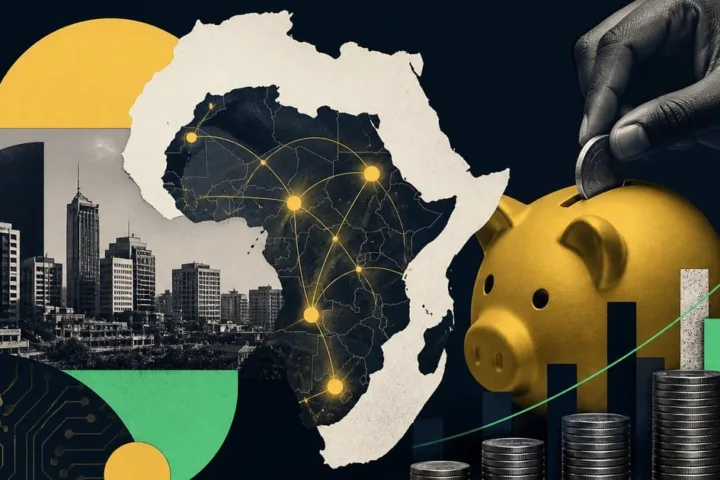

Debt is no longer a peripheral source of capital for African startups. It is becoming a structural part of how the continent’s more mature technology companies finance growth reflecting both the development of local credit markets and a venture ecosystem that has become more selective about equity.
The shift is significant.
Venture debt reached a record $1.8 billion across Africa in 2025, up 91% year-on-year, according to the African Private Capital Association. Partech separately put technology-sector debt at $1.6 billion, up 63%, accounting for roughly 40% of total tech funding. The difference in estimates reflects methodology, but both point to the same direction: debt is taking a much larger role in startup financing.
This is more than a response to the venture capital downturn.
Debt offers companies that already have revenues, receivables, or tangible assets a way to finance expansion without continuously selling equity.
- For fintechs, that can mean borrowing against loan books or receivables;
- for clean-energy and mobility companies, it can finance equipment and customer assets;
- for other businesses, it can fund working capital and extend runway.
That makes debt particularly suited to Africa’s increasingly capital-intensive technology businesses.
Fintech and cleantech accounted for the overwhelming majority of debt funding in 2025, according to Partech, with $716 million and $627 million respectively. Cleantech was particularly dependent on debt reflecting business models built around physical assets and predictable cash flows.

But the rise of debt should not be mistaken for easier access to capital.
Debt imposes a different test on a startup. Equity investors can finance a company on the expectation that future growth will eventually justify today’s valuation. Lenders need greater visibility on how and when they will be repaid. That naturally favours companies with established revenues, predictable collections, collateral, or institutional-quality financial reporting.
The result could be a widening financing divide across Africa’s startup ecosystem. Growth-stage companies with proven business models are gaining another financing option, while pre-revenue and early-stage startups remain overwhelmingly dependent on equity. Briter Intelligence has already identified this unevenness, describing growth capital as increasingly concentrated while early-stage and middle-market financing remains fragmented.
For founders, therefore, the strategic question is shifting from simply raising the next equity round to building a capital structure appropriate to the business. Equity remains the natural instrument for experimentation, product development, and early expansion. Once revenues become predictable, however, debt can finance working capital, inventory, receivables, or infrastructure without imposing the same dilution as another equity round.
That evolution is important for Africa because the continent’s funding constraints are not simply about the amount of capital available. They are also about whether the right type of capital is available at the right stage. Debt can help solve the growth-financing problem for companies that have already achieved commercial traction, but it cannot replace the risk capital required to create those companies in the first place.
The deeper shift, then, is not that African startups are replacing venture capital with debt. It is that the ecosystem is developing a more differentiated capital stack. Companies that can demonstrate durable revenues and cash flows increasingly have access to multiple forms of financing. Those that cannot will remain exposed to the availability and risk appetite of equity investors.
That could ultimately make the ecosystem more sustainable, but it also raises the importance of reaching product-market fit, building reliable revenue, and maintaining strong financial controls. In Africa’s next phase of startup financing, the ability to become financeable may matter almost as much as the ability to become investable.
The strongest supporting data point is probably Partech’s finding that debt represented 41% of African tech capital deployed in 2025, versus 17% in 2019 – that makes the argument structural rather than cyclical.
See also

Sign up to BitKE for the latest startup funding updates from across Africa.
Join our WhatsApp channel here.
Follow us on X for the latest posts and updates
_______________
Related