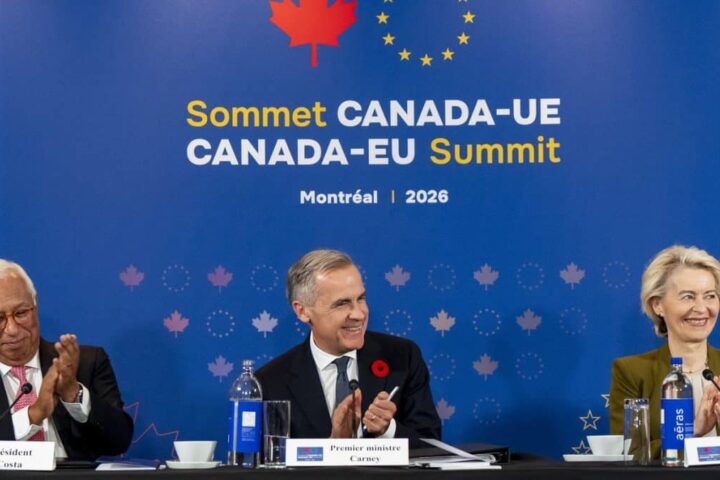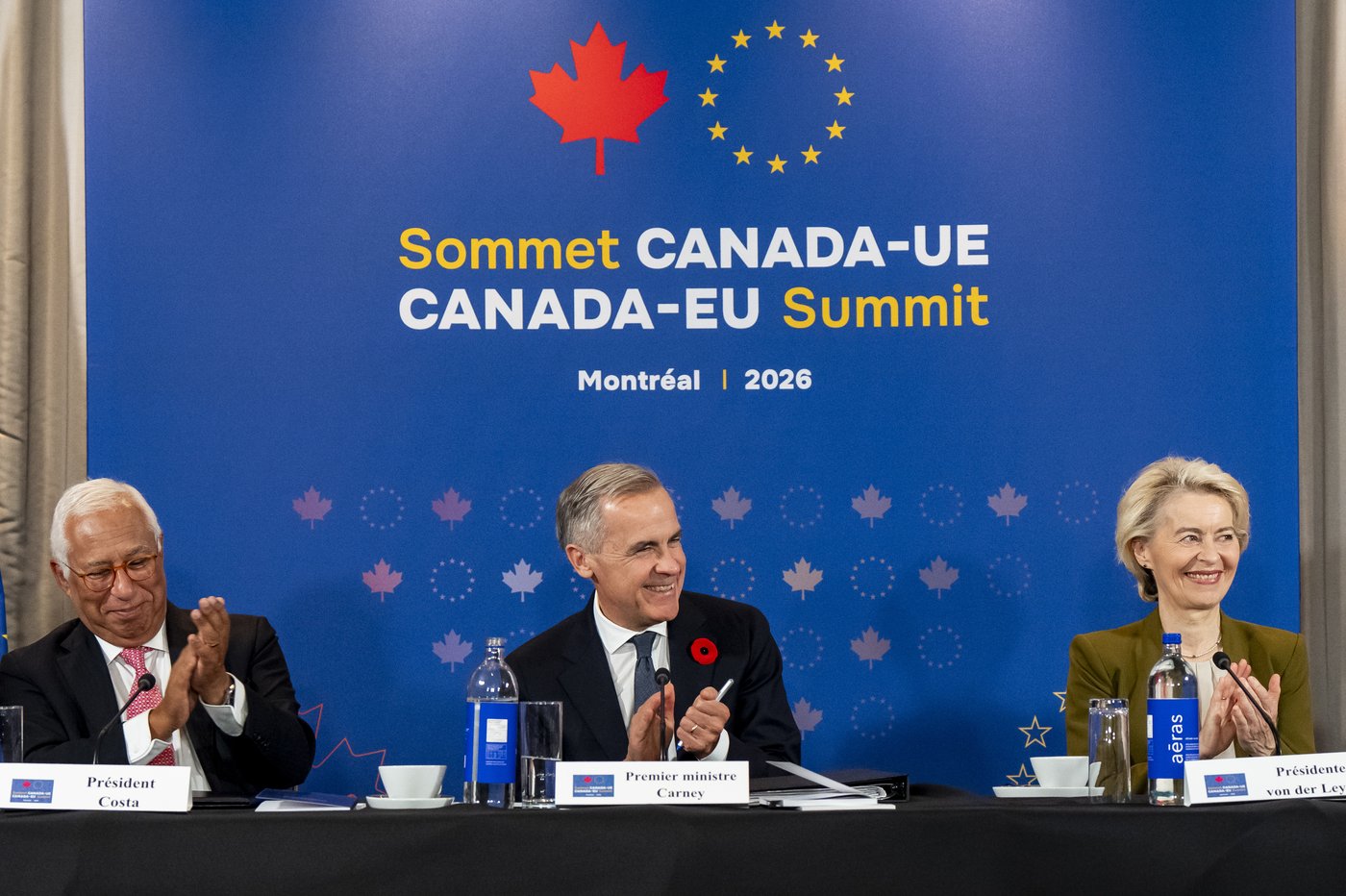
The statement included announcements of deals that officials on both sides of the Atlantic promoted in the days leading up to the Montreal summit.

They include a new digital trade agreement and a deal to allow the European Investment Bank to fund critical raw materials projects in Canada.
Carney said the various agreements signed Friday will make it easier for Canadians to do business with and within the EU.
“Seamless payments will make it easier to sell online in Europe, so a business owner in Manitoba or a lobster harvester in Prince Edward Island will clear customs faster, getting their products to European markets,” Carney said.
“A tech startup in Vancouver will have a smoother path to customers in Berlin. Bottom line, less red tape, more growth, more opportunity.”
Carney argued these agreements will help make life more affordable for Canadians.
Carney also announced Canada would join an EU loan program for Ukraine, with Ottawa pledging an initial contribution of 500 million euros, roughly $775 million.
Von der Leyen said the agreements signed Friday will help create “good jobs” and encourage companies to expand.
The joint statement also cites agreements to give Canadian artificial-intelligence researchers access to European supercomputers and to hold more discussions on Arctic and border security.
The statement calls for reforming the World Trade Organization instead of replacing it, and doing more to fight climate change and biodiversity loss.
Carney said he and the other leaders discussed resolving the prospect of Canadian goods being affected by the EU’s anti-deforestation law and its Carbon Border Adjustment Measures, which tariff imports to match European pollution pricing.
A Canadian government official speaking on background said there is more work to do on getting European institutions to recognize what Canada is doing federally and provincially to price emissions. The official said those talks are very advanced.
The agreement also pledges to “explore a next-generation youth mobility partnership” touching on work and academic exchanges.
Von der Leyen said the goal is to have Canada fully join Erasmus+, the EU’s student exchange program that offers training and study opportunities in member nations.
A Canadian government official said the goal is for Canada to join Erasmus+ midway through 2027. The program is paid for by member states and has a 2021 to 2027 funding pool of about $41 billion.
The official said Canada also wants to become a full member of the Horizon Europe program by 2028. Canada is already a second-tier member of Horizon, which funds research and innovation projects.
Costa said Thursday he wants to see this partnership expand labour mobility between Canada and Europe.
All three leaders discussed the prospect of Canada obtaining “associate member” status in the EU, despite strong pushback from member states, including Germany.
The leaders announced Friday that Carney will next spring join a meeting of von der Leyen’s cabinet — the college of commissioners — and that Costa will host Carney in June at a meeting of the European Council.
Costa said the goal is to announce more details of the partnership at that June meeting.
Culture Minister Marc Miller said Thursday any discussions of labour mobility in industries like film production would need to include the provinces, many of which have their own tax credits that promote local talent.
Miller has been meeting with his European counterparts to discuss setting new regulations on promoting Canadian and European content on streaming services, along with new safeguards for children online.
“We’re not talking about the same exact rules potentially, but convergence and allyship with respect to large, transnational companies that in some cases need to be regulated to protect kids or to promote our cultures in the face of overwhelming, monopolistic cultures, one of which is the United States, but others across the world,” Miller said in an interview.
Conservatives have criticized this week’s summit, noting that nine of the 28 countries in the EU have yet to ratify a decade-old trade deal with Canada known as CETA. They also want the EU to stop charging a carbon tariff on certain Canadian imports.
“Worse, there was lots of talk at the summit about aligning Canada with the insane European taxes, debt, immigration and anti-oil and gas policies that have left parts of Europe bankrupt and burning,” Conservative Leader Pierre Poilievre said in a statement on social media.
“Does any of this lower your mortgage payments, rent, grocery bills or gas prices, back here in the real world? Of course not. Time to get real. We have mouths to feed. Bills to pay. Crime to stop. Borders to secure. And money to save.”
The Bloc Québécois said Carney must fulfil a promise to hold a vote on the new arrangements with the EU.
“This new alliance and this status, about which we know very little, must absolutely be negotiated with Quebec,” the party wrote in French, noting Friday’s announcements touch on provincial jurisdiction.
This report by The Canadian Press was first published Oct. 30, 2026.
— With files from Dylan Robertson in Ottawa
David Baxter, The Canadian Press