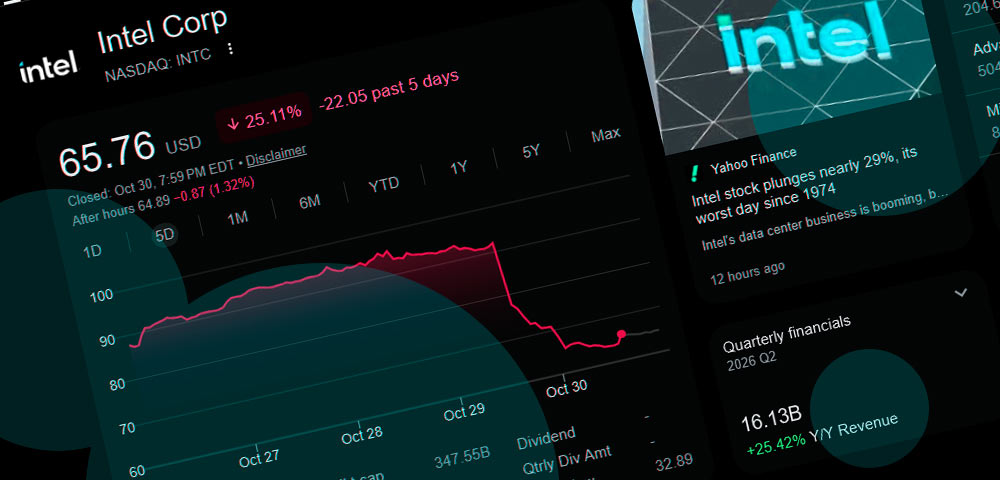

Intel (NASDAQ: INTC) shares plunged 28.58% to $65.76 on October 30, 2026, recording their steepest one-day decline since 1974 and wiping approximately $140 bn from the chipmaker’s market capitalization.
The collapse followed Intel’s third-quarter earnings report, which showed strong growth in data center revenue but delivered a fourth-quarter outlook substantially below Wall Street expectations.
The selloff triggered a wave of analyst downgrades and prior price-target reductions from Bank of America, Goldman Sachs, Morgan Stanley, JPMorgan, UBS, Bernstein and other investment firms.
The central concern is that Intel’s growing exposure to artificial intelligence has not eliminated its dependence on personal computers, while manufacturing constraints, foundry losses and rising investment requirements threaten its financial recovery.
Why Intel stock crashed nearly 30% after Q3 earnings
Intel reported third-quarter revenue of $16.5 bn, up 21% year over year, while adjusted earnings reached $0.52 per share, exceeding analysts’ expectations of approximately $0.40–$0.41.
Its Data Center and AI division generated $7.3 bn in revenue, an increase of 78% from a year earlier. The business also produced approximately $3 bn in operating profit, representing a 42% operating margin.
However, these results were overshadowed by Intel’s guidance for the December quarter.
The company expects fourth-quarter revenue of $15 bn to $16 bn, compared with analysts’ consensus forecast of approximately $17.07 bn.
At the midpoint of $15.5 bn, the outlook represents a revenue shortfall of $1.57 bn, or approximately 9.2%.
Intel also expects adjusted earnings of $0.25 per share, compared with Wall Street expectations of $0.43. That represents an earnings shortfall of nearly 42%. The company forecasts an adjusted gross margin of 38%, down from 44.1% in the third quarter.
This deterioration was particularly significant because investors had been pricing Intel shares for a sustained recovery in earnings and profitability.
The October 30 decline reversed much of the company’s extraordinary rally earlier in 2026, when its shares nearly quadrupled before reaching a June high.
Intel’s Q3 2026 earnings: data center growth versus PC weakness
According to Intel’s third-quarter financial results, the company’s major divisions delivered sharply different performances.
| Financial indicator | Q3 2026 | Year-over-year change |
|---|---|---|
| Total revenue | $16.5 bn | +21% |
| Data Center and AI revenue | $7.3 bn | +78% |
| Client Computing and Physical AI revenue | $8.1 bn | -5% |
| Intel Foundry segment revenue | $6.7 bn | +58% |
| Adjusted earnings per share | $0.52 | +126% |
| Adjusted gross margin | 44.1% | +4.1 percentage points |
| Cash from operations | $5.1 bn | Approximately doubled |
The data center business benefited from accelerating demand for server processors supporting AI applications.
Intel’s server CPU sales expanded across hyperscale cloud operators, enterprise customers and specialized AI infrastructure providers.
Management expects the broader server CPU market to grow by more than 30% in both 2026 and 2027. Yet Intel’s PC business, which generated approximately half of total quarterly revenue, is moving in the opposite direction.
Client Computing revenue declined 5% year over year to $8.1 bn and fell approximately 9% from the previous quarter.
For the fourth quarter, management expects client revenue to decline by more than 20% sequentially.
That would represent a reduction of at least $1.6 bn from the third-quarter level, substantially offsetting further growth in the data center business.
The divergence explains why Intel can report exceptional AI-related growth while simultaneously forecasting lower consolidated revenue and earnings.
Bank of America downgrades Intel and cuts its price target to $100
Bank of America Securities downgraded Intel from Buy to Neutral on October 30 and reduced its price target from $145 to $100.
Analyst Vivek Arya identified three problems affecting Intel’s investment outlook: a weaker PC market, supply limitations in server processors and insufficient evidence of progress attracting major external foundry customers.
BofA expects PC shipments to decline approximately 25%–30% sequentially during the fourth quarter, with inventory adjustments continuing into the first half of 2027.
The bank also questioned Intel’s competitive position against AMD and ARM-based processor suppliers, which have been expanding faster in several server markets.
Although BofA acknowledged the strategic value of developing a leading US semiconductor foundry, it indicated that investors still need stronger evidence of customer commitments.
The bank also reduced its estimate of Intel’s potential earnings power in 2030 to $5–$6 per share from $6–$7.
The downgrade suggests that Intel’s turnaround remains possible but could take longer and require more capital than previously anticipated.
Goldman Sachs, Morgan Stanley and JPMorgan cut Intel stock forecasts
Several other investment banks revised their expectations following the earnings announcement.
The table shows selected price-target changes announced on October 30 and the potential change from Intel’s closing share price of $65.76.
| Investment bank | Previous target | New target | Implied upside |
|---|---|---|---|
| Goldman Sachs | $150 | $100 | +52.1% |
| Bank of America | $145 | $100 | +52.1% |
| Citigroup | $130 | $100 | +52.1% |
| JPMorgan | $85 | $80 | +21.7% |
| Morgan Stanley | $84 | $75 | +14.1% |
| UBS | $100 | $80 | +21.7% |
| Wells Fargo | $120 | $80 | +21.7% |
| Bernstein | $110 | $75 | +14.1% |
| BNP Paribas | $125 | $70 | +6.4% |
Goldman Sachs analyst James Schneider maintained a Neutral rating while reducing his target by one-third to $100.
Morgan Stanley lowered its target to $75 from $84, maintaining a cautious position. The bank emphasized the need for Intel to demonstrate a competitive and credible roadmap for future server processors.
JPMorgan reduced its target from $85 to $80, while UBS cut its forecast from $100 to $80.
Wells Fargo also lowered its target to $80, compared with $120 previously.
Bernstein analyst Stacy Rasgon reduced his target from $110 to $75 and maintained a Market-Perform rating, characterizing Intel’s fourth-quarter outlook as exceptionally weak.
The breadth of these revisions is important. The market reaction was not driven by a single bearish research report but by a widespread reassessment of Intel’s earnings trajectory across Wall Street.
Most revised targets remain above the October 30 closing price. However, that potential upside should not be interpreted as a prediction of an immediate recovery. These targets depend on future operating results and may be revised again if conditions deteriorate.
The AI memory shortage is damaging Intel’s PC business
One of the most significant developments in Intel’s outlook is the impact of the global memory shortage.
The expansion of AI data centers has increased demand for high-bandwidth memory and other advanced components. Semiconductor manufacturers have prioritized products serving the AI infrastructure market, contributing to tighter availability and higher prices for conventional computer memory.
Higher component costs are making PCs more expensive and discouraging purchases by consumers and businesses.
Intel expects the industry’s PC unit market to decline approximately 12% in 2026, with shipments in the second half falling more than 20%.
Management also forecasts a further decline of approximately 10% in PC units during 2027. The company does not expect a sustained recovery until memory availability improves and prices begin to normalize.
This creates an unusual situation for Intel: the AI investment boom is strengthening demand for its server processors while simultaneously weakening the consumer computing business that remains central to its revenue.
Intel’s Israel factory disruption adds $600 mn in revenue risk
Intel’s manufacturing difficulties have compounded the weakness in its PC business.
An October accident at the company’s Kiryat Gat facility in Israel, which resulted in employee fatalities and injuries, forced a temporary suspension of manufacturing operations.
Intel estimates that the disruption will reduce fourth-quarter revenue by approximately $300 million, with a comparable impact expected in the first quarter of 2027.
The company also estimates a two-percentage-point reduction in fourth-quarter gross margin associated with the disruption.
The affected facility produces processors used in data center systems, meaning the interruption is restricting Intel’s ability to satisfy strong server demand.
Intel’s quarterly SEC filing also warns that restoration expenses, reduced manufacturing volumes and operational inefficiencies could affect profitability beyond the immediate shutdown.
The total financial consequences remain uncertain.
Intel Foundry remains a major concern for investment banks
Intel’s manufacturing division represents another unresolved issue in the company’s recovery strategy.
Intel Foundry reported third-quarter segment revenue of $6.7 bn, up 58% from the previous year. However, the figure includes substantial transactions between Intel’s manufacturing operations and its own chip-design businesses.
External foundry revenue amounted to only $411 mn, approximately 6% of the segment’s reported revenue.
The company disclosed that much of the external revenue increase came from a non-recurring customer program.
Meanwhile, Intel Foundry recorded an operating loss of approximately $1.85 bn during the quarter.
Although that was an improvement from the $2.32 bn loss reported a year earlier, the division remains far from sustainable profitability.
Intel continues developing advanced manufacturing technologies, including Intel 18A and the next-generation 14A process.
Management reported improved yields and lower production costs, while indicating that potential external customers are evaluating its technology.
Nevertheless, investment banks remain focused on the transition from customer discussions and technical testing to binding manufacturing commitments and recurring revenue.
Without substantial external orders, Intel’s foundry expansion could continue consuming capital without generating sufficient returns.
Higher capital spending raises concerns about Intel’s cash flow in 2027
Intel’s balance sheet provides financial flexibility, but the cost of its turnaround remains substantial.
The company ended the third quarter with approximately $54 bn in cash and short-term investments, supported partly by a $23 bn equity offering completed earlier in 2026.
That financing strengthened liquidity but also increased the number of shares outstanding, diluting existing shareholders’ participation in future earnings.
Intel generated approximately $1.64 bn in adjusted free cash flow during the third quarter. However, management expects investment requirements to increase significantly in 2027.
Gross capital expenditure is projected to reach approximately $20 billion in 2026, with a substantial increase anticipated next year as Intel expands manufacturing capacity and develops new process technologies.
During the earnings conference call, CFO David Zinsner indicated that the company does not expect positive free cash flow in 2027 because of the investment required to expand Intel 18A, Intel 3 and 14A manufacturing.
Even if semiconductor demand remains strong, Intel may need several more years before its manufacturing expansion produces enough cash to justify the capital committed.
The October 30 market reaction also extended into credit markets, where the cost of protecting against default on Intel’s debt increased sharply.
Intel stock price forecast: can INTC recover after the 29% crash?
Following the October 30 selloff, Intel’s share price stands below the revised targets of several major investment banks.
Three potential outcomes emerge from the latest analyst forecasts.
Cautious outlook: $70–$75
Bernstein, Morgan Stanley and BNP Paribas have price targets concentrated around $70–$75.
These levels imply approximately 6%–14% upside from the latest closing price.
Their forecasts reflect continuing uncertainty around PC demand, manufacturing execution and the profitability of the foundry business.
A prolonged PC downturn or further reductions in earnings expectations could prevent a sustained recovery.
Recovery outlook: $80–$90
JPMorgan, UBS and Wells Fargo have revised targets near $80, while several other firms maintain forecasts around $90.
The $80–$90 range would represent approximately 22%–37% upside.
Such a recovery would likely depend on continued growth in server CPU shipments, improving production capacity and evidence that the PC market is approaching stabilization.
The company would also need to demonstrate progress reducing foundry losses and maintaining adequate liquidity during its investment cycle.
Bullish outlook: $100 or higher
Goldman Sachs, Bank of America and Citigroup maintain revised targets of $100.
That implies approximately 52% upside from the October 30 closing price.
This more optimistic outcome would require stronger confidence in Intel’s long-term earnings potential.
Potential catalysts include major external foundry contracts, continued growth in data center processors, manufacturing cost reductions and a clearer route to positive free cash flow after 2027.
These ranges summarize published analyst targets rather than guaranteed trading levels or independently calculated probabilities.
What investors should watch after Intel’s historic selloff
Intel’s next financial reports will be judged against several measurable indicators:
- Whether fourth-quarter revenue reaches the company’s $15 bn–$16 bn forecast.
- Whether the PC market contracts as sharply as management expects during 2027.
- Whether data center revenue continues expanding despite manufacturing constraints.
- Whether Intel Foundry secures substantial external customer commitments.
- Whether production at the Israel facility returns to normal without additional financial disruption.
- Whether higher capital spending creates further financing requirements or shareholder dilution.
The October 30 decline third-quarter results demonstrated strong demand for server processors and meaningful improvements in operating profitability.
However, the earnings report exposed a widening gap between that demand and Intel’s ability to convert it into sustainable company-wide earnings and cash flow.
For Wall Street, the key issue is no longer whether Intel can participate in the AI infrastructure boom. It is whether the company can monetize that opportunity quickly enough to offset declining PC demand, manufacturing losses and the substantial cost of rebuilding its semiconductor production capabilities.